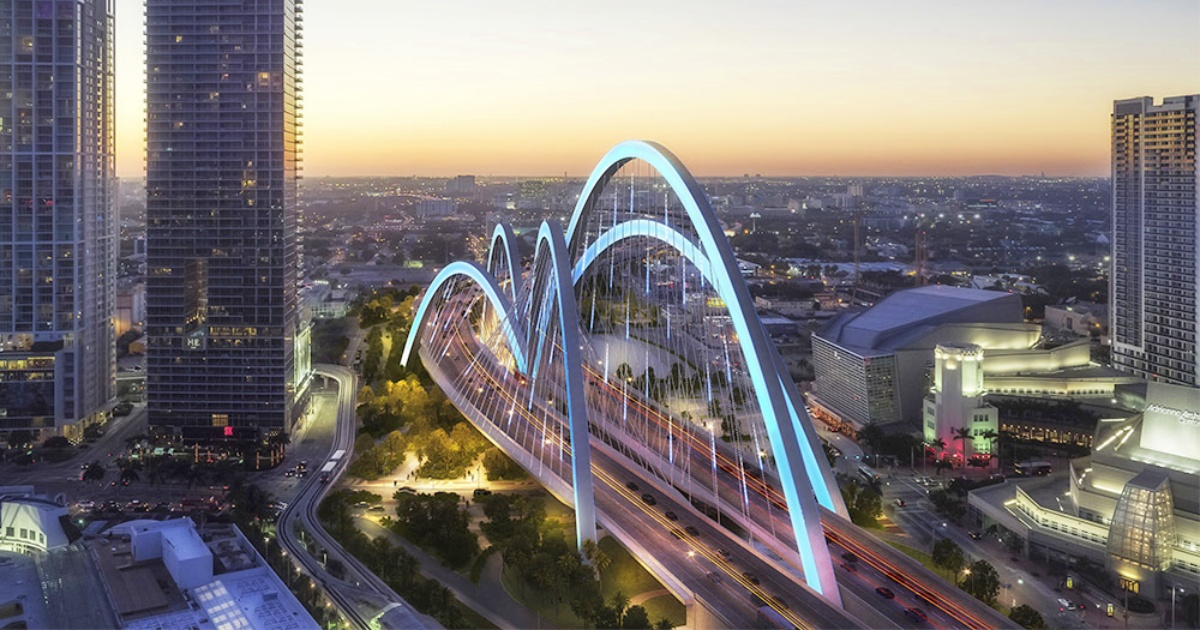
Envisioned as a centerpiece of Miami's downtown road modernization, the six-arch bridge spanning Biscayne Boulevard is mired in a series of lawsuits exposing alleged design and structural flaws.
Despite promises to ease traffic and link the city's major highways, the project remains nearly a decade behind schedule and has exceeded its budget by hundreds of millions, despite being publicly funded.
With an estimated budget of $802 million, the initiative aims to connect three of Miami's most heavily congested highways: I-95, I-395, and SR-836. The bridge, hailed as "iconic" for its architectural appeal, was initially slated for completion in 2021 but now won't be finished until at least 2029, according to the Florida Department of Transportation (FDOT).
This decade-long delay has forced residents to endure relentless traffic, constant detours, and uncertainty surrounding a taxpayer-funded venture.
Legal Challenges and Blame Game
The FDOT has previously attributed the delays to various factors such as adverse weather, supply chain issues, and public utility relocations. Additionally, a legal protest by a company that lost the original bid delayed the project by a year. However, recent civil lawsuits paint a different picture.
Documents filed by the main contractor, Archer Western-De Moya Joint Venture, point to initial design errors and faulty materials as the root causes of the chaos. According to Telemundo 51 Investigates, the construction firm argues that the engineering company HDR failed to accurately account for wind impacts on the bridge's structure.
Design Flaws: Wind Risks
The lawsuit claims that under the original plans, the bridge's arches wouldn't withstand strong winds, a critical oversight in hurricane-prone Miami. HDR had to alter the initial design to meet FDOT requirements, which increased the project’s budget by approximately $405 million and significantly contributed to the delay.
HDR has denied these claims in court, stating the design changes were part of the normal development process and were preliminary. The engineering firm reached an out-of-court settlement with the construction consortium without admitting fault and declined to comment to Telemundo, referring inquiries to the FDOT.
Concrete Woes: Compounding Issues
Beyond structural miscalculations, another lawsuit from Archer Western-De Moya targets an insurance company, alleging that sections of the bridge had to be demolished and rebuilt due to defective concrete, costing an additional $3 million.
This incident further fueled perceptions of inefficiency and improvisation regarding the project. Nicholas Duran, from Transit Alliance Miami, remarked, “It’s not entirely surprising,” emphasizing the need for the project to proceed correctly, as it is taxpayer-funded.
Growing Public Frustration
For the local residents and commuters, the construction has become a constant source of frustration. Detours, ramp closures, and lane changes have disrupted the daily routine for thousands. One motorist told Telemundo, “It’s heavy, always, at all hours,” while another added, “Traffic is a disaster.” The general sentiment is one of exhaustion.
“We’ve been dealing with this for about nine years without progress, but we hope it finishes soon,” lamented another resident.
Who Bears the Extra Costs?
Despite the mounting expenses from delays and failures, court documents suggest that contractual terms make it unlikely taxpayers will directly shoulder these additional costs. The FDOT has distanced itself from the litigation. A spokesperson stated, “The Department was not a party to this lawsuit, as it was an internal dispute among the respective team members.”
They added, “Maintaining a total commitment to safety is paramount for the FDOT, and the Department continues to work closely with the project leadership to ensure FDOT’s rigorous safety standards remain a top priority throughout the project's duration.”
Infrastructure Challenges in the Spotlight
This case highlights the struggles facing public infrastructure in the U.S. when private interests, competitive bidding, and demanding environmental conditions intersect. Institutional opacity, settlements without accountability, and a lack of clear responsibility only deepen public distrust.
Originally intended as a symbol of modernity and connectivity, the Biscayne Boulevard bridge risks becoming a monument to planning errors and the consequences of hasty design. Meanwhile, traffic continues to be a nightmare, and public patience is wearing thin.
Addressing Key Concerns about the Miami Bridge Project
What caused the delay in the Miami bridge project?
The delay resulted from design flaws, faulty materials, legal protests, and various logistical issues including adverse weather and supply chain problems.
Will taxpayers have to cover the additional costs?
Due to the contractual terms, it is unlikely that taxpayers will bear the extra expenses incurred by the delays and issues.
What are the main issues highlighted in the lawsuits?
The lawsuits emphasize initial design errors, underestimated wind impacts, and the use of defective materials as significant problems.