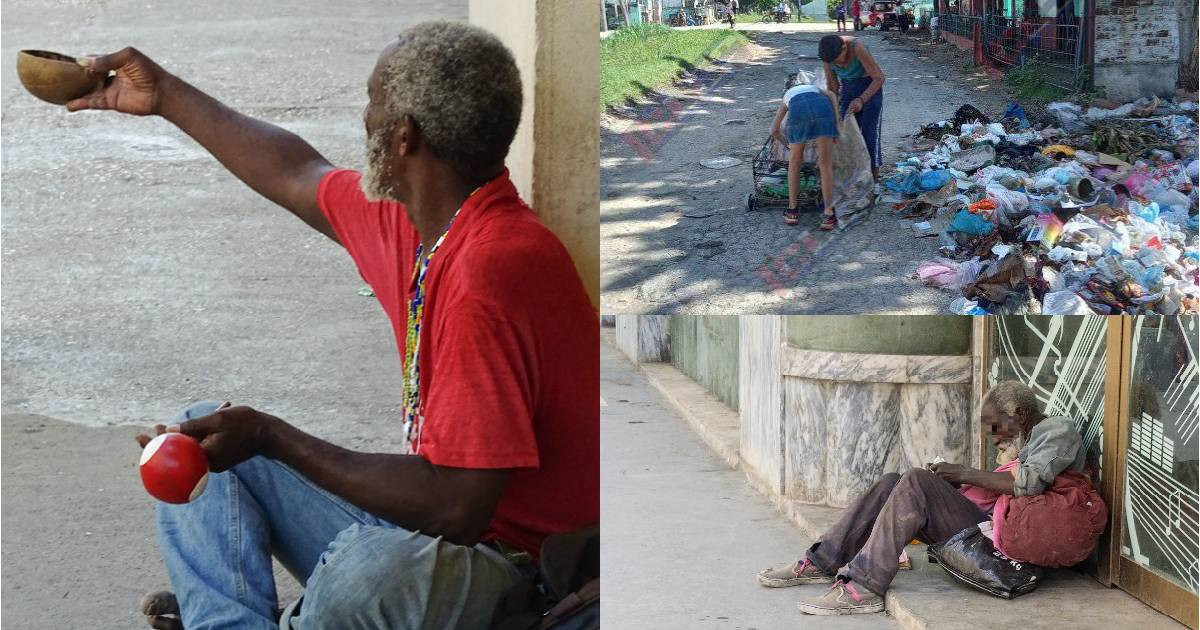
On Friday, the state-sponsored program Mesa Redonda aired a 2016 documentary about poverty in the United States, sparking a wave of criticism and mockery from Cubans both on the island and abroad. Many pointed out the regime's hypocrisy in highlighting foreign hardships while Cuba grapples with an unprecedented humanitarian crisis.
The documentary, presented by the state-aligned digital platform Cubadebate under the title "United States in Crisis: Workers Trapped in Poverty Despite Employment," was produced by Babel Press and directed by Hélène Eckmann. Originally released in 2016, it explores the plight of American "working poor"—individuals who, despite holding one or two jobs, struggle to meet their basic needs.
The comments on Cubadebate's Facebook post were immediate and scathing.
"For a moment, I thought it was about Cuba, then I realized that in Cuba, workers, retirees, children, the sick—everyone is trapped in poverty and much more," wrote Niriam Almeida.
Another user, calling themselves Oráculo de Delfos, captured the irony succinctly: "Workers trapped in poverty despite employment... Hmm... That sounds familiar, but I can't remember from where."
Ed Serrano provided a more direct depiction of Cuban daily life. "Imagine leaving work and walking home, passing by three people dressed as beggars who ask for money, but you have none. You arrive home, drink water, and there's no electricity. You sit down to wait while reading Cubadebate on Facebook and see this news. Imagine earning just over 6,000 pesos, equivalent to two cartons of eggs... As a journalist, I'd be ashamed to produce a program about the United States," he said.
The stark contrast between the two realities was devastating for the official narrative.
Cuban Reality vs. Propaganda
The Cuban Observatory for Human Rights estimates that nearly 90% of Cubans live in extreme poverty, with a monthly cost of living at 40,000 pesos, while the average salary barely reaches 7,000 pesos.
The survey "Hunger in Cuba 2025" revealed that nearly 34% of Cuban households reported that a member went to bed hungry at least once in the past year. In Matanzas, residents are asking for food daily at bus terminal kiosks.
Pensions in Cuba last less than a week and are worth less than $10 a month at the informal exchange rate, according to recent testimonies.
Pablo M Rueda challenged the official narrative with his own story. "Imagine if that's a lie, that more than half a million Cubans arrived here in 2022 with debts and nothing, and in less than two years, we had more than we ever had in Cuba," he stated.
Alison Chanon was even more blunt. "If that's true, HOW SCREWED IS CUBA that knowing life is like that in the U.S., Cubans still risk everything crossing seven borders to emigrate. OBVIOUSLY, IN CUBA, IT'S NOT JUST BAD; CUBA IS THE WORST HELL ON EARTH," she argued.
Propaganda Strategy and Public Reaction
This broadcast is part of a recurring propaganda strategy by the regime. Foreign Minister Bruno Rodríguez Parrilla used a similar tactic in December 2025, citing poverty and infant mortality rates in the U.S., and faced a similar wave of criticism.
Recently, pro-regime activist Brenda López claimed on television that the homelessness crisis in Los Angeles is "much more critical" than what she has seen in Cuba, statements contradicted by 2024 Census data showing the homeless population in Cuba has tripled.
Cuban economist Andrés Martínez Ravelo openly acknowledged on Cienfuegos television that Cuba faces "vulnerability, poverty, and begging," contradicting the official discourse the regime insists on projecting outward while denying it internally.
Frequently Asked Questions about Cuba's Poverty and Propaganda
What was the reaction to the documentary aired by Mesa Redonda?
The documentary sparked a wave of criticism and mockery from Cubans inside and outside the island, who pointed out the regime's hypocrisy in highlighting foreign hardships while Cuba faces its own severe humanitarian crisis.
How does the poverty situation in Cuba compare to the documentary's portrayal of the U.S.?
While the documentary focuses on the American "working poor," nearly 90% of Cubans live in extreme poverty, with wages far below the cost of living, leading to widespread hunger and deprivation.
How has the Cuban government used poverty statistics as a propaganda tool?
The Cuban government has frequently highlighted poverty statistics from the United States as part of its propaganda strategy, attempting to deflect attention from Cuba's own severe economic and social challenges.