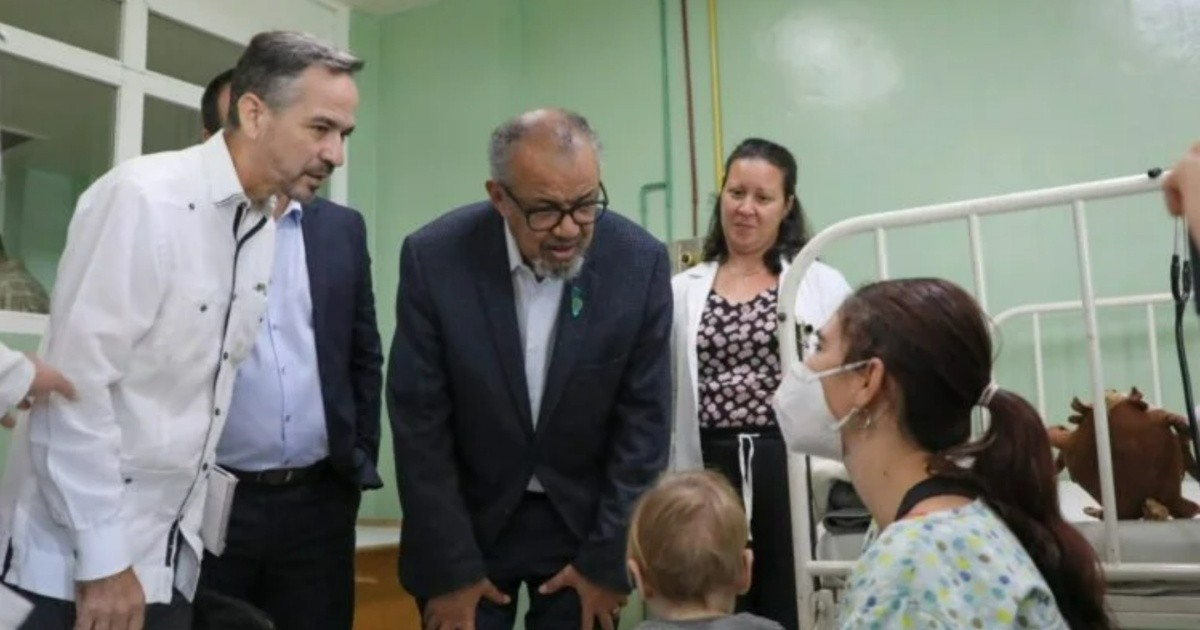
The Director-General of the World Health Organization (WHO), Tedros Adhanom Ghebreyesus, expressed his disappointment on social media platform X this past Saturday, following his visit to Cuba. He urged the United States to lift its sanctions on the island.
"Just returned from Cuba, saddened by what I witnessed. Hospital corridors filled with small hands clinging to big hopes. Healthcare workers giving their all. Children should never bear the cost of political disputes. I urge the U.S. to lift the sanctions for their sake," Tedros conveyed through his official account, accompanying his message with a photograph taken at the William Soler Pediatric University Hospital in Havana.
Invited by Cuba's Minister of Public Health, José Ángel Portal Miranda, Tedros visited the country from November 22 to 24. During his stay, he toured the William Soler hospital and its cardiocenter, where he learned about a one-year-old girl awaiting open-heart surgery. He also met with health authorities and biotechnology research institutions.
This marked his second visit to the island as the WHO chief, the first being in April 2018.
Health System in Crisis
The statistics Tedros shared in Havana depict a healthcare system in decline. According to WHO figures, life expectancy in Cuba plummeted from 78.8 to 74.4 years between 2020 and 2025, a drop of 4.4 years, representing the first decline since statistical records began on the island.
During the same period, infant mortality more than doubled, rising from four to 9.9 deaths per 1,000 live births. Additionally, the cancer survival rate for children fell 20 percentage points, from 85% to 65%.
Impact of Sanctions and Internal Issues
Tedros also highlighted that nearly 100,000 individuals were awaiting surgical procedures, including about 12,000 children. Moreover, around 34,000 pregnant women were unable to access the prenatal care they required.
The WHO leader attributed much of the healthcare collapse to U.S. sanctions and fuel shortages. However, during a press conference in Havana, he introduced a critical nuance: "There are issues in the health sector or other sectors due to the sanctions, which everyone knows about, but at the same time, it's good that the government acknowledges that there are internal problems as well."
This statement contrasts with the Cuban regime's narrative, which blamed the collapse solely on the "criminal blockade and energy siege imposed by the U.S.," without acknowledging external medical missions or failed economic policies. While Cuba maintains over 16,000 healthcare workers in about fifty countries, its own healthcare system is deteriorating, and between 2021 and 2024, more than 30,800 doctors left the island due to emigration.
Criticism and Financial Aid
Critics cautioned from the outset that Tedros would not fully grasp Cuba's healthcare reality. Alberto Tejeda Illas, a physician from Santiago de Cuba, had sent an open letter before Tedros concluded his visit: "It is said that you are visiting Cuba. It's a pity you will not truly understand Cuban healthcare," wrote Tejeda Illas, warning that authorities would control every step of the official tour.
At the end of the visit, the WHO announced a $2 million contribution to bolster Cuba's national vaccination program, aiming to immunize approximately 62,000 newborns, over 780,000 children, and more than 110,000 people in other risk groups. This funding adds to over $14 million mobilized between 2025 and 2026 through 14 projects on the island.
Portal Miranda himself had described the Cuban healthcare system as "on the brink of collapse" in an interview with AP in February 2026, acknowledging severe issues before the National Assembly in early November, such as broken generators, faulty elevators, deteriorating boilers, and reagent shortages.
Understanding Cuba's Healthcare Struggles
What did Tedros Adhanom Ghebreyesus witness in Cuba that saddened him?
Tedros observed hospital corridors filled with hopeful children and healthcare workers striving to provide care amidst challenging conditions.
How has Cuba's life expectancy changed according to WHO data?
Life expectancy in Cuba dropped from 78.8 to 74.4 years between 2020 and 2025, marking a significant decline according to WHO statistics.
What financial aid did the WHO announce for Cuba?
The WHO announced a $2 million contribution to support Cuba's national vaccination program, targeting newborns, children, and other at-risk groups.