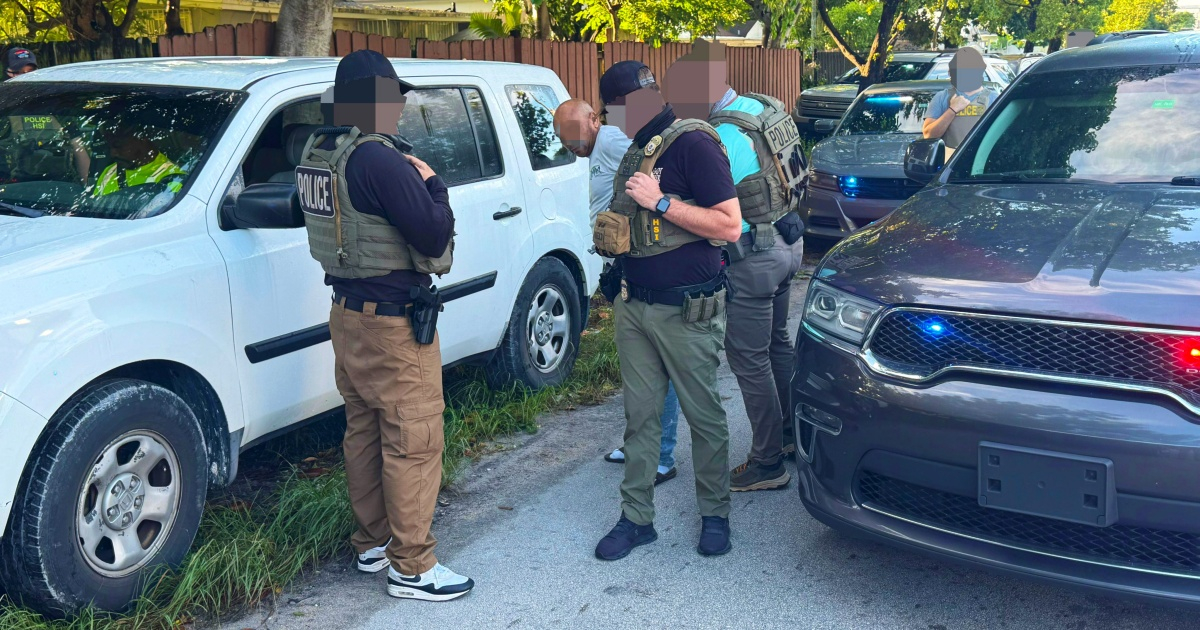
Law enforcement agencies in Florida stand to gain up to $1.4 billion in federal funding through cooperation with the Immigration and Customs Enforcement (ICE) by the end of the fiscal year 2027. This information comes from a report released on October 28 by FWD.us, a bipartisan American organization focused on immigration reform and criminal justice system changes.
Florida is way ahead of other states in receiving these funds. Currently, its agencies might already have access to about $872 million, with projections indicating potential funds exceeding three times the $421 million that Texas could receive by September 2027.
It's important to note that these figures represent funds potentially available, not necessarily already disbursed.
The Cuban Community and Police Cooperation
The expansion of these agreements is particularly significant for the Cuban community. From August 2025 to August 23, 2026, Miami police recorded 451 arrests under the 287(g) program, with 131 of those being Cubans, approximately 29% of the total. This made Cubans the largest national group detained by that agency.
Felicity Rose, Vice President of Research and Policy at FWD.us, expressed concerns to WPTV about the lack of oversight regarding federal resources, highlighting that financial incentives have led to an increase in participating agencies and immigration arrests.
Financial Incentives Behind ICE Collaborations
The 287(g) program's expansion received a financial boost with the enactment of the One Big Beautiful Bill Act by President Donald Trump on July 4, 2025. The federal funding system for participating agencies under the Task Force model includes:
- $100,000 upfront for vehicles and transportation.
- $7,500 per accredited agent for equipment.
- $15,000 quarterly per agent after the initial quarter.
- Reimbursement for salaries and benefits for time spent on immigration duties.
- Quarterly economic incentives for locating undocumented immigrants.
- Payments up to $22,500 for each unaccompanied minor migrant undergoing a security check, according to FWD.us.
These quarterly stipends can amount to $60,000 annually per accredited agent, regardless of the number of arrests made.
For the fiscal year 2026 in Florida, estimates suggest over $16 million for the Palm Beach County Sheriff's Office, while St. Lucie could receive $5.3 million, and Martin around $1.8 million.
Florida's Leadership in the 287(g) Expansion
The 287(g) program enables state and local officers, upon receiving federal training and authorization, to perform certain immigration enforcement functions under ICE supervision. The Task Force model allows routine police actions, like traffic stops, to lead to immigration procedures.
According to FWD.us estimates, by October 1, 2026, Florida had about 9,021 agents accredited under this model and had recorded 15,164 arrests related to the program between January 2025 and early August 2026.
Nationwide, the report estimates over 29,000 state and local police officers have been enabled to collaborate with ICE. Florida and Texas account for approximately half of the more than 47,000 arrests registered under these agreements from January 2025 to early August 2026.
The Department of Homeland Security promotes the program as a tool to combat crime and illegal immigration.
Impact on Cuban Immigrants
On a national scale, ICE arrests of Cuban nationals surged by 463% between October 2024 and January 2026, according to a Cato Institute analysis. This increase includes various types of immigration operations, not solely those conducted under the 287(g) program.
Additionally, over 4,000 Cubans in Florida received deportation orders between October 2025 and June 2026.
Mariana Blanco from the Guatemalan Maya Center reported to WPTV that in Palm Beach, some traffic stops have also resulted in passenger detentions, and even individuals who contacted police to report crimes have been arrested due to their immigration status.
The Palm Beach County Sheriff's Office did not respond to requests for comment from the media.
Resistance from Doral and Tallahassee
Despite increasing federal incentives, some Florida cities are considering ending their agreements with ICE. The Doral City Council postponed a vote on canceling its agreement by four votes to one. State Attorney General James Uthmeier's office warned that canceling without sufficient cause could violate state laws against sanctuary policies.
Florida's statutes section 908.11 mandates county sheriffs or detention center heads to participate in the 287(g) program and requires the State Board of Immigration Control's approval to cancel these agreements. This provision does not explicitly impose the same obligation on all municipal police forces.
Following a similar initiative in Tallahassee, Governor-elect Byron Donalds assured that he would not allow Florida to become a sanctuary state.
Consequences for Cubans with I-220A
The enhanced police collaboration coincides with a recent judicial setback for Cubans with an I-220A form. On November 17, the Eleventh Circuit Court of Appeals ruled that documented conditional release via the I-220A does not equate to the parole required by the Cuban Adjustment Act.
The ruling differentiates between conditional release under section 1226 of U.S. immigration law and parole granted under section 1182(d)(5)(A). Therefore, the I-220A form alone does not meet the admission or parole requirement needed for the Cuban Adjustment Act.
The 287(g) agreements do not alter the individual immigration status of Cubans with I-220A, nor does the ruling imply that all have deportation orders. However, the increased immigration enforcement powers of local agents raise the likelihood that a traffic stop or other routine police encounter could lead to an immigration-related arrest.
Understanding the Impact of ICE Funding on Cuban Immigrants
What is the significance of ICE funding for Florida police?
ICE funding allows Florida police agencies to receive financial incentives for participating in immigration enforcement, potentially leading to increased arrests and deportations, particularly impacting immigrant communities like the Cubans.
How does the 287(g) program affect the Cuban community?
The 287(g) program enables local law enforcement to perform immigration duties, often leading to increased detentions of Cubans, as they are a significant portion of the immigrant arrests in Florida.
Why are some Florida cities considering ending their ICE agreements?
Certain cities, like Doral and Tallahassee, are reconsidering their ICE agreements due to concerns about becoming sanctuary cities and potential legal complications with state laws.
What is the impact of the recent court ruling on Cubans with I-220A?
The court ruling clarifies that the I-220A form does not meet the requirements for the Cuban Adjustment Act, potentially affecting Cuban immigrants' ability to adjust their status based on this form.