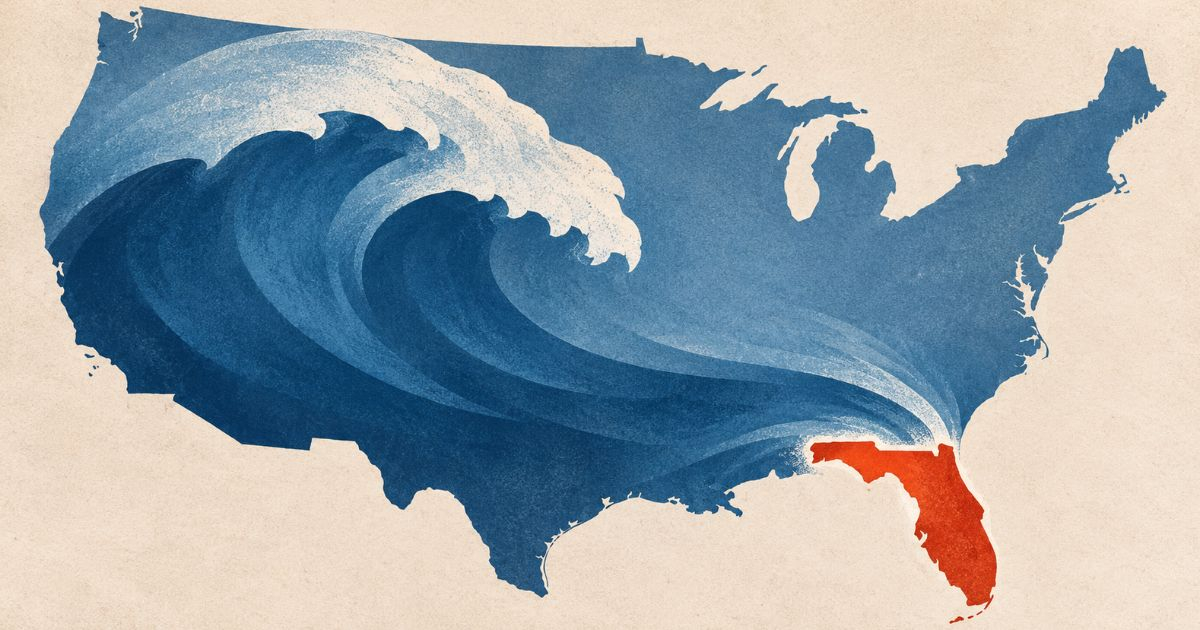
In a surprising turn during the November 3 midterm elections, Florida emerged as a notable exception to the Democratic surge that swept across much of the United States.
While the Republican Party faced significant setbacks in various states and lost control of Congress, it managed to retain crucial state positions and the governorship in Florida.
What factors allowed Florida to resist a trend that adversely affected Republicans nationwide?
Strategic Political Maneuvers and Strong Organization
Evan Power, the Chairman of the Republican Party of Florida, argued in an op-ed for the Orlando Sentinel that a mix of political principles and robust organizational efforts enabled Republicans to maintain their edge in numerous electoral contests.
However, both election outcomes and expert analyses indicate that the Republican resistance was also due to specific factors: a substantial voter registration advantage, superior financial resources, demographic shifts, and mobilization around proposals like property tax reductions.
Voter Registration Edge
One significant factor was evident long before the polls opened. According to Florida's Department of State, as of late October, there were 5,720,737 registered Republicans compared to 4,203,512 Democrats.
This resulted in a difference of 1,517,225 voters in favor of the Republican Party—a considerable edge in an election year characterized by a strong Democratic push nationwide.
This shift reflects a political transformation that has been years in the making. Back in 2020, Democrats still had a higher voter registration count than Republicans in Florida. Since then, the growth of the Republican base and the arrival of new residents have altered the party balance.
Political scientist Aubrey Jewett from the University of Central Florida explained to The Washington Post that this advantage provided Republicans a buffer against the electoral discontent that hit the party in other regions.
Financial Resources and Established Electoral Structure
Financial backing also played a crucial role. According to campaign spending data from The Washington Post, Republican Byron Donalds and his political committee had spent over $165 million by October 29, compared to around $25 million by Democrat David Jolly’s campaign and committee.
This financial disparity allowed Republicans to sustain a campaign with greater advertising and mobilization capabilities.
Experts interviewed by WUSF, Florida’s public radio, pointed out that Democrats in Florida did not receive the level of party investment seen in other competitive states.
Furthermore, Florida's demographic composition influenced the results. The state has attracted numerous older residents, a group that typically leans more Republican.
WUSF highlighted that this trend contrasts with states like Texas and Georgia, where the growth of younger and more diverse electorates benefited Democrats.
Impact of the Cuban-American Vote
In South Florida, a significant portion of the Cuban-American community continues to bolster Republican strength.
The FIU Cuba Poll 2026, released by Florida International University before the elections, revealed that 68% of surveyed Cuban-Americans intended to vote for Republican congressional candidates.
This support coexisted with disagreements over Donald Trump's immigration policy, as 76% opposed increased deportations of Cubans without criminal records.
The post-election debate also showcased this contradiction. Florida Republican leaders dismissed deportations as the primary reason for electoral setbacks among Cubans and Hispanics, citing economic and national political factors instead.
However, Cuban-American support does not imply that all Hispanic voters in Florida voted similarly. Election results highlighted significant differences across communities, regions, and age groups.
Republican Gains and Challenges
While Republicans celebrated victories, the margin was narrower compared to past elections. According to Florida's official results, Donalds secured 4,135,955 votes, or 50%, while Jolly garnered 4,030,579, or 48.73%.
The gap was a mere 105,376 votes, or 1.27 percentage points. This stands in stark contrast to the 2022 elections, where Ron DeSantis was re-elected with a margin exceeding 19 points, and the 2024 presidential race, where Trump won Florida by approximately 13 points.
Moreover, Democrats gained 15 seats from Republicans in the state House of Representatives, ending their supermajority, although the Republican Party retained legislative control.
Notable shifts occurred in the southern part of the state as well. Miami-Dade gave the majority of its votes to Democratic candidates for both the governorship and the U.S. Senate, after previously supporting Trump in 2024 and DeSantis in 2022.
In the wake of the elections, Donalds acknowledged that some Republican voters either abstained or supported Democratic candidates, attributing part of this discontent to economic concerns affecting families.
Key Factors Behind Florida's Republican Resilience
What factors contributed to Florida's Republican resistance?
Factors included a significant voter registration advantage, substantial campaign funding, demographic shifts, and mobilization around specific proposals like property tax reductions.
How did financial resources impact the elections?
Republicans outspent Democrats significantly, which allowed for greater advertising presence and voter mobilization, contributing to their electoral success.
What role did the Cuban-American community play in the elections?
The Cuban-American community in South Florida provided substantial support for Republicans, although there were disagreements over immigration policies.