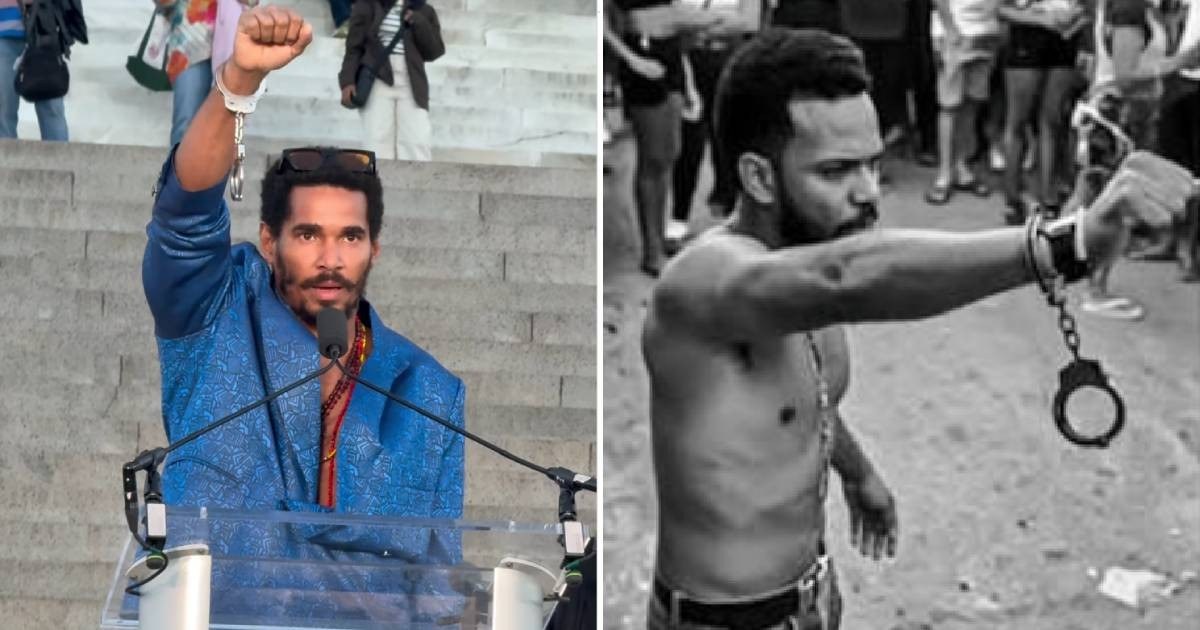
On Friday, Cuban artist and activist Luis Manuel Otero Alcántara conducted two symbolic performances on the steps of Washington D.C.'s Lincoln Memorial. The events were part of his observance of the International Day of Political Prisoners, where he called for the release of Maykel Osorbo and Lizandra Góngora.
Central to the occasion, which he shared on his Instagram account, was the reenactment of Maykel Osorbo's iconic gesture from April 4, 2021. On that day, the musician famously evaded police detention in Havana, raising a handcuff on his wrist as a symbol of defiance.
"Through this performance, I recall Maykel's act of raising the handcuffs for Cuba's freedom. From today until December 10, I will wear these handcuffs as a pledge to those still imprisoned," Otero Alcántara wrote along with the video.
Otero Alcántara committed to wearing the handcuffs until December 10, which marks International Human Rights Day, as an act of solidarity with Cuban political prisoners.
Highlighting Cuban Political Prisoners
The tribute centered on two significant figures: Maykel Castillo Pérez — known as Maykel Osorbo, who co-authored the anthem "Patria y Vida" and has been imprisoned since June 2022 with a nine-year sentence — and Lizandra Góngora Espinosa, a mother of five serving a 14-year sentence for participating in the July 11, 2021 protests, receiving the harshest punishment for a woman involved in the 11J demonstrations.
"Maykel Osorbo is an artist, a musician, imprisoned for singing a song, for stirring a nation with a song," Otero Alcántara expressed during his performance.
Regarding Góngora, he lamented that her five children would be deprived of their mother for 14 years "unless that dictatorship falls."
Otero Alcántara's Continued Advocacy
This act was part of the "Roll Call for Freedom" event, organized by the National Endowment for Democracy (NED) and the October 30 Coalition — a group including Freedom House, Human Rights Foundation, McCain Institute, Free Russia Foundation, among others — with the aim of publicly reading the names of political prisoners from various countries.
In a second performance of the day, Otero Alcántara shared the personal significance of the gesture: he himself endured five years in a Cuban prison before being exiled to Miami in July 2026 by the regime.
Choosing to wear vibrant colors in stark contrast to the drab prison uniform he wore for years, he stated, "I spent five years in gray, and today I chose to wear colors to bring life and energy to my brother Maykel Osorbo and all political prisoners worldwide."
"After five years in prison, I know how much it matters to know that people on the outside have not forgotten you. I am in exile, but my freedom remains incomplete while you remain imprisoned," he asserted.
This performance is part of Otero Alcántara's robust activism agenda since his exile. In mid-October, he made an appearance at the UN headquarters in New York, speaking at a forum on Cuban regime repression, which was disrupted by members of Havana's official delegation.
According to data from Prisoners Defenders as of October 1, 2026, Cuba holds at least 1,372 individuals incarcerated for political reasons, including 40 minors.
"Maykel Osorbo and Lizandra Góngora epitomize the Cuban people's struggle for freedom over more than 60 years. We only ask for 'Patria y Vida'," the artist concluded before the Lincoln Memorial.
Understanding the Plight of Cuban Political Prisoners
Who is Luis Manuel Otero Alcántara?
Luis Manuel Otero Alcántara is a Cuban artist and activist known for his performances and protests against the Cuban government.
Why is Maykel Osorbo imprisoned?
Maykel Osorbo is imprisoned for his role in creating the song "Patria y Vida," which has become an anthem for freedom in Cuba. He was sentenced to nine years in prison for his activism.
What is the significance of the performance at the Lincoln Memorial?
The performance at the Lincoln Memorial was a symbolic act to raise awareness about the plight of Cuban political prisoners and to call for their release, embodying solidarity and resistance against oppression.