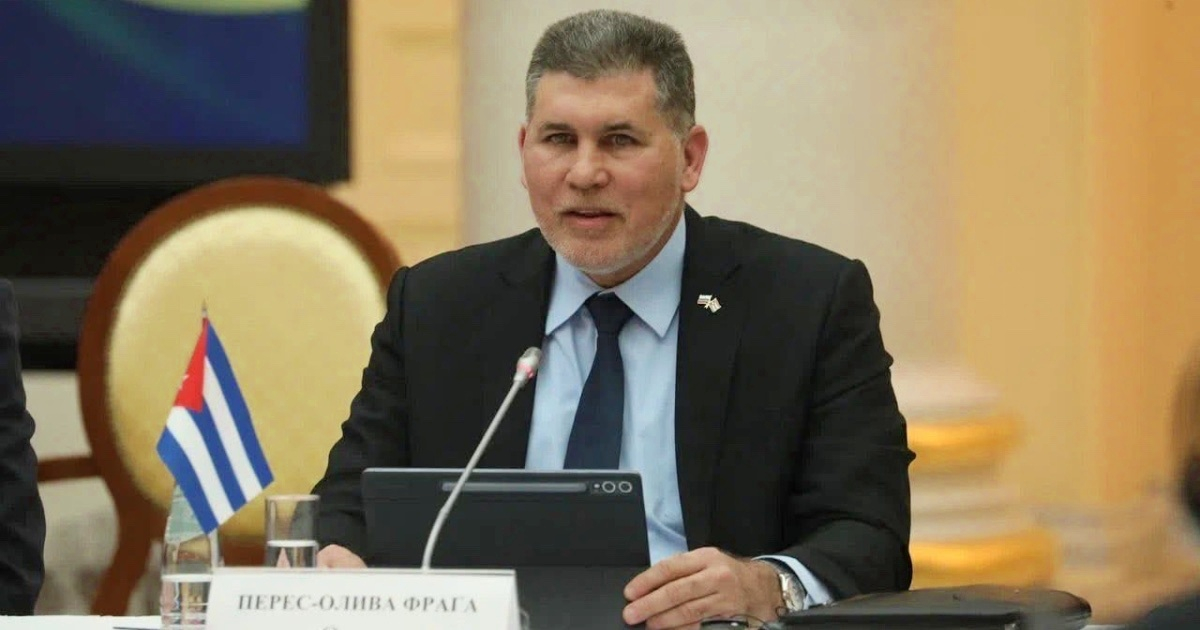
Óscar Pérez-Oliva Fraga, the great-nephew of Fidel and Raúl Castro, has dismissed any ambitions to rise to power in Cuba. In an extensive interview from his office in Havana with Reuters, he clarified his stance.
The 55-year-old official, serving as Deputy Prime Minister and Minister of Foreign Trade in Cuba, addressed the growing rumors about his potential future role within the Cuban regime amid heightened diplomatic pressure from the Trump administration.
Firm Stance on Leadership Ambitions
When queried by Reuters about his potential involvement in a political transition scenario, Pérez-Oliva was unequivocal: "I have no aspirations in that regard."
This statement gains significance considering an August report by The New York Times, which revealed that the Trump administration was seeking individuals within the Cuban regime who could take on governmental roles in a possible transition, similar to Delcy Rodríguez's position in Venezuela after Nicolás Maduro's capture.
The New York Times suggested that the regime seemed to be positioning Pérez-Oliva as a potential successor, though Washington would likely find him "almost certainly unacceptable." The newspaper also mentioned Raúl Guillermo Rodríguez Castro, known as "El Cangrejo," and Interior Minister Lázaro Alberto Álvarez Casas as more palatable interlocutors for the U.S.
Rapid Rise within the Regime
Pérez-Oliva, an electronic engineer educated at the Technological University of Havana, is the son of Mirsa Fraga Castro and grandson of Ángela Castro, the eldest sister of Fidel and Raúl, who passed away in 2013. His familial ties make him a great-nephew of the revolutionary leaders.
Before his political ascent, he gathered over 15 years of experience in foreign trade, working as Business Evaluation Director in the Mariel Special Development Zone under General Luis Alberto Rodríguez López-Calleja, the "czar of GAESA" and former son-in-law of Raúl Castro.
In May 2024, he replaced Ricardo Cabrisas Ruiz as Minister of Foreign Trade. Just a year later, in October 2025, he was promoted to Deputy Prime Minister while retaining his ministerial role, a remarkably swift rise even by Cuban bureaucratic standards.
His public profile has grown noticeably, with increased appearances on state television and interviews with international outlets like CNN and Reuters. In November 2025, the Ministry of Foreign Affairs highlighted him as the sole figure at a National Defense Council session led by Díaz-Canel, excluding other leaders.
Refuting Ties with Trump-Linked Companies
In the Tuesday interview, Pérez-Oliva also denied reports suggesting that companies associated with President Donald Trump had traveled to Cuba this year to explore business opportunities.
"I am unaware of any company directly linked to President Trump making contact with Cuba," he stated, emphasizing that neither he nor any other Cuban officials had met with representatives from such companies.
Embargo as a Barrier to Reforms
The official used the interview to defend a package of 176 free-market reforms approved by the National Assembly in June 2026—the most significant since the 1959 revolution—and identified the U.S. embargo as the main obstacle to their implementation.
"It is not Cuba's policy to prohibit U.S. companies from investing, trading, or conducting any business with Cuba," Pérez-Oliva declared. "What prevents this possibility is the existence of the commercial embargo," he added.
He also condemned a petroleum blockade imposed by Washington in January 2026, which nearly halted fuel imports from Mexico, Venezuela, and other historical suppliers of the island.
The regime claimed on Monday that it had implemented 89% of the reforms package, which includes opening up to direct foreign investment in the private sector, private banking, removing the 100-employee cap for small and medium-sized enterprises, and private exchange houses.
Diplomatic Tensions Amid Potential Openings
The interview took place amid mixed signals between Washington and Havana. Last Friday, Trump predicted that the U.S. and Cuba "will make a deal," ruling out military action against the island.
A week earlier, at the U.N. General Assembly, the U.S. president declared that Marco Rubio "is handling a negotiation" with Cuba. Meanwhile, Cuban Foreign Minister Bruno Rodríguez stated at the U.N. that the island is open to dialogue with the U.S., but under conditions of sovereign equality and without preconditions.
In this highly pressured and potentially open scenario, Pérez-Oliva's statement—"I have no aspirations in that regard"—temporarily closes the door on his role as a transition figure, though his rapid ascent within the regime remains one of the most closely watched political developments in Havana.
Frequently Asked Questions on Cuba's Political Dynamics
Who is Óscar Pérez-Oliva Fraga?
Óscar Pérez-Oliva Fraga is the great-nephew of Fidel and Raúl Castro, serving as Cuba's Deputy Prime Minister and Minister of Foreign Trade.
What is the significance of the U.S. embargo on Cuba?
The U.S. embargo is considered the main obstacle to implementing Cuba's recent free-market reforms, preventing U.S. companies from investing and trading with the island.
What are the recent reforms in Cuba?
Cuba's recent reforms include opening to foreign direct investment in the private sector, private banking, eliminating the 100-employee cap for small and medium-sized enterprises, and allowing private exchange houses.