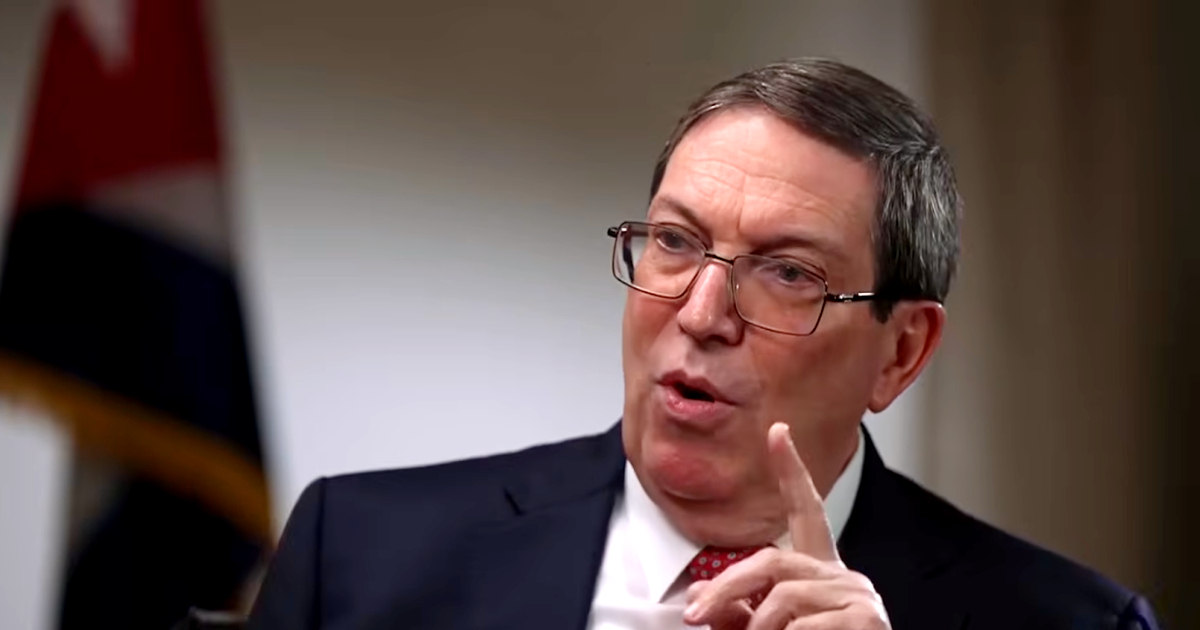
Cuban Foreign Minister Bruno Rodríguez Parrilla responded with a terse and emphatic retort, saying, "Lies, lies once again."
In an exclusive interview with NBC News, the leading diplomat of the Cuban regime dismissed the assertion made by U.S. Secretary of State Marco Rubio that there are Cuban officials with whom Washington can never negotiate because they have "blood on their hands."
Rubio had stated on Wednesday during a press conference that "obviously, there are individuals in that regime with whom we can never work because their hands are stained with blood, but there are also people whom I believe we could collaborate with, if they are willing to steer the country towards political and economic freedom."
Rubio's statement came a day after President Trump labeled Cuba as a "completely failed state" at the General Assembly and predicted that the regime would "fall," remarks that prompted the Cuban delegation to leave the room in protest.
Context and Controversies Surrounding Cuban Officials
Rodríguez Parrilla's response, however, sidesteps a context that is difficult to overlook: several potential regime interlocutors in talks with Washington face serious allegations.
Raúl Castro was formally charged in May 2026 by the U.S. Department of Justice with four counts of murder and conspiracy over the downing of the Brothers to the Rescue planes on February 24, 1996, which resulted in the deaths of Armando Alejandre Jr., Carlos Costa, Mario de la Peña, and Pablo Morales.
Lázaro Alberto Álvarez Casas, the Minister of the Interior, has been sanctioned by the U.S. since 2021 for severe human rights violations. The ministry he leads—the MININT—was the operational hub of the July 11th crackdown, which left at least one confirmed dead (Diubis Laurencio Tejeda), over 1,400 detained, and sentences of up to 30 years in prison.
Despite this, Álvarez Casas met with CIA Director John Ratcliffe in Havana in May 2026, an unusual meeting whose photos were released by the CIA itself, and some media have pointed to him as a potential transitional figure.
The third figure in the spotlight is Raúl Guillermo Rodríguez Castro, also known as "El Cangrejo," a colonel in the MININT and Raúl Castro's grandson.
According to an August 2026 investigation by the New York Times, he is linked to a criminal network in Quintana Roo, Mexico, where at least 25 people died during maritime journeys organized by the group. He has not been formally charged in the U.S., but he was also mentioned as a potential interlocutor in negotiations and was reportedly involved in the meeting with Ratcliffe.
Diplomatic Relations and Rubio's Stance
In the NBC interview, Rodríguez Parrilla confirmed that "representatives appointed by the Cuban government have held talks with the American side," although he refused to disclose who is involved or the terms of the discussions. When directly asked if "El Cangrejo" is involved, he declined to provide details.
The foreign minister also rejected Rubio's attempt to condition bilateral relations on internal Cuban criteria, arguing that "relations between the United States and Cuba do not hinge on the interests of South Florida" and that Cuba "is not a domestic issue" nor "an electoral topic" in the U.S.
Rubio, meanwhile, expressed openness to working with regime figures willing to embrace a real transition, although he warned that "you can't reverse sixty-some years of mismanagement, corruption, and incompetence in six months" and did not rule out the use of force if Cuba poses a national security threat to the United States.
Key Questions About U.S.-Cuba Relations
What are the allegations against Raúl Castro?
Raúl Castro was charged by the U.S. Department of Justice in May 2026 with four counts of murder and conspiracy for the 1996 downing of Brothers to the Rescue planes, which killed four individuals.
Who is Lázaro Alberto Álvarez Casas?
Lázaro Alberto Álvarez Casas is the Cuban Minister of the Interior, sanctioned by the U.S. since 2021 for serious human rights violations and involved in the July 11th repression.
Why did the Cuban delegation leave the room during Trump's speech?
The Cuban delegation exited the room in protest after President Trump labeled Cuba as a "completely failed state" and predicted the regime's fall during the General Assembly.