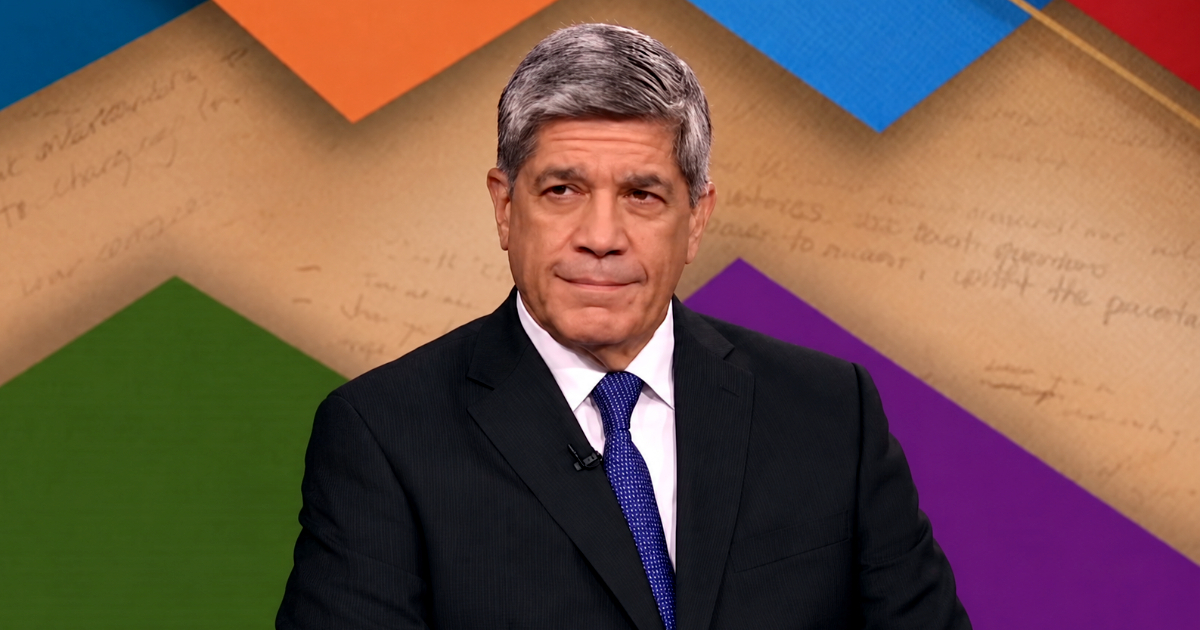
Carlos Fernández de Cossío, the Deputy Minister of Foreign Affairs of Cuba, invoked International Law to assert that "an entire nation's population" is being punished for an ambiguous political goal.
During an interview with Antonia Hylton on MS NOW's program The Assignment, the deputy minister employed a rhetorical question to evade a stark and undeniable truth: Cubans have been stripped of their rights not by a foreign power, but by a political system that blocks them from freely determining their country's future.
"An entire nation's population is being punished for an undefined political objective (...), to seize control of a foreign nation and its wealth. Under what logic (...) is that acceptable?" queried Fernández de Cossío.
The Cuban regime questions the rationale of pressuring a foreign state but never addresses the logic behind banning political pluralism, controlling the media, punishing dissent, and closing all institutional paths for citizens to hold power accountable.
The Cuban Constitution identifies the Communist Party as the supreme political force of society and the State; this legally enshrines the subordination of the country to a single political organization.
This is the central contradiction of the official Cuban discourse: it demands sovereignty externally while denying it internally.
The Internal Contradictions of Cuban Sovereignty
The regime speaks of national self-determination, yet it does not allow the nation to self-determine through free elections, independent parties, uncensored press, and citizens protected from state abuse.
The regime's logic is not rooted in International Law but in its own survival. It aims to remain in power even as the country is drained by emigration. It persists even as hospitals crumble, blackouts become routine, and millions of Cubans endure scarcity, inflation, and hopelessness. It continues even when all forms of peaceful criticism are branded as threats, crimes, or betrayals.
International organizations have documented for years the repression against activists, independent journalists, artists, dissidents, and citizens voicing government criticism.
Human Rights Watch reports that Cuban authorities continue to suppress and punish dissent and public criticism; Freedom House describes Cuba as a one-party system that bans political pluralism, restricts independent media, and curbs basic civil liberties.
The Concentration of Wealth and Power
Discussing national wealth is incomplete without considering who controls it. GAESA, the business conglomerate linked to the Armed Forces, has been identified as a dominant player in strategic sectors of the Cuban economy, including tourism, foreign exchange, retail commerce, and other key income streams.
In a nation where citizens lack real mechanisms to audit power, this economic concentration bolsters an opaque and militarized structure.
This makes Fernández de Cossío's statement particularly revealing. The Cuban regime portrays itself as a victim of external aggression but avoids addressing its internal victims: political prisoners, exiled youth, censored journalists, mothers protesting for food and electricity, and citizens monitored for their opinions.
The question, therefore, must be returned in full: under what logic is it acceptable for a political elite to retain power for over six decades, control information, manage national wealth without transparency, and suppress those who demand basic freedoms?
Such logic does exist. It is neither legal nor democratic. It is the logic of a power that turned the state into private property, the citizen into a subject, and the nation into a captive.
Understanding the Logic of Cuban Political Power
What is the basis of the Cuban regime's logic according to international organizations?
International organizations state that the Cuban regime's logic is grounded in maintaining power at all costs, often through repression and control of information, rather than adhering to international legal standards.
How does the Cuban Constitution support the regime's power?
The Cuban Constitution recognizes the Communist Party as the supreme political force, legally enforcing the country's subordination to a single political entity, thereby entrenching the regime's power.
Who controls the strategic sectors of the Cuban economy?
GAESA, a conglomerate linked to the Cuban Armed Forces, dominates key sectors of the economy, such as tourism, foreign exchange, and retail, further consolidating the regime's control over national wealth.