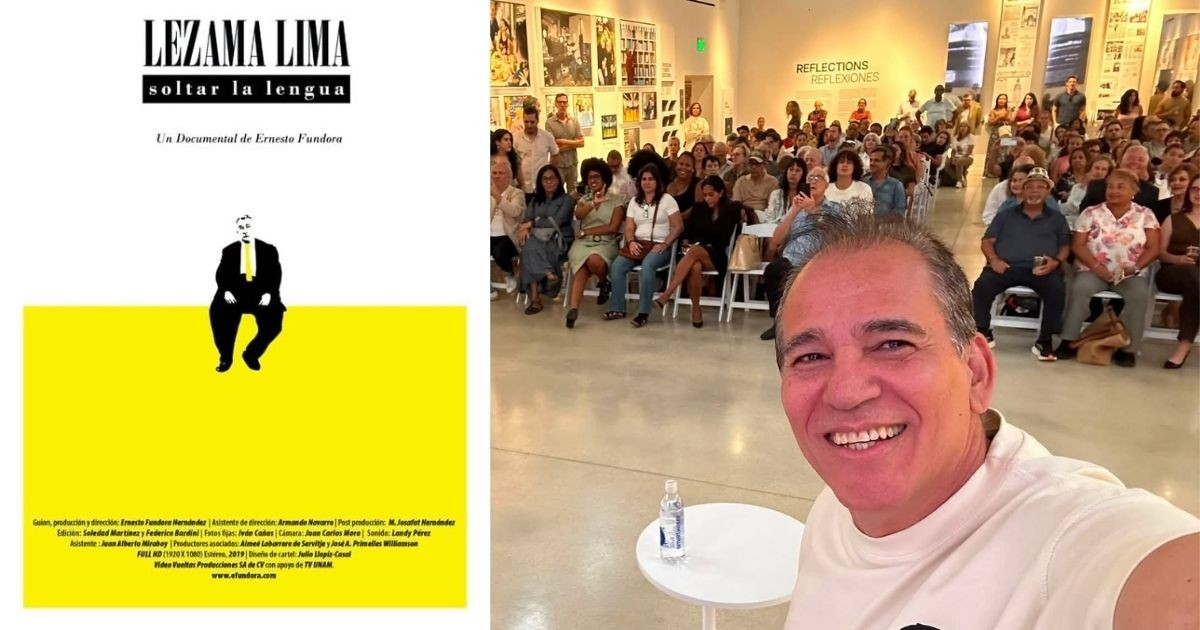
The Coral Gables Museum in Florida is set to showcase the biographical documentary "Lezama Lima: Untying the Tongue," directed by Cuban filmmaker Ernesto Fundora Hernández. This screening, scheduled for September 9 at 6:30 PM, commemorates both the 50th anniversary of Cuban poet and novelist José Lezama Lima's passing and the 60th anniversary of his groundbreaking novel, Paradiso. These details were shared by the museum and Fundora on their social media platforms.
As part of the series "Persecuted: Artists Censored by Communist Cuba," this event highlights two significant periods in Cuban cultural history marked by state censorship of dissident art. Cuban writer and literary critic José Prats Sariol will be a special guest, and the film will include English subtitles, enhancing accessibility.
Exploring Lezama Lima's Literary Legacy
The Coral Gables Museum describes the film as a comprehensive portrait of José Lezama Lima, a towering figure in 20th-century Latin American literature. Through interviews with writers, artists, scholars, friends, and former students, the documentary delves into Lezama's life, literary vision, and enduring influence, capturing firsthand accounts from those who knew him intimately.
Produced between 2018 and 2019 by Video Vueltas Producciones SA de CV with support from TV UNAM, the documentary features interviews conducted in Miami, Havana, and other locations. Notable Cuban cultural figures such as Cintio Vitier, Fina García Marruz, César López, Anton Arrufat, and Silvio Rodríguez contribute their insights.
The Controversial Legacy of "Paradiso"
The screening coincides with a significant dual anniversary. Published in Cuba in 1966, Paradiso is lauded as a "bold, partially autobiographical novel" that weaves together familial memories, Cuban history, mythology, philosophy, and innovative poetic language, creating one of the region's most unique literary works. Despite its acclaim, the novel was swiftly removed from Havana's bookstores due to its sexual content and homosexual references, particularly in Chapter VIII, leading the regime's cultural bureaucrats to label it "pornographic."
Lezama's homosexuality clashed with the Cuban regime's cultural and moral policies, which, during the 1960s and 1970s, repressed homosexuals through mechanisms like the Military Units to Aid Production (UMAP) and the cultural exclusion policies of the so-called Grey Quinquennium. His sexuality, Catholic faith, advocacy for literary autonomy, and stance during the Padilla Affair progressively marginalized him within Cuba. In his final years, authorities denied him permission to travel abroad, and he passed away in Havana on August 9, 1976.
The "Persecuted" series draws parallels between the censorship of the 1960s and the repression faced by visual artist Luis Manuel Otero Alcántara, co-founder of the San Isidro Movement, who was arrested in July 2021 and sentenced to five years in prison. The series' first installment featured the documentary "Luis Manuel Otero Alcántara: We Are Connected" on August 5, coinciding with the anniversary of the 1994 Maleconazo, with Alcántara himself present at the museum.
Ernesto Fundora's Cinematic Journey
Ernesto Fundora, now based in Mexico City, graduated from the Higher Institute of Art (ISA) in Havana and the International School of Film and Television (EICTV) in San Antonio de los Baños. Since founding Video Vueltas Producciones in 1996, he has directed over 90 music videos for artists like Celia Cruz, Willy Chirino, and Carlos Varela, in addition to more than 20 documentaries. Bringing these stories to audiences has been challenging; in May, Fundora was physically assaulted by Mexican Communist Party militants during a presentation of "We Are Connected" in Coyoacán, where the attackers hurled insults such as "Damn worms!"
Regarding the Cuban reality depicted in his work, Fundora has been outspoken: "We are kidnapped by a group of Satanists. The Cuban nation is held hostage by a group of Satanists," he declared in a recent interview.
Understanding José Lezama Lima and Cuban Censorship
Who was José Lezama Lima?
José Lezama Lima was a prominent Cuban poet, novelist, and essayist, recognized as one of the most influential figures in 20th-century Latin American literature.
Why was his novel "Paradiso" controversial?
"Paradiso" was controversial due to its explicit sexual content and homosexual references, which led the Cuban regime to label it as "pornographic" and remove it from bookstores shortly after its release.
What is the "Persecuted" series about?
The "Persecuted" series examines the state censorship and persecution faced by Cuban artists under the communist regime, spanning from the 1960s to contemporary cases like that of Luis Manuel Otero Alcántara.