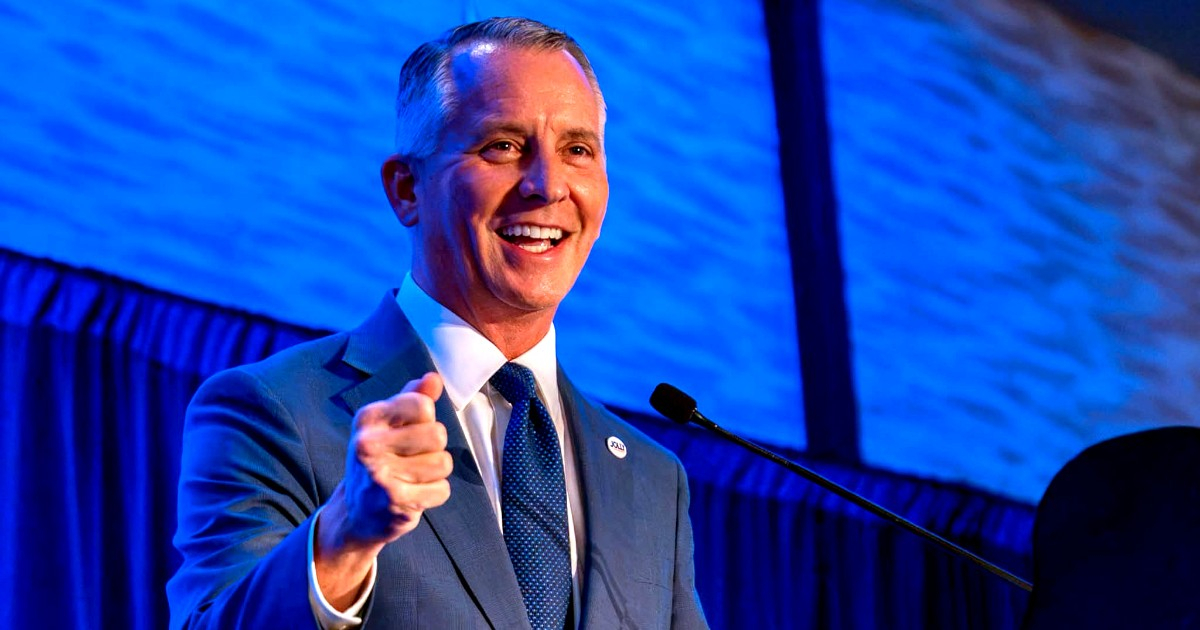
David Jolly, a former congressman who left the Republican Party eight years ago, clinched the Democratic primary for Florida governor this Tuesday, securing 61% of the vote and defeating his nearest competitor by a staggering 45 percentage points.
At 53, Jolly, hailing from the Tampa Bay area, becomes the Democratic hopeful aiming to reclaim the state's governorship, held by Republicans uninterrupted since 1999.
Come November 3, Jolly will face off against Republican Byron Donalds, a 49-year-old former Naples congressman who emerged victorious in his primary with 48% of the vote, bolstered by President Donald Trump's endorsement since February 2025.
Historic Race with High Stakes
This election carries a dual historical significance: Donalds seeks to become Florida's first Black governor, while Jolly endeavors to break a lengthy Democratic drought in the governor's mansion, the last Democrat being Lawton Chiles, narrowly re-elected in 1994 against Jeb Bush.
Jolly's political journey is unique for a Democrat; he served Florida's 13th congressional district as a Republican from 2014 to 2017, left the party in 2018, and only formally joined the Democrats in 2025, the same year he launched his gubernatorial campaign. His running mate, Gwen Graham, a former congresswoman and daughter of former governor Bob Graham, was announced in June.
Implications of the Primary Results
The breadth of Jolly's primary win—leading his closest opponent by 45 points—suggests Florida Democrats are rallying behind a moderate voice capable of attracting independents and disillusioned Republicans, a strategy diverging from Democratic tactics in other states.
Donalds, meanwhile, entered the primary with a 49% polling advantage over 10 other Republican contenders. Lieutenant Governor Jay Collins, who pitched himself as a continuation of Ron DeSantis' legacy, finished a distant second with just 25%. DeSantis, unable to seek a third consecutive term due to constitutional limits, refrained from endorsing any candidate, including his lieutenant governor.
Challenges Ahead for Democrats
Following the results, Donalds took to X to deliver a message that called for Republican unity while critiquing his opponent: "My Democratic rival would hike taxes, inflate living costs, and impose the radical Democrat agenda on the Sunshine State. Florida cannot afford the liberal David Jolly."
The electoral terrain is notably challenging for Democrats. Republicans hold a supermajority in Florida's Legislature, controlling 27 of 40 Senate seats and 83 of 120 in the House of Representatives, enabling them to pass laws with minimal resistance.
Once a swing state, Florida has shifted decisively to the right, partly due to the Hispanic electorate's pivot towards the Republican side, including traditional Democratic strongholds like Miami-Dade County. Donalds' candidacy is closely watched by the Cuban-American community due to his stance on Cuba and connection with Trump.
Preliminary data from the Florida Division of Elections indicates that nearly two million voters participated before primary day—1.15 million by mail and 818,000 in early personal voting—with over 1.3 million casting ballots in person on Tuesday, as more than 96% of precincts reported.
Key Questions About Florida's Gubernatorial Race
What makes David Jolly's candidacy unique?
David Jolly's candidacy is notable because he was a former Republican who served as a congressman before joining the Democrats in 2025, presenting a moderate platform to attract a broad voter base.
What are the historical aspects of this gubernatorial race?
The race is historic as Byron Donalds aims to be Florida's first Black governor, while David Jolly seeks to become the first Democratic governor in over 30 years.
How does the current political landscape in Florida affect the election?
With Republicans holding a supermajority in the state legislature, Democrats face an uphill battle in a state increasingly leaning Republican, influenced by shifting Hispanic voting patterns.