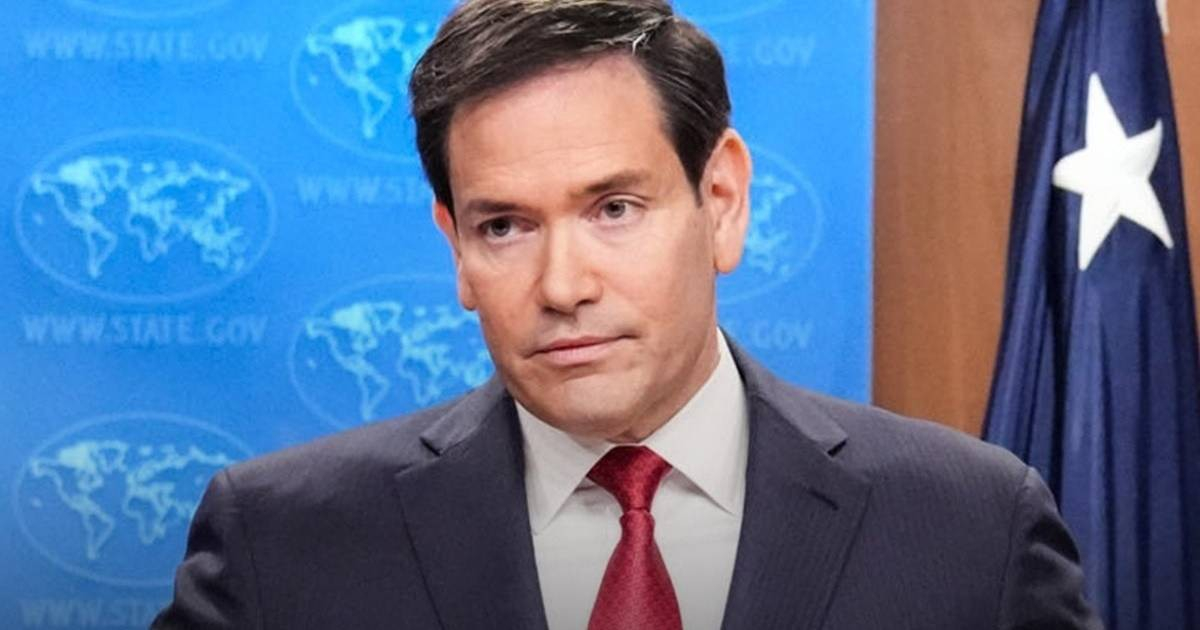
Secretary of State Marco Rubio has declared that Cuba is "undoubtedly a priority" for the Trump administration, expressing confidence that the island will be on an "irreversible path toward a vastly different future" before the presidential term concludes.
These remarks were made during the 51st episode of the Katie Miller Pod, recorded at the State Department, when the host directly questioned him about whether Cuba would be "next" following the capture of Nicolás Maduro in Venezuela on January 3, 2026.
"I am confident that Cuba, before this administration ends, will be on an irreversible path toward a very different future," Rubio responded unequivocally.
However, the head of U.S. diplomacy cautioned that change won't happen overnight: "You can't uproot something that's been entrenched for 70 years and expect to replace it overnight with something entirely new. There needs to be a transition and a process."
Rubio drew on Eastern Europe's experience after the fall of communism to illustrate his viewpoint: "Eastern European countries took three to five years to become what we know today. Poland is probably the best example."
The Secretary of State emphasized that his stance on Cuba aligns with U.S. national interests, though he acknowledged his personal connection to the island as the son of Cuban immigrants: "I work for the United States of America. I care about Cuba, obviously I have a personal connection, but I don't work for Cuba. I believe it's in our national interest to have a safe, stable Cuba aligned with the U.S."
Rubio explicitly equated the policy toward Cuba with the same approach applied to Venezuela: "The same sentiment I have about Venezuela."
These statements are part of a maximum pressure campaign that the Trump administration has intensified through 2026, with more than two dozen actions against the Cuban regime, including sanctions on over 40 entities and at least 38 individuals.
Among the latest measures, on July 23, Rubio expanded sanctions against nine entities and two Cuban officials, including the Minister of Public Health, José Ángel Portal Miranda.
The sanctions also targeted the Mariel Container Terminal, the Cuban Medical Services Marketing Company, and the Central Unit for Medical Cooperation, among others.
Rubio's stated objective is to close every "escape valve" the regime might use to evade sanctions, a strategy that began with the sanctioning of CUPET in June under Executive Order 14404, signed by Trump on May 1, 2026.
Jeanette Rubio, the Secretary of State's wife, revealed on the same program that during the weeks leading up to Maduro's capture, she noticed signs that something significant was underway: "I knew something was happening. He was constantly coming and going. We didn't do anything during the holidays. I knew something was up, but I didn't know exactly what it was."
Rubio has been involved in foreign relations for 14 years from the Senate and was appointed Secretary of State by Trump within 48 to 72 hours after winning the election, without the offer being presented as an option: "It wasn't like 'would you be interested?'. It was more like: you're going to be, and I said, okay, here we go."
Understanding U.S. Policy Toward Cuba Under Rubio
What is Marco Rubio's vision for Cuba's future?
Marco Rubio envisions Cuba on an irreversible path toward a vastly different future, aligning with U.S. national interests and undergoing a necessary transition process.
How has the Trump administration increased pressure on the Cuban regime?
The Trump administration has intensified pressure through over two dozen actions, including sanctions on more than 40 entities and at least 38 individuals, aiming to close escape routes for the regime.