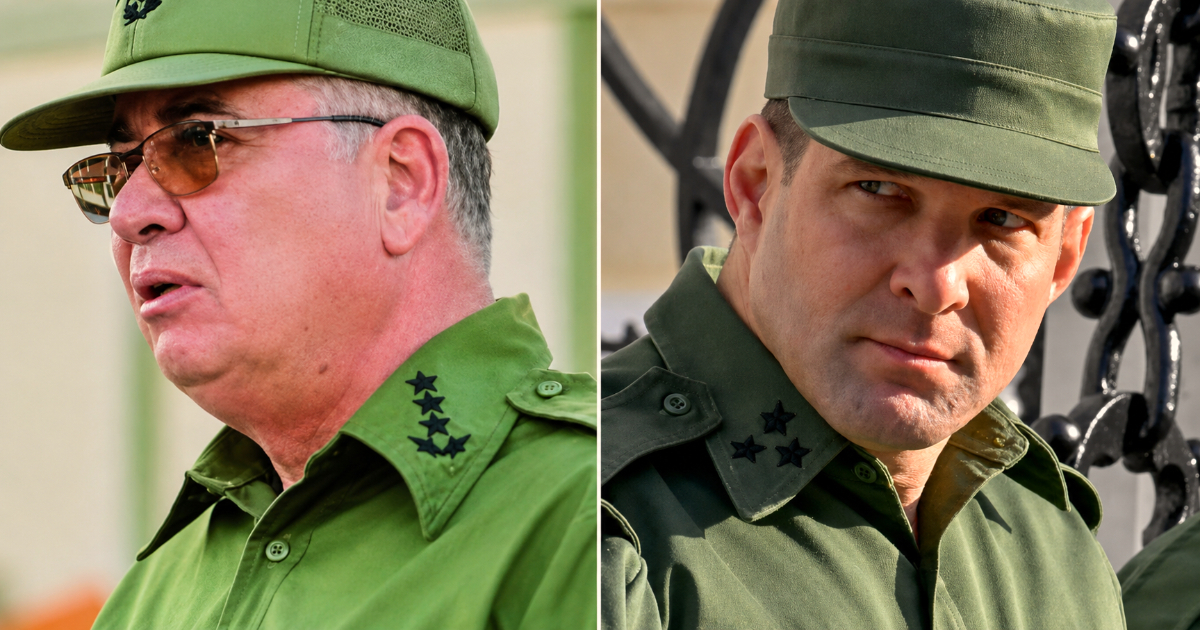
Raúl Guillermo Rodríguez Castro, widely known as "El Cangrejo" and the grandson of Raúl Castro, along with Lázaro Alberto Álvarez Casas, the Minister of the Interior, are emerging as potential figures that Washington might find acceptable in a possible political transition in Cuba, as reported by The New York Times on Friday.
The American newspaper disclosed that the Trump administration has been searching among both current and former Cuban regime officials for a candidate capable of assuming power in Havana and collaborating with the U.S. in the event of a leadership change.
A Model Inspired by Venezuela
The approach being considered by the White House mirrors the strategy employed in Venezuela with Delcy Rodríguez, who temporarily took the presidency after Nicolás Maduro was captured by U.S. forces in January.
The Times noted that U.S. officials viewed Delcy as a pragmatic figure, capable of maintaining state control without creating a power vacuum, while also working closely with Washington.
The Trump administration is seeking a similar profile within Cuba, although U.S. intelligence assessments suggest there are few pragmatic officials well-positioned to take charge of the country.
Key Figures in Consideration
In this context, the names "El Cangrejo" and Álvarez Casas have surfaced as potential candidates.
The newspaper indicates that it remains unclear who the White House would ultimately prefer as an alternative within Cuba's power structure, but suggests that the Trump administration might be open to Rodríguez Castro.
"El Cangrejo" has been closely associated with his grandfather, Raúl Castro, as part of his security team, although he has never held a high-ranking public office or institutional representation.
The Times also mentions that Álvarez Casas, the current Interior Minister, could also be acceptable to U.S. officials. This is especially noteworthy as Álvarez Casas leads one of the main security and repression apparatuses of the Cuban regime and is sanctioned by the U.S. under the Global Magnitsky Act.
Uncertain Future of Cuban Leadership
The report does not specify the U.S. officials endorsing these assessments. The investigation draws on current and former U.S. officials, as well as individuals familiar with intelligence reports.
The article does not claim that Washington has formally chosen Rodríguez Castro or Álvarez Casas to lead a transition but presents them as figures who could be acceptable within the U.S. search for viable interlocutors in a potential power shift.
This revelation sheds new light on the unusual visit by CIA Director John Ratcliffe to Havana on May 14.
CiberCuba reported that Ratcliffe met directly with "El Cangrejo" and Álvarez Casas, as well as Brigadier General Ramón Romero Curbelo, head of the Intelligence Directorate of the Ministry of the Interior (MININT).
Rodríguez Castro's presence at the meeting was reported by Axios and USA Today, citing CIA officials.
Ratcliffe conveyed a message from Trump: Washington was open to negotiating economic and security issues, but demanded "fundamental changes" in Cuba.
A CIA official at the time mentioned that discussions included intelligence cooperation, economic stability, and security matters.
Implications of the New York Times Report
The meeting was particularly notable as it put the director of the main U.S. intelligence agency face-to-face with figures directly linked to the core of the regime's security and Raúl Castro's inner circle.
The New York Times' new information allows for a different interpretation of that meeting: two of the men who sat across from Ratcliffe are now mentioned as figures that could be acceptable to Washington in an eventual succession scenario.
The Times asserts that the Trump administration has tasked its intelligence agencies with identifying a Cuban official or former official who could play a role similar to Delcy Rodríguez in Venezuela.
However, the intelligence assessments cited by the newspaper indicate challenges in replicating that model on the island.
According to those evaluations, Cuba is more akin to Iran than Venezuela: there are few pragmatic leaders prepared to take power, while several figures in the second tier represent even harsher factions.
This investigation comes just two days after the same newspaper revealed that the CIA secretly established a task force focused specifically on Cuba, aimed at exploiting divisions within the ruling elite and promoting the rise of leaders considered more pragmatic and receptive to Trump's demands.
This special group is already incorporating specialists in source recruitment, intelligence analysis, cyber operations experts, and personnel specialized in covert influence operations.
The combination of these revelations paints a scenario where Washington is not only increasing pressure on the current Cuban leadership but also attempting to identify who could fill power vacuums should that pressure lead to a regime reconfiguration.
Understanding Cuba's Potential Transition Figures
Who is "El Cangrejo" in the context of Cuban politics?
"El Cangrejo" is the nickname for Raúl Guillermo Rodríguez Castro, the grandson of Raúl Castro. He is considered a potential figure for a political transition in Cuba due to his close association with his grandfather, although he lacks public office experience.
What role does Lázaro Alberto Álvarez Casas play in Cuba?
Lázaro Alberto Álvarez Casas is the current Minister of the Interior in Cuba. He heads one of the main security and repression bodies in the country and is sanctioned by the U.S. under the Global Magnitsky Act. He is viewed as a possible candidate for transition by U.S. officials.
What is the significance of the CIA Director's visit to Cuba?
CIA Director John Ratcliffe's visit to Cuba is significant because it involved direct meetings with key figures like "El Cangrejo" and Álvarez Casas, indicating potential U.S. interest in them as acceptable figures for a transition. The visit underscores Washington's strategy of engaging with potential Cuban leaders.