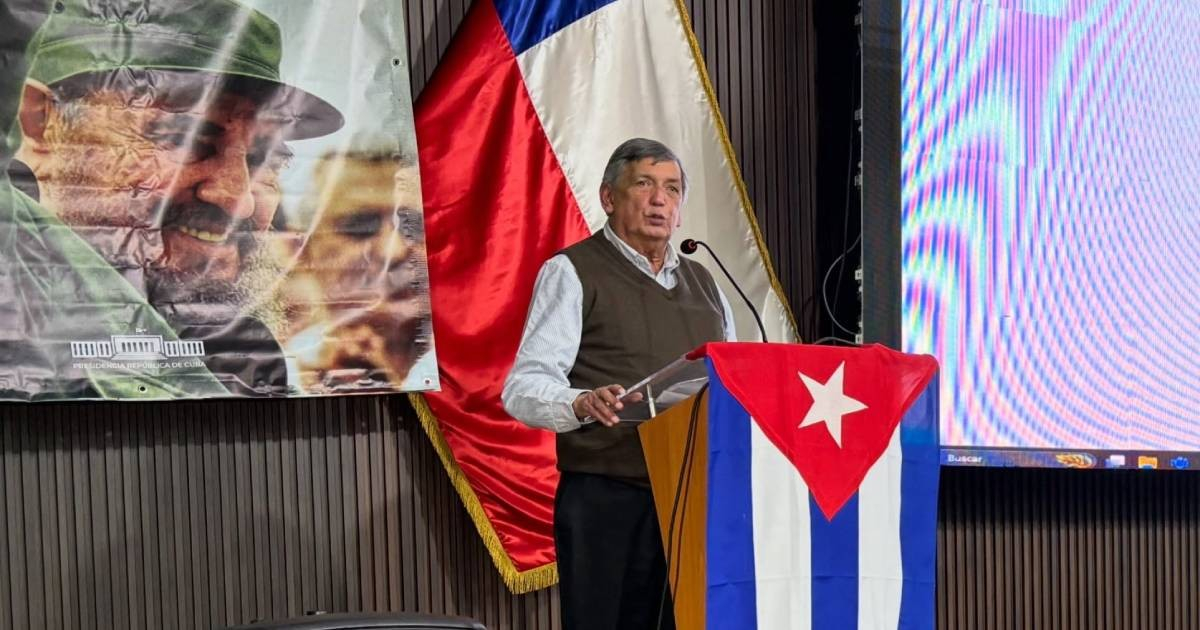
The head of Chile's Communist Party, Lautaro Carmona, recently expressed that Cuba represents a "democratic system from a historical perspective." This statement was made during an interview with El Mercurio, just days before his scheduled trip to Havana for an international event dedicated to Fidel Castro.
Carmona, along with the party's general secretary, Bárbara Figueroa, plans to attend the first International Colloquium "Fidel: Legacy and Future," set to take place from August 10 to 13. This event is part of the activities commemorating the centenary of the Cuban dictator's birth, as reported by T13.
Defending Cuba's Political System
In the interview, Carmona defended Cuba's political framework and justified the existence of a single-party system by referencing Cuba's independence history. "Why is there a one-party system? It dates back to Martí's era when the Cuban people needed to organize to expel the Spanish," he explained.
He also placed Fidel Castro among the key figures in the international communist movement, stating, "Fidel is a significant reference for the 20th-century communist movement; alongside Lenin, Fidel stands as a major figure, along with Mao and Ho Chi Minh."
Contrasting Views and Political Reactions
These remarks stand in contrast to the views expressed during Chile's 2025 presidential campaign when the then Communist Party candidate, Jeannette Jara, acknowledged that "Cuba is not a democracy." When questioned about this discrepancy, Carmona asserted that the party's historical stance is not swayed by electoral considerations, saying, "The Communist Party's historical opinion is not flexible to gain or lose a vote."
Carmona's comments have drawn criticism from various Chilean political sectors. Former deputy Pepe Auth criticized Carmona on social media for praising figures like Fidel Castro, Lenin, Mao Zedong, and Ho Chi Minh, ignoring the harsh realities of the dictatorships they inspired over the past fifty years.
International Criticism and Internal Disputes
From the right-wing opposition, UDI deputies labeled the trip to Cuba as "unjustifiable," while Libertarian National Party deputy Cristóbal Urruticoechea claimed Fidel Castro led a dictatorship whose repercussions are still felt by the Cuban people.
Meanwhile, Bárbara Figueroa dismissed the criticism, alleging a "double standard," arguing that such objections only arise when leftist leaders engage in international activities.
Carmona’s statements also clash with evaluations by international entities regarding Cuba's political system. According to Freedom House's Freedom in the World 2026 report, Cuba scored 9 out of 100, receiving zero points for political rights, maintaining its status as a "Not Free" country.
The 2019 Cuban Constitution designates the Communist Party of Cuba as the "superior guiding political force of society and the State," with no legal recognition for opposition parties.
Historical Defense of the Cuban Regime
This is not the first time Carmona has defended the Cuban regime. In January, he publicly criticized then-Chilean President Gabriel Boric after Boric labeled Cuba a dictatorship in an interview with the Spanish newspaper El País. That same month, Carmona visited Havana and met with Miguel Díaz-Canel and other senior leaders, who conveyed that Cuba is facing "the most complex moment in its history since the Revolution, including the Bay of Pigs invasion."
In April 2026, Chile's General Comptroller questioned the University of Chile for allowing its facilities to host an event where Carmona participated, honoring Cuban soldiers killed during the operation that captured Nicolás Maduro.
Currently, the Chilean Communist Party finds itself in opposition following the election of the ultra-conservative José Antonio Kast in March 2026. His administration has openly criticized the Cuban regime and, in June 2026, declared its support for a potential U.S. intervention in the island nation.
Cuba's Political System and International Perceptions
Why does Lautaro Carmona consider Cuba a democracy from a historical perspective?
Carmona argues that Cuba's one-party system is rooted in its historical need for unity during the struggle for independence, dating back to Martí's era, where organization was necessary to expel Spanish colonial forces.
How has the international community rated Cuba's political freedom?
International organizations, such as Freedom House, have rated Cuba poorly in terms of political freedom, categorizing it as a "Not Free" country with a score of 9 out of 100 in their Freedom in the World 2026 report.