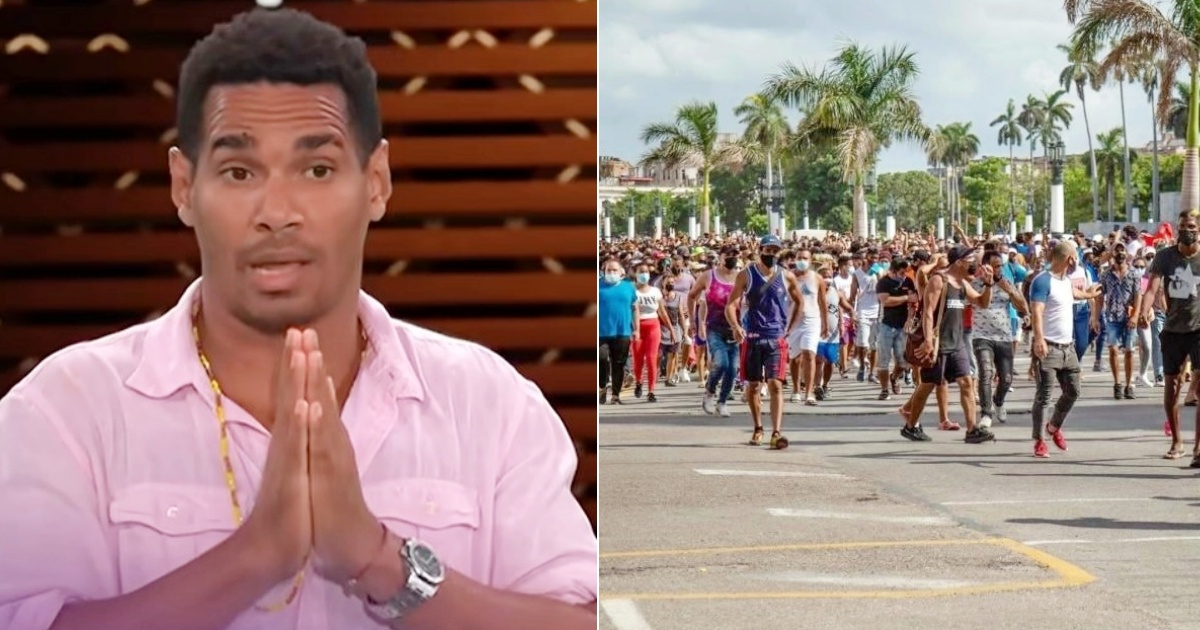
Luis Manuel Otero Alcántara, the founder of the San Isidro Movement, has issued a stark warning about the state of affairs in Cuba. In a recent interview with EFE, he suggested that the country is ripe for a social upheaval that could eclipse the massive protests seen on July 11, 2021, the largest in nearly 30 years.
The 38-year-old artist arrived in Miami on July 18, after serving a five-year prison sentence at the Guanajay facility. His release was contingent on permanent and forced exile, as he was imprisoned for "contempt, public disorder, and insult to national symbols."
Conditions Ripe for a Major Social Uprising
Speaking candidly to EFE, Otero Alcántara described the current climate in Cuba as a powder keg: "The conditions are set for a decisive social uprising in Cuba that could topple the dictatorship. It is up to us—the thinkers, artists, civic activists, and politicians—to organize and guide the people."
He emphasized that the base of support willing to protest has expanded significantly since 2021: "Cuba's situation is so dire now that a social explosion similar to or larger than that of July 11 could happen any time. People who were once aligned with the system or indoctrinated are now disillusioned and ready to join the movement."
Otero Alcántara's Ideal Vision for Cuba
Despite the potential for unrest, Otero Alcántara remains committed to non-violence: "The ideal scenario for me, as a pacifist, involves nine million Cubans taking to the streets to claim their future. Will it happen? Hopefully. Do we need international support? Yes."
International Influence and Support
Otero Alcántara expressed gratitude towards the Trump administration for the humanitarian parole granted on July 17, 2026, which allowed his departure from Cuba. He also acknowledged Marco Rubio's public welcome in Miami and his call for the release of over 700 political prisoners on the island.
He remarked on the credibility gap between Cuban authorities and Washington: "People trust the words of Donald Trump and Marco Rubio more than those of Cuba's president, Miguel Díaz-Canel. When Trump imposed sanctions, it was met with gratitude by Cubans."
When asked about supporting a military intervention for change, his response was nuanced: "I would back any action that improves the Cuban reality, but it should be rooted in pacifism and aligned with the desires of those who want change now."
Maykel Osorbo's Continued Imprisonment
Otero Alcántara also spoke about his fellow San Isidro Movement member, Maykel Osorbo, who remains imprisoned in Guanajay despite being granted humanitarian parole by the U.S. on July 21. Osorbo is serving a nine-year sentence set to end in 2030.
Speculating on why the regime refuses to release Osorbo, Otero Alcántara stated: "They might fear his influence if he joins the current wave of momentum. His presence could be pivotal."
In an earlier interview, he elaborated on the regime's cautious approach: "They likely have better insights than we, the opposition, about Cuba's reality. They understand the impact of the San Isidro Movement, Maykel Osorbo, and Luis Manuel Alcántara."
Art and Action in Florida
Upon arriving in Florida, Otero Alcántara plans to blend art with political activism. He aims to publicly display over 4,000 paintings created during his imprisonment, organize a collective mural with political prisoners, and perform acts to highlight the suffering of the Cuban people.
"These artworks are testimonies of five years filled with injustices, suffering, frustrations, and a suffocating sense of confinement that almost leads to death," he described.
Otero Alcántara's vision of a free Cuba includes the ability to exhibit at the National Museum of Fine Arts and critique the government without facing imprisonment.
Understanding the Potential for Social Unrest in Cuba
What factors contribute to the potential for a larger social uprising in Cuba?
The critical economic and social conditions, along with growing disillusionment among those previously aligned with the regime, contribute to the potential for a larger social uprising in Cuba.
Why is Luis Manuel Otero Alcántara advocating for non-violence?
Otero Alcántara, a self-proclaimed pacifist, believes that a non-violent approach involving mass public participation is the most effective way to achieve meaningful change in Cuba.
What is the significance of Maykel Osorbo's continued imprisonment?
Maykel Osorbo's imprisonment underscores the regime's fear of his influence and the momentum he could bring to the opposition movement if released.