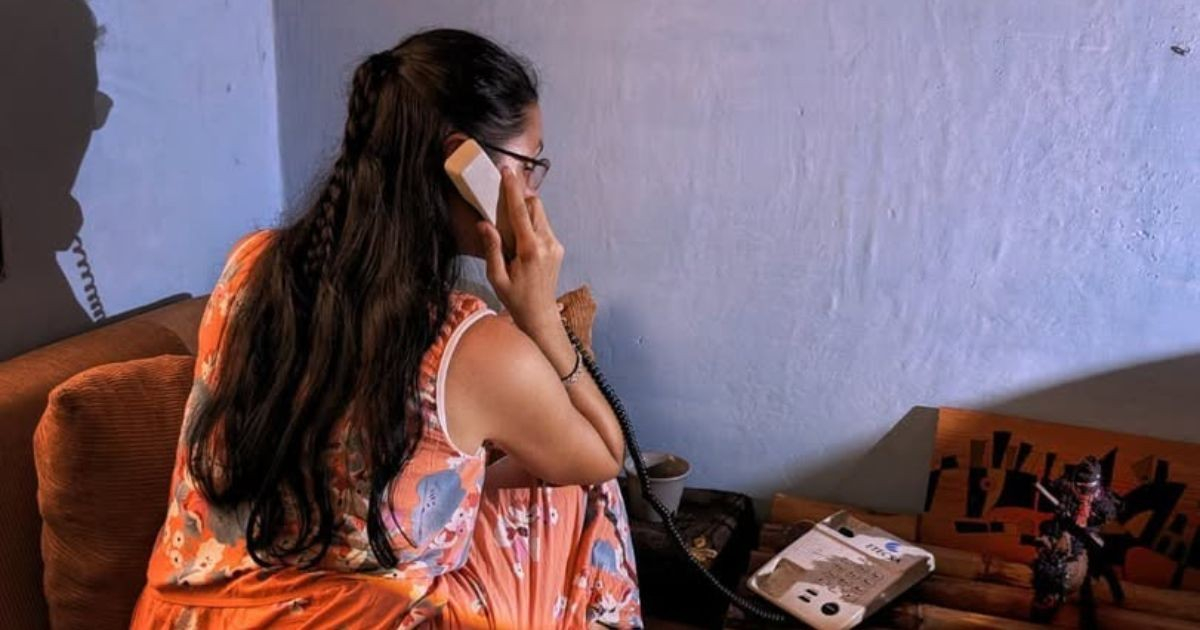
The Cuban intellectual, Isabel Cristina López Hamze, who is a theatrologist and professor at the University of the Arts (ISA) in Havana, has crafted a piece of poetic prose envisioning her hypothetical departure from Cuba. Released this past Sunday, her work employs the recurring motif of "The house remains empty," serving as a poignant reflection of the collective pain caused by the massive migration leaving homes across the island desolate.
Despite clarifying her lack of intention to emigrate, López Hamze was moved by the departure of several close acquaintances within a single month. "This month, several people close to me have left, and it's inevitable to feel a sense of abandonment mingling with my happiness for them. I don't want to leave, but I am interested in stepping into the shoes of those who do because my dream is to write novels. Imagining my own departure, I penned this text," she explained.
A Poetic Inventory of What Remains
The result is a poetic enumeration of the items that would be left behind: the grandmother's rocking chair swaying in the wind "as if a ghost sat in it every afternoon," the couch where the cat and visitors from around the world once slept, the pot used for frying pork rinds, and the porch swing "where we dreamt of children who never came to be."
Each detail carries a distinct domestic narrative: the bicycle tire that punctured during a trip to the Gran Piedra, kept because "it was lovely to preserve that memory," the bathroom tiles set with "improvised cement," the empty clotheslines, and the corroded water tank still in use "because we had no alternative."
Solitude Even in Occupation
The text reaches its emotional peak when López Hamze suggests that even if identical new occupants were to inhabit the house, it would still remain solitary: "And if we decided to stay in the house, sealing doors and windows, filling every gap with wads of paper so we couldn't leave... the house would still be alone."
The metaphorical closure pushes the imagery to its limits: "To save it from loneliness, the house would have to be burned with all its scents inside. Yet, even as ashes dispersed in the air, our solitary home would fall over the city. It would drift over people's heads, over other houses, over its own abandoned memory."
Demographic Realities Mirror the Poetic Narrative
This micro-narrative resonates with an unparalleled demographic reality. According to the National Office of Statistics and Information, in 2025, Cuba experienced a net migration loss of 245,264 people, with 317,320 emigrants against just 72,056 immigrants.
Compounding this issue is a negative natural growth: only 68,051 births versus 134,354 deaths in 2025, meaning Cuba's population dwindles both due to emigration and aging. The island's population closed that year at 9,434,593, significantly lower than the approximately 11.3 million before the rapid exodus following the July 11, 2021 protests. Independent specialists estimate the current population may even be below 8.1 million.
Approximately 80% of those who emigrate are aged between 15 and 59, exacerbating the aging population and straining the pension system. In 2025, the most significant population losses were reported in Havana, with 57,433 people, followed by Santiago de Cuba, Holguín, and Matanzas.
The exodus spares no demographic. Artists and intellectuals have fled the island, driven by incessant power outages, chronic shortages of food and medicine, and persistent inflation. Musician William Vivanco emigrated to Spain in January 2025, declaring that Cuba has "no future" for artistic work. In July 2026, visual artist Luis Manuel Otero Alcántara left for Miami after five years in prison, describing his departure as a forced expulsion.
About 38% of Cuban families have at least one member living abroad. López Hamze's piece circulated on social media, resonating with Cubans both on the island and overseas, who saw in those everyday objects—the rocking chair, the pot, the rusty tank—their own stories of leaving or waiting, capturing with precision what no statistic can: the silent emptying of homes left behind by the exodus.
Understanding Cuba's Migration Crisis
What motivates the current wave of migration from Cuba?
The exodus is driven by factors such as economic hardship, persistent power outages, food and medicine shortages, and inflation, pushing individuals, including artists and intellectuals, to seek better opportunities abroad.
How has Cuba's population been affected by migration?
Cuba's population has significantly decreased due to both migration and natural decline, dropping to about 9.4 million in 2025 from approximately 11.3 million before 2021, with independent estimates suggesting it could be below 8.1 million now.
What percentage of Cuban families have members living abroad?
Approximately 38% of Cuban families have at least one member residing outside the country, highlighting the widespread impact of emigration on Cuban society.