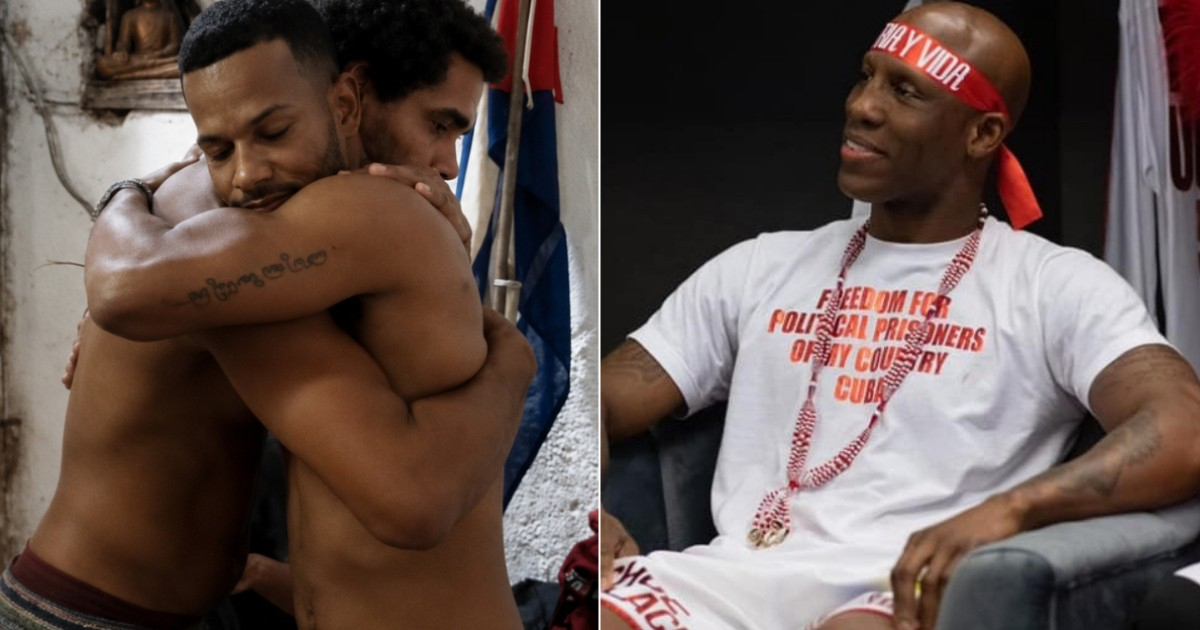
Former world boxing champion Yordenis Ugás publicly defended Luis Manuel Otero Alcántara, leader of the San Isidro Movement (MSI), against criticism he faced upon arriving in Miami looking physically well. Ugás accused the Cuban regime of orchestrating this image to divide the Cuban exile community.
In a post on X, Ugás shared that he visited Otero Alcántara with his mother to hug him and convey their family's and neighbors' gratitude from Cuba. "Cubans don't unite for anything," Ugás remarked, clearly frustrated by the low turnout to welcome the activist, whom he hailed as a "Cuban hero who spent over five years in prison."
Challenging Skepticism
Ugás addressed those questioning Otero Alcántara's credibility due to his healthy appearance. "Some Cubans are so twisted that they needed Luis Manuel to arrive in a wheelchair, seriously ill, and broken down," Ugás expressed.
The boxer offered a straightforward explanation: the regime knew precisely what it was doing. "Not everyone is the same, and since he was a well-known prisoner, it didn't suit the dictatorship to release him looking thin and sickly, exactly to foster distrust among some," he argued.
A Calculated Move by the Regime
To Ugás, this strategy is another victory for the regime. "The dictatorship once again gets its way. They haven't been there for 68 years without reason," he stated.
Otero Alcántara, co-founder of the MSI, arrived in Miami on July 19 after serving five years in Guanajay's maximum-security prison in Artemisa. He was arrested during the July 11, 2021 protests and sentenced for "insulting national symbols," "contempt," and "public disorder."
The Controversial Exile
His release was far from straightforward: although his sentence formally ended on July 9, 2026, the regime moved him to an unknown location on July 7—a move Amnesty International condemned as enforced disappearance—and conditioned his freedom on permanent and irrevocable exile from Cuba.
Upon his Miami arrival, Otero Alcántara made it clear: "I was expelled from Cuba." Back in January 2022, while still imprisoned, he had publicly stated, "I will die here," rejecting any notion of exile.
Otero Alcántara's exile sparked debate on social media, with some questioning both his appearance and his acceptance of exile.
Activist José Daniel Ferrer also defended him, demanding respect for someone with "many days of brave history," as he put it.
Ugás, known for his political activism—from publicly challenging Díaz-Canel in 2022 to celebrating Ferrer's Miami arrival in October 2025—concluded his message by reaffirming his commitment: "We will continue to demand freedom for all political prisoners. And we will keep denouncing the Cuban dictatorship. God, Homeland, Life, Freedom."
Understanding the Cuban Exile Controversy
Why did Ugás defend Luis Manuel Otero Alcántara?
Ugás defended Otero Alcántara to counter the criticism he received for his healthy appearance upon arriving in Miami, and to highlight the regime's manipulation intended to create division among Cubans.
What was the regime's strategy regarding Otero Alcántara's release?
The regime released him in a healthy state to prevent public sympathy and distrust, as it wouldn't benefit them to show him as a victimized prisoner.
How did Otero Alcántara respond to his exile?
Otero Alcántara acknowledged his forced exile by stating, "I was expelled from Cuba," despite previously vowing to die in his homeland rather than leave.