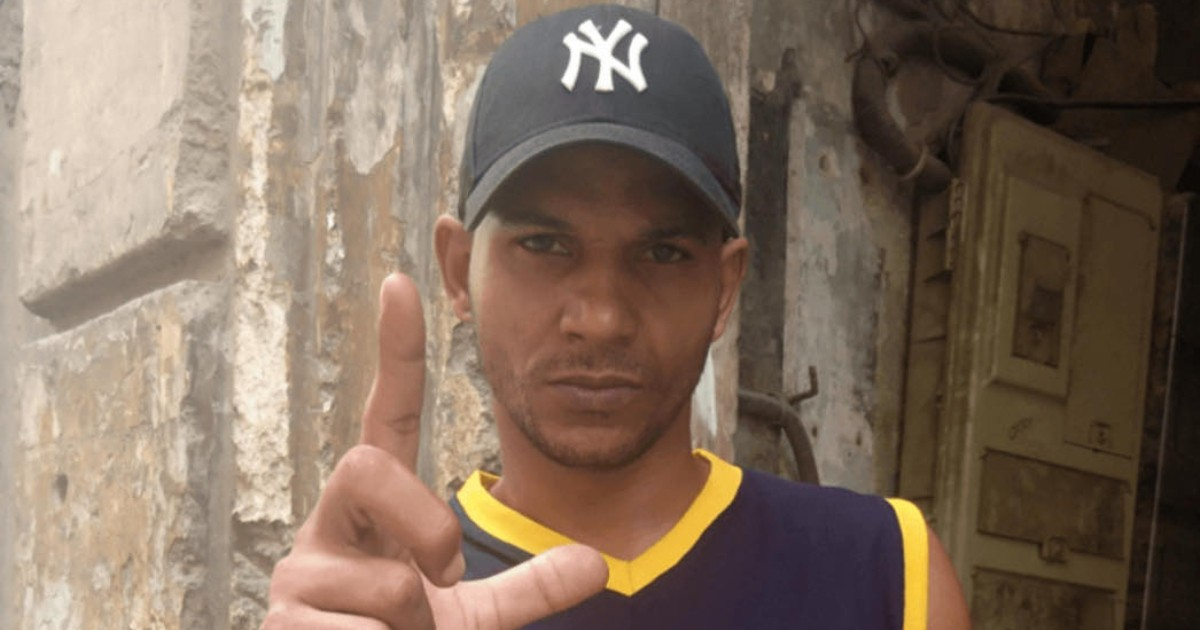
This Tuesday, the Cultural Rights Observatory and activist Anamely Ramos announced that the United States has processed and approved a humanitarian parole for Cuban rapper and political prisoner Maykel Castillo Pérez, known as Maykel Osorbo. He remains incarcerated at the maximum-security prison in Guanajay.
The statement revealed that this immigration authorization was managed concurrently with another granted to Luis Manuel Otero Alcántara, his fellow member of the San Isidro Movement. Otero Alcántara arrived in Miami last Saturday after spending five years in prison, forced into exile by the regime as a condition for his release.
“We also announce that alongside the U.S. parole granted to Luis Manuel Otero Alcántara, a similar one was processed and approved for Maykel Castillo Pérez,” stated the Observatory and Ramos in their release.
Ongoing Injustice: The Case of Maykel Osorbo
They explained that the parole was grounded in the belief that his arbitrary detention is politically motivated, infringing on his human rights and his right to free expression and artistic creation.
Unlike Otero Alcántara, Osorbo has not been freed. He is serving a nine-year sentence handed down in June 2022 for charges of assault, resistance, contempt, public disorder, and defamation of institutions. These charges are seen as retaliation for his activism and co-authorship of "Patria y Vida," the anthem of the July 11, 2021 protests. His sentence is set to expire in 2030.
Recent Developments in Osorbo's Case
It was also revealed on Tuesday that Osorbo received his first visit in Guanajay, where he was transferred on July 10 from Kilo 8 prison in Pinar del Río without prior notice to his family.
During the visit, the artist confirmed he was placed in an area known as "la Incrementada," the same cell previously occupied by Otero Alcántara. This move happened just three days after Luis Manuel was removed from that facility, a tactic described by Cubalex as deliberate psychological torture used by the Cuban political police against dissidents.
International Recognition and Calls for Release
In May 2026, State Security agents offered Osorbo the chance to go into exile; he agreed, but the regime did not follow through. He was not included in any of the pardons announced by the Cuban authorities either.
The Inter-American Commission on Human Rights declared his detention arbitrary and politically motivated in Report No. 78/26, recommending the annulment of his sentence and his immediate release. Amnesty International recognizes him as a prisoner of conscience.
The Observatory and Ramos concluded their statement with a direct demand: “We reiterate the immediate demand for the release of Maykel Castillo Pérez and once again denounce the instrumentalization of the Cuban prison system against artists, activists, and critical voices opposing the Cuban Government.”
Understanding the Humanitarian Parole for Cuban Political Prisoners
What is a humanitarian parole?
A humanitarian parole is a special permission granted by the U.S. government allowing individuals to enter the country for urgent humanitarian reasons, even if they do not have a visa.
Why is Maykel Osorbo still imprisoned in Cuba?
Maykel Osorbo remains imprisoned in Cuba due to a nine-year sentence for charges including assault and public disorder, which are widely regarded as retaliatory actions for his activism and involvement in "Patria y Vida."
Who is Luis Manuel Otero Alcántara?
Luis Manuel Otero Alcántara is a Cuban artist and activist, also associated with the San Isidro Movement. He recently arrived in the U.S. after being released from a five-year prison sentence.