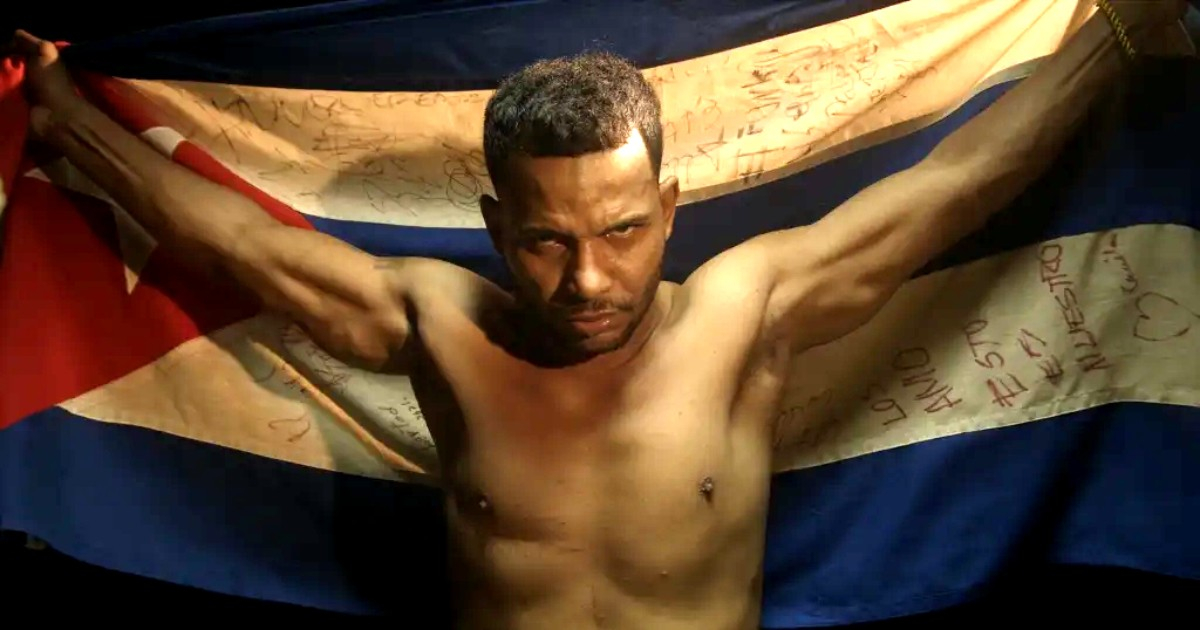
The Legal Information Center, Cubalex, has reported that political prisoner Maykel Castillo Pérez, widely known as "Osorbo," has been relocated from Kilo 8 prison in Pinar del Río to Guanajay prison in Artemisa. He has been held there since July 10.
What makes this transfer particularly unsettling is that the rapper and activist was placed in the very cell previously occupied by his friend and fellow member of the San Isidro Movement, Luis Manuel Otero Alcántara. Otero was removed from that prison on July 7 by State Security agents and subsequently deported to the United States, arriving in Miami on July 19.
Cubalex described this action as another example of the Cuban political police's use of psychological torture against dissidents. They argue that the timing of Otero Alcántara's forced exile and Osorbo's arrival in his former cell is no coincidence.
While the move brings Osorbo geographically closer to Havana compared to his previous incarceration in Pinar del Río, the organization warns that he remains distanced from his home and family, with no official explanation given for the transfer.
According to Cubalex, this practice is part of a systematic pattern: prison transfers are used as an additional punitive measure to complicate family contact and worsen incarceration conditions. This is particularly harsh in a country where the collapse of public transportation and frequent power outages make it nearly impossible for families to travel long distances to visit their loved ones or provide them with food, medicine, and hygiene products.
The organization's report highlights that this marks the fourth consecutive episode of isolation for Osorbo, who was moved to Kilo 8 in January 2026 under accusations of planning a riot, without prior notification to his family.
Maykel Castillo Pérez is serving a nine-year sentence handed down in June 2022 for charges of assault, resistance, contempt, public disorder, and defamation of institutions. This sentence is seen as retaliation for his activism and his role as a co-author of "Patria y Vida," the anthem of the July 11, 2021 protests.
The Inter-American Commission on Human Rights (IACHR), in its Report No. 78/26, declared his detention arbitrary and politically motivated, recommending the annulment of his sentence and his immediate release. Amnesty International recognizes him as a prisoner of conscience.
His sentence is set to expire in 2030, and he was not included in any of the recent pardons announced by the Cuban regime.
Cubalex has demanded that Cuban authorities cease using prison transfers as a tool of retaliation and isolation against individuals imprisoned for political reasons, and respect the right of inmates to maintain contact with their families.
Key Questions on Maykel Osorbo's Transfer and Imprisonment
Why was Maykel Osorbo transferred to Guanajay prison?
The reasons for Maykel Osorbo's transfer to Guanajay prison have not been officially disclosed. Cubalex suggests that it is part of a systematic pattern of using prison transfers as a punitive measure against political dissidents.
What is the significance of Osorbo being placed in Otero Alcántara's former cell?
Osorbo's placement in Otero Alcántara's former cell has been described by Cubalex as a form of psychological torture, suggesting coordinated efforts by the Cuban regime to intimidate political activists.