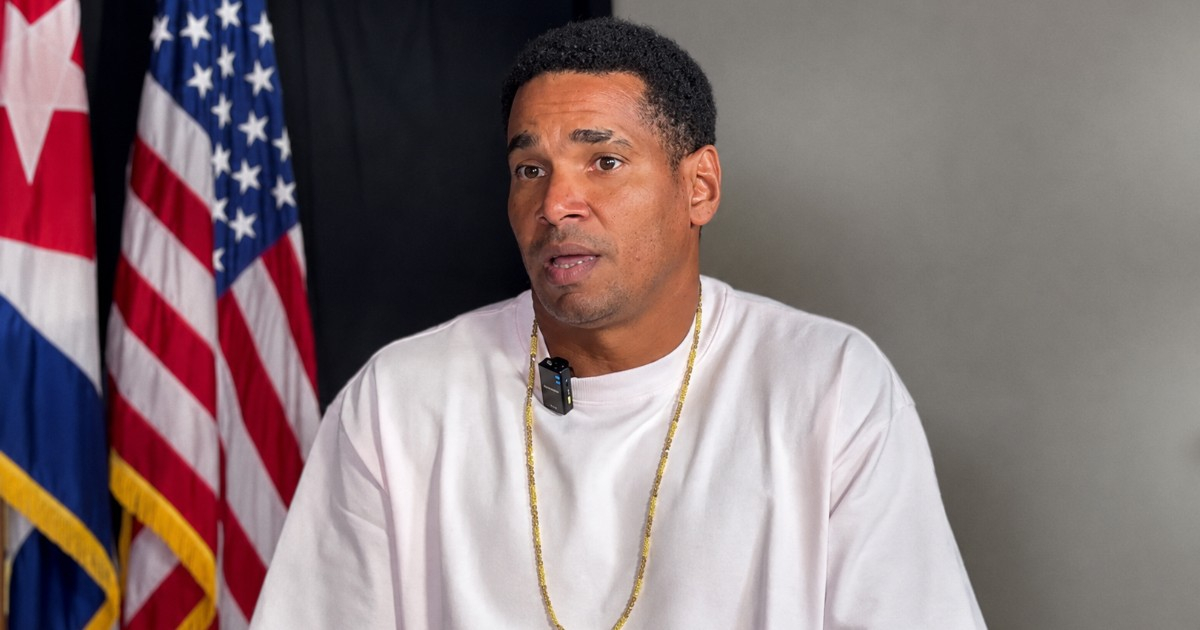
On Monday, Luis Manuel Otero Alcántara disclosed that the days leading up to his departure from Cuba were not spent in freedom, but rather in a different form of detention. After being released from Guanajay prison on July 7, State Security transferred him to a house near Guanabo, where he was kept under watch as his entry into the United States was being processed.
"I was still a prisoner. They were simply taking me to another place," the artist and founder of the San Isidro Movement stated in an interview with Martí Noticias.
Otero Alcántara arrived in Miami this past Saturday after enduring five years as a political prisoner in Cuba. His entry into the U.S. was permitted following the approval of an individual humanitarian parole on July 17. This request was filed using form I-131 with the U.S. Citizenship and Immigration Services (USCIS) after several weeks of efforts.
While in Guanabo, he managed to bid farewell to some family and friends, yet he noted that every conversation was recorded. He considered himself still imprisoned, as he was under the vigilant eye of State Security. Various international organizations labeled his situation as a "forced disappearance."
Insights During Confinement
The artist revealed that officials used those days to gauge his emotional state and future plans, as well as to assess his willingness to negotiate. He emphasized that the authorities were aware they couldn't keep him isolated indefinitely due to international pressure and interventions by global organizations.
Following his move from Guanajay and the completion of his sentence, the United Nations Committee on Enforced Disappearances initiated an Urgent Action on his behalf. At the same time, Amnesty International condemned his state as a forced disappearance and demanded his immediate and unconditional release.
Otero Alcántara acknowledged that footage from those days could potentially be used to discredit him. "I love cameras," he remarked. "Using it against me depends on the perception of us who are building narratives," he added.
Exile as the Sole Option
The founder of the San Isidro Movement stated that from the outset of his imprisonment, State Security made it clear that accepting exile was the only way to gain his freedom. He was forced to leave Cuba permanently as a condition for his release, despite having fully served his sentence. Otero Alcántara chose the United States due to its proximity to Cuba and because some of his family reside there.
During the interview, the dissident artist shared that painting was his main solace during the five years of incarceration. Despite the isolation and the confiscation of some of his works, he continued to create art. "If they took all my paintings, at least 20 people changed with the works we did in prison," he said, highlighting the impact his art had on fellow inmates.
When asked why authorities allowed him to keep painting and to remove much of his art from prison, he responded: "Because I was dying, and they didn't want me dead."
Call for El Osorbo's Freedom
Otero used part of his conversation with Martí Noticias to advocate for the release of rapper and political prisoner Maykel Castillo Pérez, known as El Osorbo, who is serving a nine-year sentence. The musician was transferred on July 10 from Kilo 8 prison in Pinar del Río to the maximum-security prison in Guanajay without prior notice to his family.
He criticized the Cuban regime for continuing to use political prisoners as bargaining chips. Regarding Cuba's political future, he expressed that he does not foresee an immediate resolution but rather the beginning of a longer transition process. "I don't think there's an end. I think there's a transition, and transitions lead to evolution," he stated.
The artist also mentioned discussions with other inmates about the potential for U.S. military action against the Cuban regime. "People want something to happen. People are eager for something to happen," he expressed.
Otero announced that he will persist in developing his art and activism from exile, focusing on the liberation of political prisoners and increasing international awareness of Cuba's situation. "We will keep working and won't waste a minute, because every minute lost is another minute of dictatorship," he concluded.
Frequently Asked Questions about Luis Manuel Otero Alcántara's Situation
Why was Luis Manuel Otero Alcántara kept under state surveillance before leaving Cuba?
He was kept under surveillance as part of a continuation of his detention, despite being moved from prison to a house near Guanabo while his entry to the United States was being processed.
What led to Otero Alcántara's release from Cuban detention?
His release was facilitated by an individual humanitarian parole granted by U.S. authorities, following international pressure and advocacy from various organizations.
What role did art play in Otero Alcántara's imprisonment?
Art was a vital coping mechanism for him during his imprisonment. Despite challenges, he continued to create and share his works, which had a transformative impact on fellow inmates.
What are Otero Alcántara's plans following his arrival in the United States?
He plans to continue his artistic and activist efforts from exile, focusing on the freedom of political prisoners and raising awareness of the Cuban situation globally.