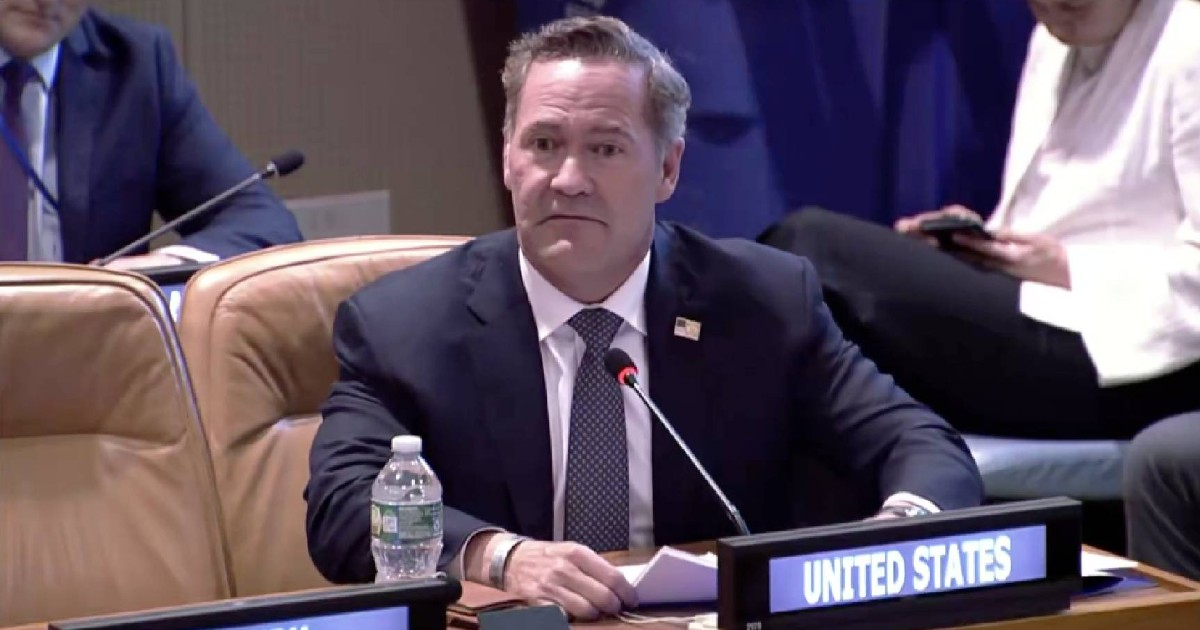
On Saturday, Mike Waltz, the U.S. ambassador to the United Nations, commemorated the fifth anniversary of the July 11th protests with a strong message of solidarity for Cuban political prisoners and condemnation of the Havana regime.
“Five years ago, the Cuban people took to the streets demanding freedom. The regime responded with batons, prison cells, show trials, and fear. Today, over 800 political prisoners remain behind bars: artists, rappers, poets, parents, daughters, brothers. They dared to voice what millions know: Cuba deserves to be free. We stand with them. Patria y Vida,” Waltz declared from his official account @USAmbUN on X.
This message was part of a week filled with diplomatic activity for the ambassador regarding Cuba. On July 7, during a special session of the UN General Assembly convened by the Cuban regime to discuss the U.S. embargo, Waltz displayed photographs and read the names of political prisoners to the member nations.
During the same session, the ambassador engaged in a tense exchange with Cuban Foreign Minister Bruno Rodríguez, who attempted to interrupt him as he highlighted the plight of the detainees.
“Stand with the Cuban people, not with the regime that has broken this country. You can’t do both. It’s time to choose,” Waltz urged the representatives of the attending nations.
The following day, on July 8, the U.S. formally demanded the release of political prisoners at the UN, citing more than 775 individuals jailed for peaceful activism.
Among the cases highlighted were rapper Maykel “Osorbo” Castillo Pérez, co-author of “Patria y Vida,” sentenced to nine years, and poet Duannis León Taboada, 24, sentenced to 14 years and held in solitary confinement at Combinado del Este.
The fifth anniversary of July 11 comes amid record levels of repression. Prisoners Defenders documented 1,306 political prisoners in Cuba as of July 9, 2026, the highest number recorded to date. At least 338 of them remain imprisoned for crimes directly linked to the 2021 protests.
The most notable case is that of Luis Manuel Otero Alcántara, leader of the San Isidro Movement, whose five-year sentence formally expired on July 9, yet he remains missing after being transferred from Guanajay prison without notifying his family. Amnesty International labeled the situation as a forced disappearance on July 10.
This Saturday, the U.S. Embassy in Havana also called for the release of the political prisoners, and representative Mike Hammer met with families of the July 11 detainees in Cuba.
Senator Marco Rubio warned that Washington will use "all available tools" to push for reforms on the island and demanded the immediate release of the political prisoners.
The pardon announced by the regime in April 2026 for more than 2,000 inmates explicitly excluded those convicted of "crimes against authority," the legal figure used to criminalize the July 11 protesters, leaving hundreds imprisoned precisely for taking to the streets five years ago without any benefit. The organization Justicia 11J encapsulated the significance of the date with a powerful statement: “No cause can advance if it abandons the prisoners.”
Key Questions About Cuban Political Prisoners
Who is Mike Waltz?
Mike Waltz is the U.S. ambassador to the United Nations, actively advocating for the release of Cuban political prisoners.
What is the significance of the July 11th protests in Cuba?
The July 11th protests, known as 11J, marked a significant uprising where thousands of Cubans demanded freedom and reform, leading to widespread crackdowns by the regime.
How many political prisoners are currently in Cuba?
As of July 9, 2026, there are 1,306 documented political prisoners in Cuba, according to Prisoners Defenders.