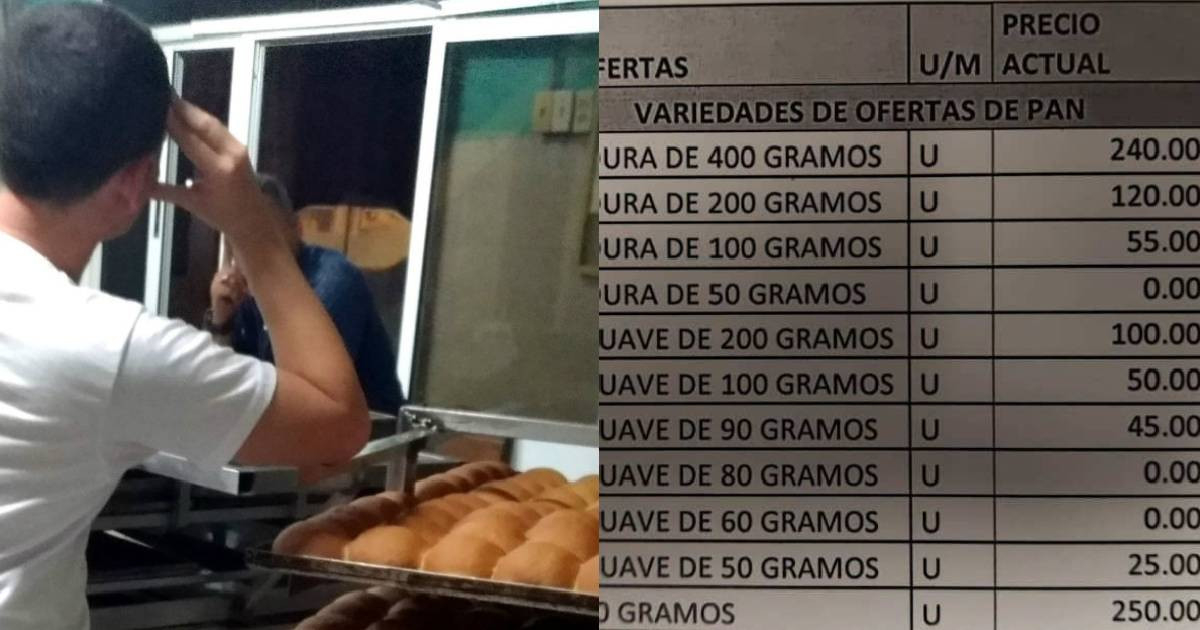
In a controversial move, the Municipal Assembly of Popular Power in Centro Habana officially announced new bread prices a week after local bakeries began charging significantly higher rates. This delay has sparked criticism from citizens, who argue that their salaries are insufficient to afford even a few loaves per month.
The announcement, made on the government's Facebook page, unleashed a storm of complaints from frustrated Cubans. Many expressed concern about the negative impact of the price hike on a population already struggling with inflation and diminishing purchasing power.
The outrage was not only directed at the price increase itself but also at the timing of the announcement. The new rates were implemented on July 2, yet it took more than a week for the official confirmation to be released, leaving many consumers shocked at the bakeries.
"Elderly folks arrived with their bags expecting to pay 120 pesos for bread, only to find it costs 250. They had no choice but to leave empty-handed," lamented one user, questioning why the notification came after the increase had already taken effect.
Public Discontent Over Bread Prices
A widely shared comment highlighted the economic strain on Cubans: "Our wages now cover just six loaves of this hard-crust bread weighing 400 grams. We're progressing with increased resistance."
The plight of retirees was a focal point of concern. "Which retiree can afford bread? Or which worker living on a meager salary can buy bread daily for their children's snacks? It's truly frustrating," wrote another user.
One mother described the new bread price as "outrageous," noting that it was one of the few foods families could afford for their children's breakfast. "It was the only thing we could buy to feed our kids in the morning," she pointed out.
State Accountability and Public Reaction
Some users blamed the government directly for the price surge. "This price reflects all the state's inefficiencies," commented one individual, while another summed up the vicious cycle Cubans face: "The government is the first to raise prices. What's the point of slightly increasing salaries if prices continue to soar?"
Irony colored many reactions. "Always thinking of the people," quipped one commenter. Another added, "Consider that it could be worse... they could have priced it in USD, but in consideration of the public, they didn't."
A third person remarked, "We used to buy little due to the poor quality of bread; now we can buy even less because of its high cost. I can afford eight loaves a month. This is the land of the absurd."
Economic Challenges and Bread Production
The Cuban Bread Company nearly doubled the price of various products in Havana. The 400-gram hard-crust loaf jumped from 240 to 500 Cuban pesos, an increase of 108%, while the 200-gram loaf went from 120 to 250 pesos and the 500-gram sandwich bread rose from 250 to 550 pesos.
With a new minimum wage of 3,210 pesos, effective from July 1 but payable in August, a worker can buy just about six loaves of the 400-gram hard-crust bread per month. The situation is even more dire for retirees, whose minimum pension is 3,056 pesos.
This price hike occurs amidst the decline of the state-run bread production system. In 2025, national production fell by 100,900 tons, and 17 companies in the sector reported losses totaling 364 million pesos. Consequently, more Cubans are turning to baking bread at home as prices continue to rise and access to this staple food becomes increasingly limited.
Understanding the Impact of Bread Price Increases in Cuba
Why did the bread prices in Havana increase so significantly?
The increase in bread prices is attributed to the inefficiencies within the state-run production system and the broader economic challenges Cuba is facing, including inflation and a decrease in national production.
How are the new bread prices affecting Cuban citizens?
Many Cubans are struggling to afford basic food items as their salaries have not increased in line with rising prices. The bread price hike adds further strain, particularly on retirees and low-income families who rely on these staples.
What has been the public reaction to the delayed announcement of the price hike?
The public has reacted with frustration and anger, not only at the increased prices but also at the delay in the official announcement, which left many surprised and unprepared for the cost at local bakeries.