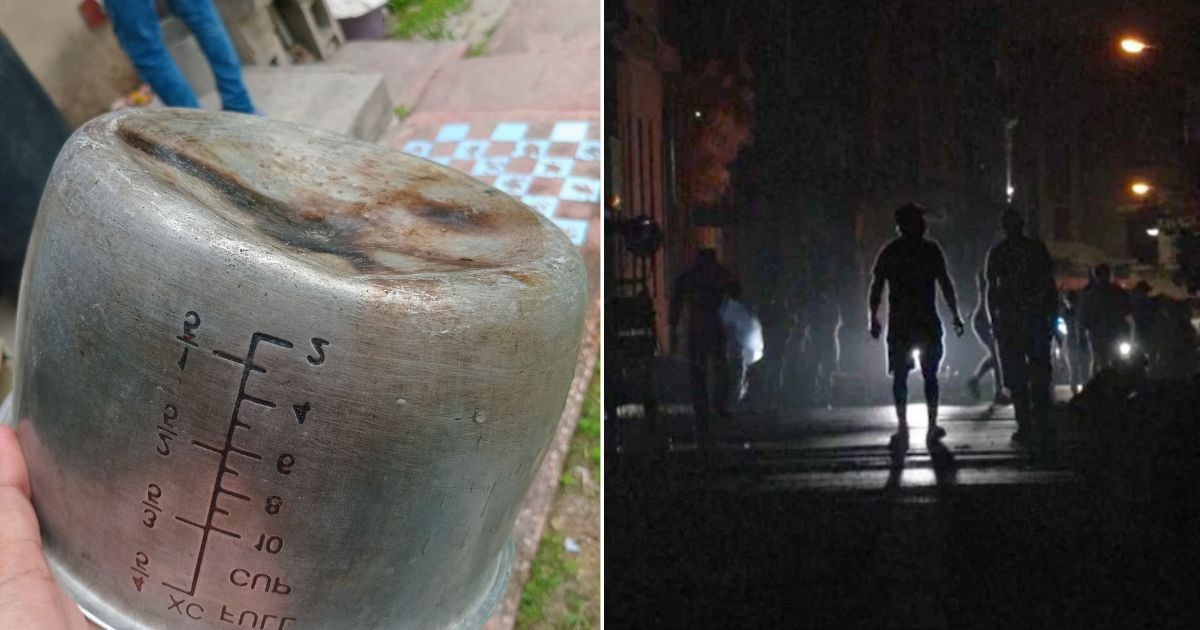
Cuban writer, linguist, and translator Rodolfo Alpízar Castillo shared a biting commentary on Facebook titled "Cuban Cubanism?" this past Sunday. His post humorously critiques the Cuban regime's hypocritical stance on cacerolazos—a form of protest using pots and pans. While similar protests abroad are labeled as "public discontent," those within Cuba are dismissed as a quaint expression of national character.
The post was sparked by an interview Miguel Díaz-Canel granted to Puerto Rican newspaper CLARIDAD, a publication known for its sympathetic views toward the Cuban government. When asked why Cuba hadn't seen a social upheaval, Díaz-Canel brushed off the question, attributing the noise of banging pots and pans to a mix of genuine frustration and national quirks. He suggested, sarcastically, that Cubans should direct their protests at the "northern neighbors" responsible for the blackouts.
Alpízar, a respected figure among the cultural institutions in Cuba and a past recipient of the Distinction for National Culture, highlights the irony with a feigned naiveté. He notes that when protests occur in other countries against inflation, Cuban state media eagerly covers them as "manifestations of popular discontent against government policies."
However, when Cubans resort to clanging their cookware from within their homes—since taking to the streets could lead to imprisonment despite constitutional rights—the state media turns a blind eye, labeling these acts as mere "Cuban Cubanism."
The Double Standard Exposed
Alpízar extends the regime's logic to a hypothetical scenario: if pots and pans were banged in Argentina tomorrow, would it also be rebranded as "Argentinian Cubanism"? He wraps up his critique with an exasperated quip, "Man, I'm too old for this, I can't grasp something so simple."
The irony of the post underscores admissions Díaz-Canel made in the same interview: "There's a lack of transportation, food, medicine here, and the power outages last over twenty hours. No one can be happy under these conditions, the people are suffering." Yet, he places the blame solely on the U.S. embargo, absolving the regime of any responsibility.
Reality on the Ground
On the streets, the truth is starkly different from the regime's narrative. Cuba faced its largest-ever power generation deficit of 2,208 MW on June 25, leaving nearly 70% of the country in the dark. The Cuban Conflict Observatory recorded 1,311 protests in May 2026 alone, the highest monthly total on record, and 107 street protests in June, nearly twice the previous high.
The government's response involved military deployment, armed security forces, police operations, and internet blackouts. Cubalex documented at least 38 arrests in June, including six minors. A resident of Zamora, Marianao, protesting after over 24 hours without power, aptly summarized: "They have fuel to patrol and repress the neighborhood, but not to ensure basic services for the country."
On social media, Cubans mirrored Alpízar's irony. One commenter noted, "Full pots don't make noise; they bang because of hunger and the yearning for freedom." Another sarcastically warned, "Just don't start arresting people, since he himself authorized it." A succinct remark read, "The height of cynicism."
This isn't the first critique Alpízar has directed at the government. Earlier, on June 13, he publicly posted five demands on Facebook—amnesty, freedom of expression, abolition of the death penalty, transparency, and a plebiscite—requests the regime can't easily dismiss as "imperialist mercenary" rhetoric. Meanwhile, Díaz-Canel concluded his interview with his standard resolve: "We will not surrender."
The Economic Commission for Latin America and the Caribbean (ECLAC) forecasts a 6.5% contraction in Cuba's GDP for 2026, the most severe in Latin America, with some economists predicting an even worse outcome.
Understanding Cuba's Political Climate and Public Discontent
What is the significance of "cacerolazos" in Cuba?
"Cacerolazos" are protests where participants bang pots and pans to express discontent, often due to economic hardships and political issues. In Cuba, they symbolize popular frustration with the regime.
How has the Cuban government reacted to recent protests?
The government has responded with increased militarization, police operations, and internet blackouts, alongside several arrests, including minors.
What are the economic projections for Cuba?
ECLAC projects a 6.5% contraction in GDP for Cuba in 2026, marking the worst economic performance in Latin America, with some forecasts indicating even steeper declines.