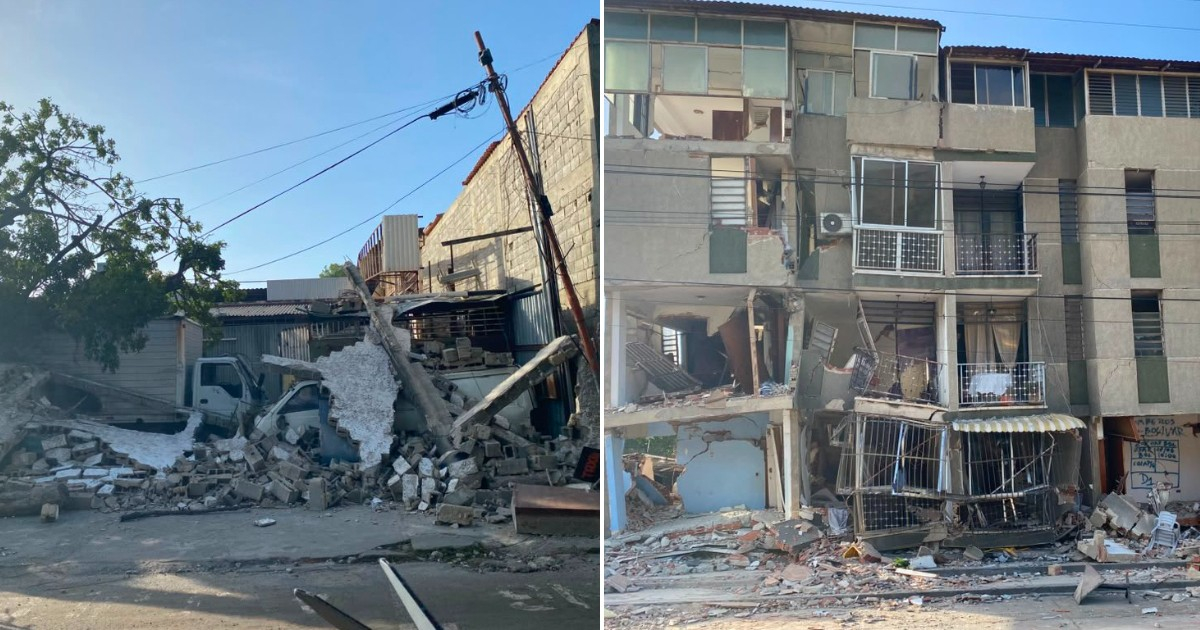
Frank Morey, a dedicated Venezuelan firefighter, has been tirelessly sifting through debris in the most affected areas following the devastating earthquakes that struck Venezuela on June 24, 2026. His account, shared with the Cuban magazine Juventud Técnica, paints a catastrophic picture beyond what any social media image can convey.
From the coastal stretch of Maiquetía, Catia La Mar, and Playa Grande—areas connecting Caracas to the Caribbean Sea and known for their fragile, aging infrastructure—Morey describes the scene as akin to a war zone. "Many buildings have collapsed, and countless people are on the streets. They've lost everything," he says. "It's a city in complete ruins."
The twin earthquakes, measuring magnitudes 7.2 and 7.5 and occurring just 39 seconds apart, shook the northern region of the country at 6:04 PM local time. The epicenter was near Morón, Yaracuy state. The U.S. Geological Survey (USGS) deemed it the strongest seismic event in Venezuela since 1900, issuing a Red Alert with a 42% likelihood of fatalities ranging from 10,000 to 100,000.
As of July 1, the official report from the Venezuelan government listed 2,295 dead and 11,267 injured. However, international bodies, such as the UN, estimate up to 50,000 missing and 6.76 million affected, suggesting the actual figures could be significantly higher.
Morey is no stranger to large-scale disasters. In August 2022, he traveled to Cuba to assist in the aftermath of the Matanzas Supertanker Base fire, which burned for days and resulted in missing firefighters. Now, it's Venezuela's turn to receive international aid, and Morey once again finds himself on the front lines.
One of the most heart-wrenching moments for him was the collapse of a building hosting a children's sleepover. "We arrived to find between 15 and 20 kids. That structure completely collapsed," he recounted. "I talked to my wife, who is also a firefighter, and said, 'I don't want to be here right now.'"
Informing families about their loved ones found in the rubble is equally harrowing. "We wish we could tell them, 'Your relative is safe.' But we can't. Yesterday, we recovered several bodies and handed them over to their families. Imagine that ordeal. It's not easy."
More than 2,200 rescuers from at least 17 countries are working alongside Morey. Cuba dispatched an initial team of 13 specialists and three trained dogs on June 28, followed by a second group from the Henry Reeve Contingent arriving in Valencia on June 29. The Cuban community in Venezuela has also suffered significantly: a family of six was found deceased under rubble in La Guaira on June 30, and at least 30 Cubans remain missing.
The conditions for rescuers are harsh—improvised camps with minimal comforts and relentless work schedules. Morey recalled going nearly five days without a cold drink until a neighbor offered him a popsicle. "I kept it in my uniform pocket for two days because I didn't have time to eat. Eventually, I gave it to someone else," he shared.
Despite the exhaustion, Morey refuses to give in. "We're human. We hear people crying and want to cry ourselves, but we can't falter. They need our help, a hug, a word of encouragement. We don't know how long we'll be here, but we have to endure and push forward."
The NASA estimated that approximately 58,870 buildings were damaged or destroyed nationwide, while the United Nations Development Program (UNDP) assessed direct economic damages at $6.7 billion.
Understanding the Earthquake Aftermath in Venezuela
What were the magnitudes of the earthquakes in Venezuela?
The earthquakes measured 7.2 and 7.5 in magnitude, occurring just 39 seconds apart.
How many people are estimated to have been affected by the earthquakes?
The UN estimates up to 50,000 individuals are missing and 6.76 million have been affected.
What role did Frank Morey play during the Venezuelan disaster?
Frank Morey is a firefighter who has been actively involved in rescue operations, working in the most devastated areas to recover survivors and provide aid.