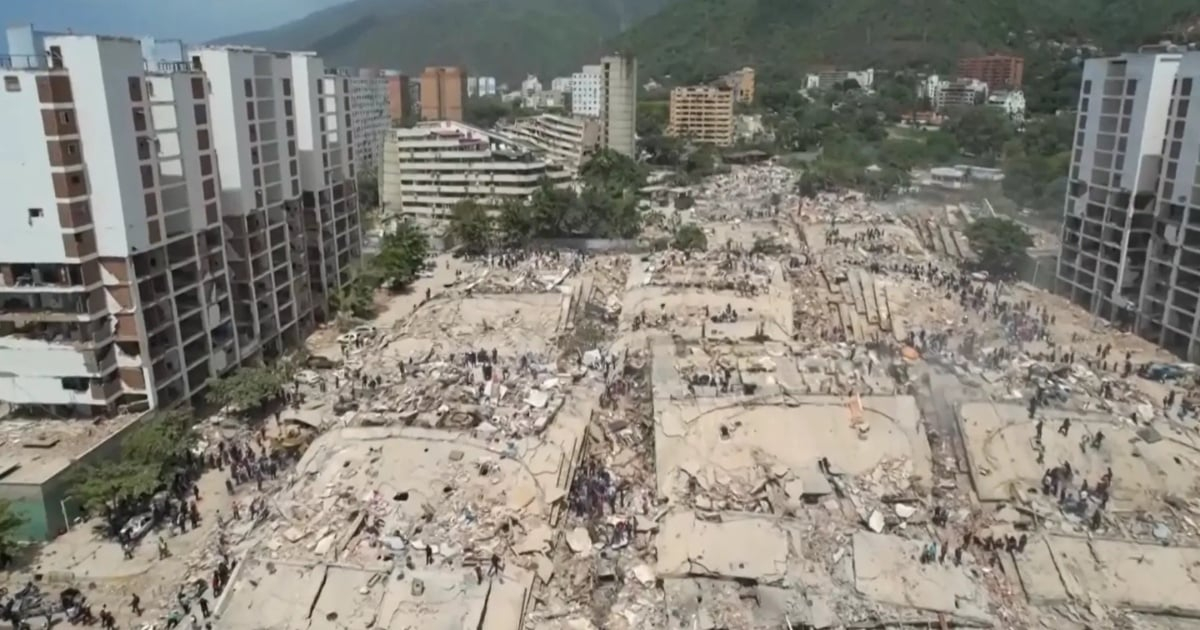
An experimental assessment released this Monday by NASA suggests that around 58,870 structures in Venezuela may have been either damaged or destroyed due to the catastrophic seismic events on June 24, 2026.
The analysis was conducted by researchers Corey Scher and Jamon Van Den Hoek from Oregon State University, utilizing data from the Sentinel-1 satellite radar, part of the European Copernicus program. This represents the first satellite-based tool at this scale aimed at guiding on-the-ground response teams.
The primary quake, registering a magnitude of 7.5, occurred just 39 seconds after a 7.2 magnitude tremor. Both epicenters were located in Yaracuy state, near San Felipe and Yumare, in Venezuela's north-central region.
Mapping the Destruction
The tremors extended violently across the central coast and the metropolitan area of Caracas, marking the most powerful earthquake in Venezuela since 1900. To map the destruction, researchers compared satellite images taken after the quake — one on June 24 over the epicentral region and another on June 25 over greater Caracas, including Petare and Antímano — against a database of 65 reference images captured in the year preceding the disaster.
The method used, known as coherence change detection, assesses surface stability between two satellite passes. A sudden loss of coherence indicates abrupt changes, such as structural collapse.
Evaluating the Damage
According to this methodology, a building is classified as damaged if at least 50% of its footprint falls within the coherence loss map, with a threshold set to keep false alarm rates at or below 1% in areas experiencing mild shaking.
Approximately 75% of the evaluated land was successfully covered by satellite images; areas lacking data correspond to regions where radar passes did not overlap, as well as open waters and sparsely built southern terrains.
The most severe damage was concentrated along the central coastal strip and the Caracas corridor, consistent with the quake’s recorded intensity. European Copernicus program data also identified 434 entirely demolished buildings, with 30% of Catia la Mar's structures collapsed and a 6% impact in La Guaira.
Human and Economic Toll
In Caracas, the neighborhoods of Los Palos Grandes, San Bernardino, and Altamira suffered the worst damage, including the collapse of the 14-story Petunia residential building and the Bancaribe building, among others.
The assessment is labeled as preliminary and not field-validated by NASA, cautioning that it should be viewed as an indicator rather than a precise building-by-building census.
The human toll from the disaster is dire: the Venezuelan government confirmed 1,719 fatalities and 5,034 injuries, while the UN estimated up to 50,000 missing individuals and a total of 6.76 million affected.
The U.S. Geological Survey (USGS) issued a Red Alert — its highest level — and estimated a 42% chance that the final death toll could range between 10,000 and 100,000.
The United Nations Development Program (UNDP) estimated direct damages at $6.7 billion, equating to 6% of Venezuela's GDP, with potential total impacts between $10.05 billion and $20.1 billion.
Understanding the Impact of Venezuelan Earthquakes
What caused the extensive damage in Venezuela?
The extensive damage resulted from two powerful earthquakes that struck in quick succession, with magnitudes of 7.5 and 7.2. The epicenters were in Yaracuy state, leading to widespread destruction across central coastal areas and Caracas.
How did NASA assess the damage in Venezuela?
NASA's assessment utilized satellite data from Sentinel-1 of the Copernicus program, employing a method called coherence change detection to compare post-earthquake images with reference images captured prior to the disaster.
What areas in Caracas were most affected by the earthquakes?
In Caracas, the neighborhoods of Los Palos Grandes, San Bernardino, and Altamira were among the most affected, experiencing significant structural collapses, including the Petunia residential building and the Bancaribe building.