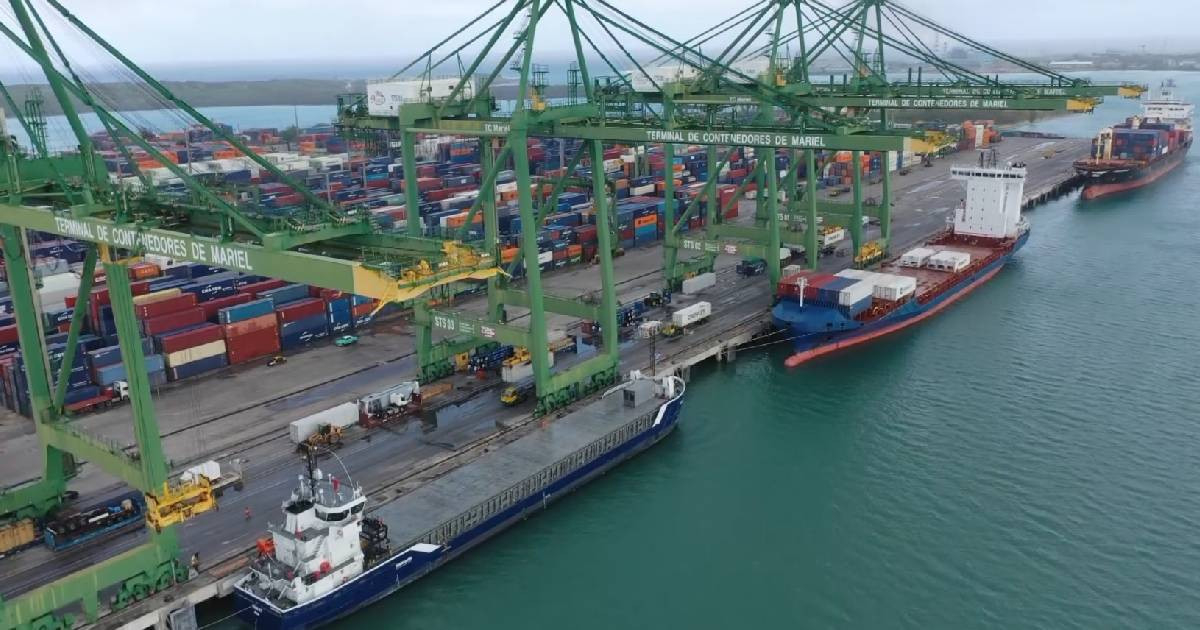
The Mariel Container Terminal S.A. (TC Mariel), associated with the Business Administration Group S.A. (GAESA), recently announced the sale of its assets to Coral Marítima S.A., a newly established Cuban commercial company that will form the subsidiary Terminales Portuarias CORAL S.A. to take over port operations. This development was reported by the AFP news agency on Saturday.
The move was supported by an official letter signed by Yamile Barrios San Martín, TC Mariel's commercial director, just two days following Washington's sanctions on Almacenes Universales S.A. (AUSA). AUSA, a subsidiary of the elite Cuban military conglomerate, managed container traffic in the Mariel Special Development Zone, located about 28 miles west of Havana in the Artemisa province.
"We are reaching out to inform you that Terminal de Contenedores Mariel S.A. has transferred its assets to the Cuban commercial company Coral Marítima S.A., which has established the subsidiary Terminales Portuarias CORAL S.A. to take over the operations previously handled by TC Mariel," states the document dated June 25 in Artemisa, which has begun circulating on social media.
Analysts and opposition figures view this transaction as a tactic to bypass sanctions through a formal restructure: altering the operator's name while maintaining actual business control within the same power circles.
U.S. Pressure Intensifies on Cuban Economic Core
This development occurs amidst heightened pressure from the United States on the economic core of the Cuban regime. On June 23, the same sanctions targeting AUSA also impacted the Banco Financiero Internacional (BFI), RAFIN S.A., GeoMinera S.A., and the José Martí Steel Company.
Secretary of State Marco Rubio was unequivocal in his remarks following these measures: "Foreign banks and other companies providing services to these entities must immediately freeze those activities."
Rubio's global warning about doing business with GAESA directly addresses secondary sanctions, prompting hotel chains like Meliá, Iberostar, Blue Diamond, and Aston Hotels to scale back or cease operations in Cuba in recent months.
Historical Patterns of Sanction Evasion
TC Mariel's behavior mirrors past actions; when the Office of Foreign Assets Control (OFAC) sanctioned Fincimex, a GAESA-related company involved in remittances, the regime promptly established Orbit S.A. within 24 hours, located physically next to the sanctioned entity.
Economist Miguel Alejandro Hayes, who highlighted the risks of dismantling GAESA without dismantling the regime, documented this pattern accurately. "The Cuban regime could formally dissolve GAESA as an economic and repressive institution tomorrow and simultaneously create something parallel that fulfills the exact same function," warned Hayes.
AFP reported that GAESA has begun a broader divestment process of several of its companies, which analysts describe as a systematic strategy to evade sanctions through formal restructurings that do not alter actual control.
GAESA's Extensive Economic Reach
GAESA, which controls between 40% and 70% of the Cuban economy and manages sectors such as tourism, trade, ports, and telecommunications, was directly sanctioned on May 7, 2026, under Executive Order 14404 signed by President Donald Trump, alongside its executive president, Brigadier General Ania Guillermina Lastres Morera.
As TC Mariel completes its transition and prepares new contracts under the name Coral Marítima S.A., the Cuban populace continues to endure power outages, shortages, and repression, with no change in corporate labels altering the reality of those who dominate the island.
Understanding the Impact of GAESA's Asset Sale
Why did GAESA sell its assets in Mariel?
GAESA sold its assets in Mariel as part of a broader strategy to evade U.S. sanctions by restructuring and changing the names of its operating entities, while maintaining control within its power circles.
What are the implications of U.S. sanctions on Cuban entities like AUSA?
U.S. sanctions on Cuban entities like AUSA aim to cut off financial resources to the Cuban regime, pressuring them to change their repressive practices. These sanctions also discourage foreign banks and companies from engaging with these entities.
How has the Cuban regime historically responded to sanctions?
The Cuban regime has historically responded to sanctions by quickly restructuring and renaming sanctioned entities to continue operations under new names, allowing them to evade the direct impact of sanctions while maintaining control.