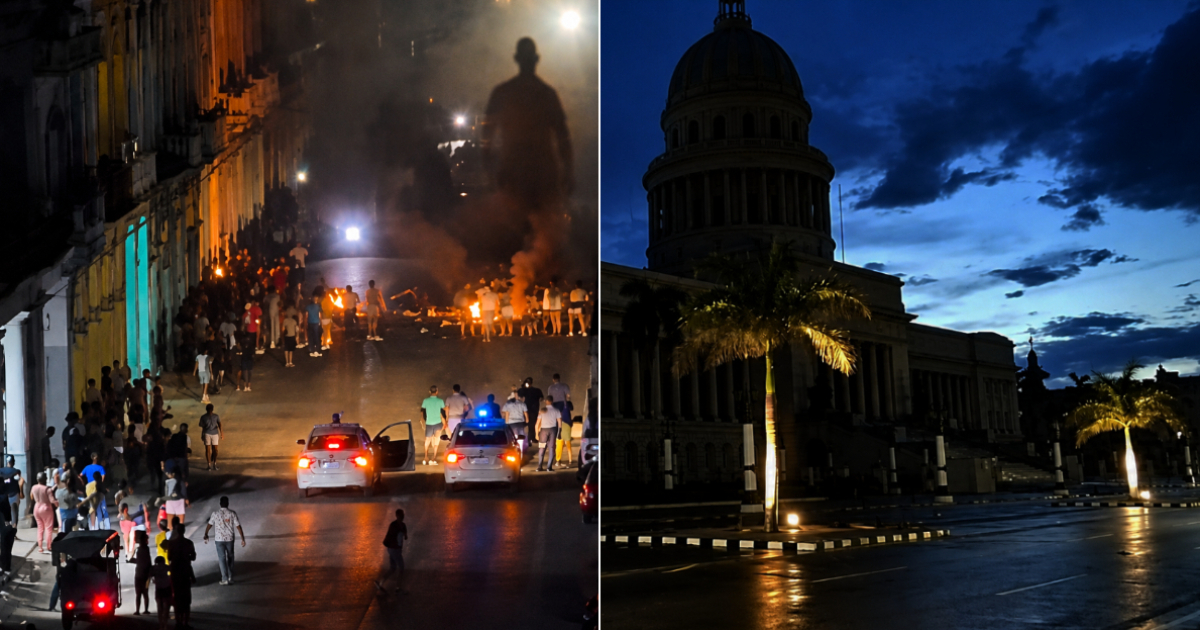
Some photographs capture a moment, while others tell a deeper story. The image taken on Tuesday night in Central Havana falls into the latter category.
In the dimly lit streets, illuminated by the fiery light of protests against widespread power outages, a massive human shadow seems to stride through the smoke.
This image, a still from a video, was captured at the intersection of Manrique and Reina, mere blocks from the National Capitol. Here, dozens of residents had poured into the streets, demanding the restoration of electricity after enduring prolonged blackouts.
The shadow itself is an illusion, a mere product of the interplay between light, smoke, and perspective. Yet, it is compelling and seems to communicate something profound: the true pulse of a nation descending into chaos, a grim reality, a stark truth.
Protests Escalate Amid Widespread Outages
The unrest seen in Central Havana is not an isolated incident. In recent weeks, the sounds of banging pots have echoed through neighborhoods like Santos Suárez, El Vedado, Cayo Hueso, Luyanó, Regla, and Guanabacoa.
With power outages lasting more than 30 hours in some areas and over two days in other provinces, discontent has become a shared experience among millions of Cubans.
Statistics highlight this trend. The Cuban Conflict Observatory recorded 1,245 protests in March 2026, followed by 1,133 in April—the highest levels since the July 11, 2021 demonstrations. Cubalex has also documented arrests linked to blackout protests in the capital in recent months.
A Symbolic Statement Near the Halls of Power
The events at Manrique and Reina carry undeniable symbolic weight. These protests didn't occur in a distant village or rural outpost; they took place almost at the doorstep of Cuba's political power.
As the Communist Party's Central Committee prepared for an Extraordinary Session to evaluate economic reforms announced by Miguel Díaz-Canel, the clamor of pots resounded through the capital.
This timing was illuminating. As the regime’s institutions prepared to endorse the decisions of Cuba's totalitarian leadership with their "revolutionary spirit" in air-conditioned halls, the crisis was already speaking loudly in the streets.
A Nation on the Brink
While authorities attempt to introduce reforms like greater autonomy for municipalities and state enterprises, adjustments in subsidy policies, agricultural incentives, and limited foreign investment opportunities, a growing portion of the population demands immediate solutions to the ongoing crisis that manifests with each blackout.
The shadow captured in the photograph likely vanished moments after it was formed. Smoke dissipated. Lights shifted. Yet, the image remains, powerful because of what it symbolizes.
This shadow doesn't represent an individual; it embodies a collective sentiment. The exhaustion from years of economic crisis, inflation, scarcity, and power cuts is gaining increasing visibility.
The grievances long confined to darkened homes, whispered conversations, or private complaints are now emerging in the streets, neighborhoods, and public spaces, inching ever closer to the centers of power.
Perhaps this is why the photograph is so unsettling. The towering figure moving through the smoke isn't a single person but a manifestation of a reality too significant to ignore. It's as if the pent-up discontent of years found a fleeting, visible form, rising above the street like a golem born from the surrounding darkness and fire.
Just blocks from the Capitol, the discontent took shape and, for a moment, cast its shadow over power.
Understanding the Protests in Cuba
What sparked the recent protests in Central Havana?
The protests were sparked by frequent and prolonged power outages, which have become a common grievance among Cuban citizens.
How widespread are these protests?
Protests have been recorded across various neighborhoods in Havana, highlighting a widespread dissatisfaction with the current situation.
What measures is the Cuban government proposing?
The government is proposing economic reforms, including increased autonomy for local governments and state enterprises, as well as changes in subsidy policies and agricultural incentives.