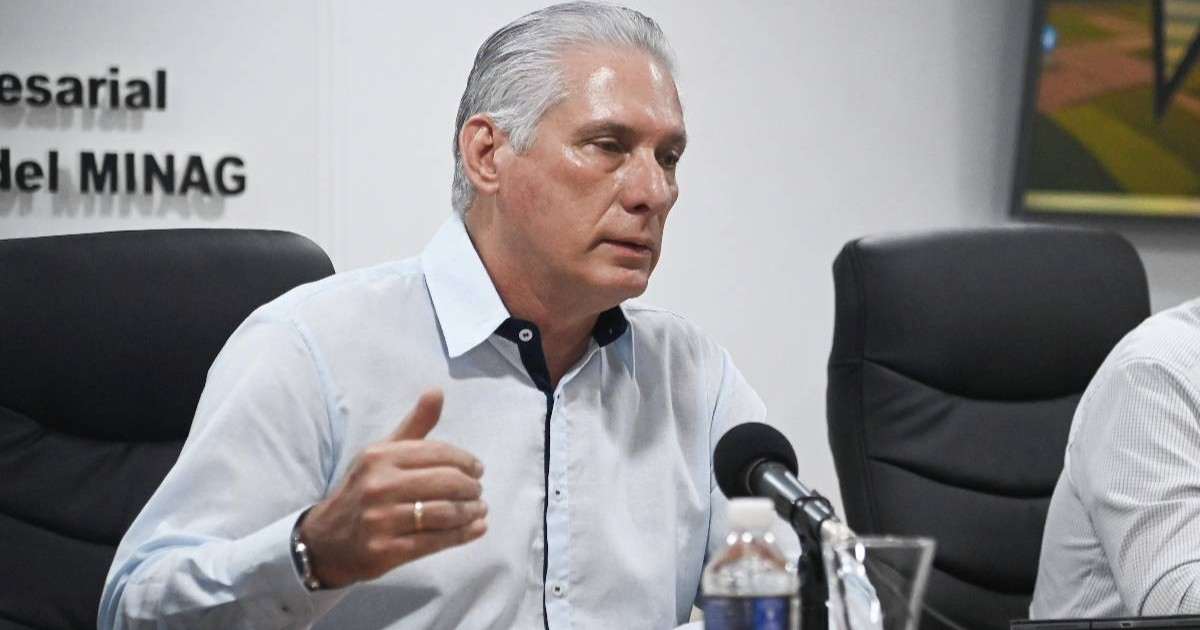
On Thursday, Cuban leader Miguel Díaz-Canel once again vowed to make "food availability" a top priority, declaring that the best measure of progress will be "the reduction of prices." He made these remarks during the Technical Advisory Council meeting of the Ministry of Agriculture at the headquarters of the Business Group of Logistics (GELMA) in the Boyeros district of Havana.
The meeting, attended by Vice Prime Minister Jorge Luis Tapia Fonseca and Agriculture Minister Ydael Pérez Brito, focused on the production of corn and soy for animal feed, agricultural extension, and the analysis of these grains' value chain.
Díaz-Canel acknowledged the ongoing challenge of producing the food the nation needs, warning that without a business plan, "everything will remain just wishful thinking."
He also promised "access to knowledge" and "well-being," though he admitted that these plans have medium to long-term projections.
His speech echoes promises he has made for years, with little tangible progress to show.
Back in September 2025, during a visit to a farm in Alquízar, Artemisa, he asserted that "if we have food freely available, prices will inevitably drop."
In May 2024, he urged Cubans to grow their own food and claimed, "As we have more food, prices must come down."
By March 2024, he conceded that prices "will remain high" due to structural issues but vowed to prevent "abusive and speculative" pricing.
These declarations have failed to reverse the trend.
The Stark Reality for Cubans
The grim reality for Cubans starkly contrasts with the official rhetoric. According to the Food Monitor Program (FMP), as of May 17, 2026, a staggering 96.91% of the Cuban population lacks adequate access to food.
Five provinces—Havana, Matanzas, Cienfuegos, Guantánamo, and Santiago de Cuba—are experiencing critical levels of food insecurity, as reported by the same organization.
The ration book system is virtually collapsing, failing to meet basic needs for rice, sugar, and peas.
Rice production has plummeted by 81%, and egg production by 61%, partly due to diesel shortages crippling 96.4% of over 9,200 registered agricultural micro, small, and medium enterprises (mipymes).
Economic Hardships and Empty Promises
The cost of a carton of eggs has soared to 3,800 Cuban pesos (CUP), and imported rice is selling between 690 and 840 CUP per kilogram, while the average state salary is a mere 6,930 CUP monthly, equivalent to about 13 dollars on the informal exchange market.
The gap between rhetoric and reality was starkly evident just four days before the Technical Council meeting: the May 17 Farmer's Day was marked by empty or sparsely stocked agricultural markets nationwide.
Cuba imports roughly 800,000 tons of corn and 350,000 tons of soy annually for animal feed—a dependency Díaz-Canel's plans aim to reduce, albeit without clear timelines or financing.
"The greatest innovation we can achieve with all these programs is to ensure food is available," the leader stated on Thursday, a promise Cubans have heard too often as shelves remain bare.
Understanding Cuba's Food Crisis
Why is food scarcity a persistent issue in Cuba?
Food scarcity in Cuba is largely due to structural economic issues, a lack of sufficient agricultural production, and heavy reliance on imports for essential commodities.
What measures has the Cuban government proposed to address food shortages?
The Cuban government has proposed increasing domestic production of key crops like corn and soy, enhancing agricultural extension services, and reducing dependency on imports.
How has the diesel shortage affected Cuba's agricultural sector?
Diesel shortages have severely impacted Cuba's agricultural sector, paralyzing 96.4% of the country's agricultural mipymes, thus hindering production and distribution.