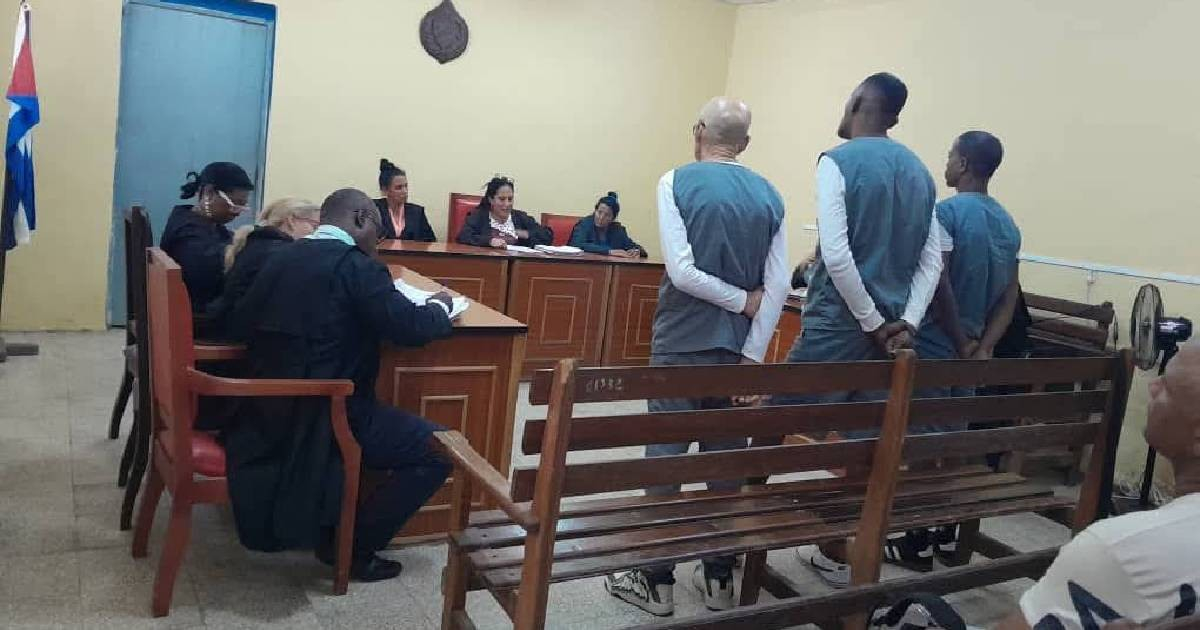
The Provincial Popular Court of Matanzas has sentenced two men to 15 years in prison each, and a third to 10 years, following a public trial marked as "exemplary" amidst the rising crime rates on the island.
This case, identified as Case 10 of 2026, originated in the town of Máximo Gómez, Perico municipality, where the three defendants broke into a home intending to steal valuable items, according to the local newspaper Girón on Facebook.
During the incident, one of the homeowners encountered the intruders and was assaulted, resulting in multiple bodily injuries.
The prosecution initially sought sentences of 10, 17, and 20 years of imprisonment based on each defendant's level of responsibility, referencing articles 34.1, 42.1, and 59.1 of the Cuban Penal Code.
The court, aligning the trial with the Fifth National Exercise Against Crime, categorized the actions as robbery with violence or intimidation in an attempted stage. It reduced the sentences compared to the prosecution's request: 15 years for two of the defendants and 10 years for the third, along with additional penalties such as deprivation of rights and a travel ban.
Furthermore, all convicted individuals are required to compensate the victim for the harm and damages caused. The prosecution also demanded specific reparations for the victim's wife to cover medical and transportation costs due to the injuries.
Members of the so-called civil society organizations participated in the trial, consistent with the regime's public and deterrent approach to such proceedings.
Public Trials as a Deterrent in Cuba
This trial is part of the Fifth National Exercise against crime and corruption, initiated last Monday from the Communist Party's Central Committee headquarters via videoconference with provincial authorities throughout the country.
One of the initiatives announced was to conduct around twenty "exemplary" trials nationwide, focusing on crimes related to drugs and attacks on the electrical system, although it also includes common crimes like violent robbery.
"Exemplary trials" are a common tool used by the Cuban judicial system to exert social control through public criminal proceedings widely covered by official media. The regime employs these as a deterrent mechanism in response to the increasing crime rates on the Island.
This practice has intensified in recent years. During the national exercise in December 2024, over 3,300 arrests and trials were reported in less than a week, alongside more than 508,000 inspections and the temporary closure of 680 businesses across the country.
In March 2025, the regime pledged new exemplary trials as part of an ongoing offensive against crime, amid a sustained deterioration in public safety acknowledged by Cuban authorities themselves.
Frequently Asked Questions about Cuba's Public Trials
What are exemplary trials in Cuba?
Exemplary trials in Cuba are public judicial proceedings designed to serve as a deterrent against crime. They are widely publicized and are part of the government's strategy to maintain social control.
Why are public trials used as a deterrent in Cuba?
Public trials are used as a deterrent in Cuba to discourage criminal activity by making an example of those convicted. The government aims to demonstrate the consequences of breaking the law through these widely covered trials.
How has crime been addressed through trials in Cuba recently?
Recently, Cuba has intensified the use of public trials as a method to combat crime. This includes conducting numerous arrests, trials, and inspections as part of national exercises against crime and corruption.