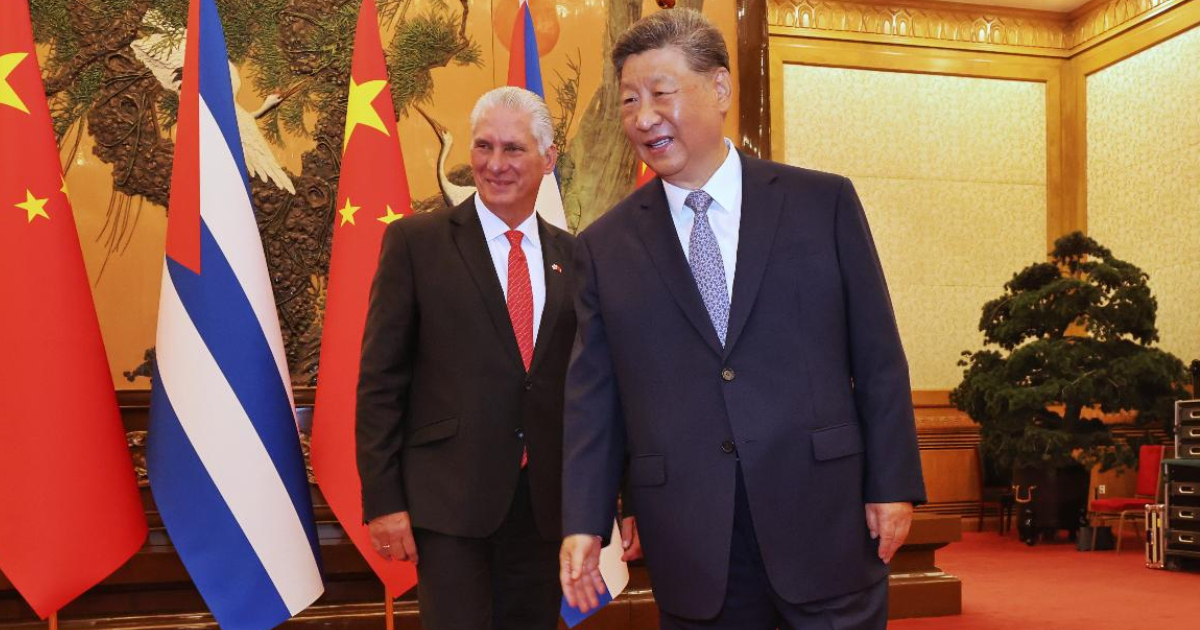
The Chinese Ministry of Foreign Affairs called on Washington this Tuesday to immediately lift the embargo on Cuba and cease "all forms of coercion and pressure." This explicit support for Miguel Díaz-Canel's regime follows a new wave of U.S. sanctions and warnings from the Cuban leader about alleged military threats.
Chinese spokesperson Lin Jian stated that Beijing opposes unilateral sanctions that lack a basis in international law and "strongly supports Cuba in safeguarding its sovereignty and national security." He urged the U.S. to "stop infringing on the Cuban people's rights to survival and development."
The statement was made one day after Díaz-Canel took to social media to claim that Cuba is facing "threats of military aggression" from the United States, which he described as "an international crime."
Escalating Tensions and Military Concerns
The Cuban leader warned that if these threats materialize, they could result in "a bloodbath with incalculable consequences," posing a "destructive impact on regional peace and stability."
Díaz-Canel also asserted that Cuba harbors "no aggressive intentions against any country, including the U.S.," but is enduring "a multidimensional aggression from Washington" and holds "the legitimate right to self-defense."
Allegations of Military Acquisitions
A report from Axios, released last Sunday, suggested that since 2023, Cuba has acquired over 300 military drones, allegedly with support from Russia and Iran. Cuban officials reportedly discussed potential uses of these systems against the Guantanamo Naval Base, U.S. Navy ships, and hypothetically, Key West, Florida.
The Cuban regime dismissed the report as "fraudulent files" intended to justify the tightening of the embargo and potential military action.
U.S. Sanctions and China's Response
On the same Monday, the U.S. Treasury Department sanctioned nine Cuban citizens, including ministers of communications, energy, and justice, as well as the Cuban Intelligence Directorate (DGI/G2), the island's main espionage agency.
This marks the second wave of sanctions under Executive Order 14404, signed by President Donald Trump on May 1, 2026. The first wave, announced by Secretary of State Marco Rubio on May 7, targeted GAESA and its leadership.
China had already reacted to the first wave: Lin Jian previously stated that "the intensification of illicit and unilateral U.S. sanctions against Cuba severely violates the Cuban people's rights," and spokesperson Guo Jiakun made a similar call on April 21.
Beijing has also rejected allegations of supposed Chinese intelligence facilities in Cuba, calling them "pretexts" and "rumors." Lin Jian summarized this stance on April 29: "Fabricated pretexts, rumors, and slander will never justify the brutal blockade and illegal U.S. sanctions against Cuba."
Foreign companies and financial institutions operating with GAESA have until June 5, 2026, to cease operations, under threat of secondary sanctions from Washington.
Frequently Asked Questions About U.S. Sanctions on Cuba
What is the basis for U.S. sanctions against Cuba?
The U.S. imposes sanctions on Cuba under the premise of promoting human rights and democracy, arguing that the Cuban government engages in activities contrary to these principles.
How has China responded to U.S. sanctions on Cuba?
China has condemned the U.S. sanctions, calling them illegal and stressing its support for Cuba's sovereignty and right to self-defense.
What are the implications of Cuba acquiring military drones?
The acquisition of military drones by Cuba, reportedly with Russian and Iranian support, raises concerns about potential military confrontations and regional instability.