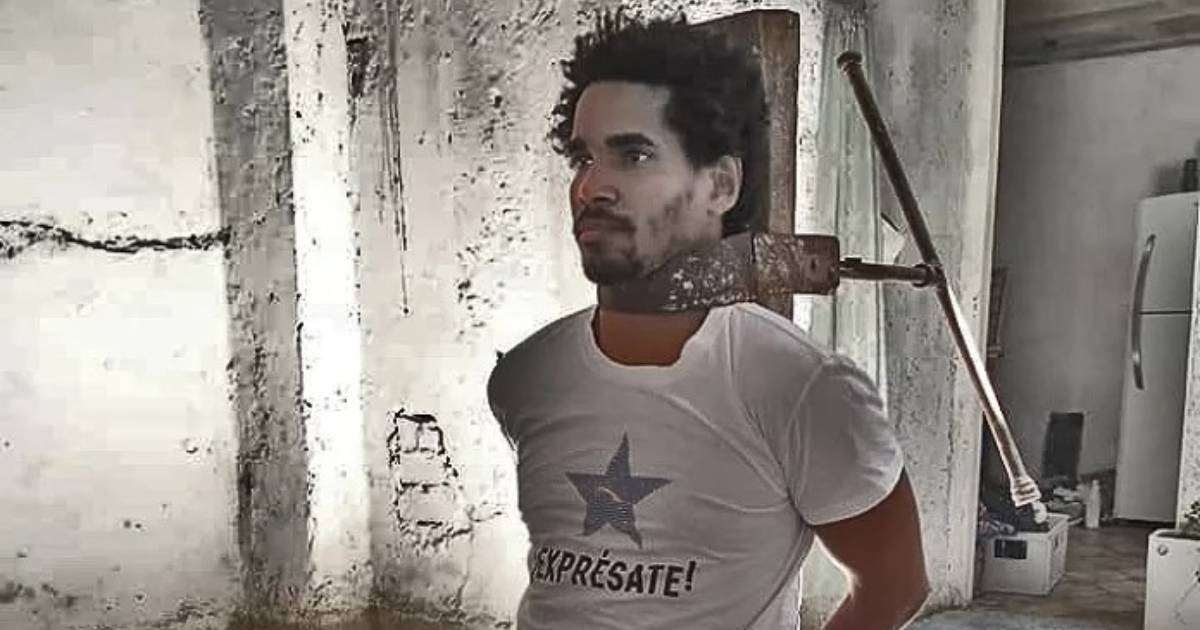
From his cell at the Guanajay prison, Luis Manuel Otero Alcántara shared his thoughts with USA Today in an audio interview released this Wednesday. He reflected on the bold choice he and fellow artist Maykel "Osorbo" Castillo Pérez made to forgo their burgeoning international art careers to wield their craft as a catalyst for change in Cuba, fully aware that this decision might land them in jail.
"I am an artist, and like Maykel, I could currently be in New York, immersed in the art scene, striving to make a name for myself globally. But we chose to abandon that vanity," Otero Alcántara expressed in the recording.
He continued, "We discovered a path through art, a belief that art could transform things. By dedicating our art and our very bodies to effect change in Cuba, we accepted that it came with the consequence of imprisonment."
Art as a Medium for Protest
The audio interviews were obtained by USA Today amid clandestine negotiations between Washington and Havana, where both artists are central to the diplomatic discussions.
Meanwhile, Osorbo recounted from the high-security Kilo 8 prison in Pinar del Río, the ultimatum he faced from State Security agents: "Do you want to emigrate—tell me if you want to emigrate—or do you want to remain in your current predicament, imprisoned until 2030?"
Despite acknowledging that no one wants to be incarcerated, and recognizing his medical needs and life plans, the rapper was firm: "Freedom cannot be bought at any cost. That is non-negotiable. I will always make that clear."
Failed Promises and Diplomatic Pressure
The ultimatum came five days after a U.S. State Department delegation secretly met Cuban officials in Havana on April 10, marking the first U.S. government plane landing in Cuba since 2016. Washington demanded the release of both artists within two weeks as a sign of goodwill.
Though both Otero and Osorbo agreed to exile, the deadline passed without their release. As of now, they remain incarcerated.
The regime's "exile or prison" tactic is not a novel strategy. In October 2021, authorities attempted to banish the artists, an offer they publicly declined. In 2026, similar pressure was exerted on other political prisoners like Félix Navarro and his daughter Saylí Navarro, who also firmly rejected it.
Otero Alcántara was arrested in July 2021 during the 11J protests and sentenced to five years in prison. His sentence is set to end on July 9, 2026, but the Supreme Court dismissed an appeal for early release in April. Osorbo was detained on May 18, 2021, and received a nine-year sentence.
Following Cuba's failure to comply, the U.S. State Department issued a warning: "The Cuban regime must cease its games during direct negotiations. They have a narrow window to strike a deal."
Understanding the Struggle of Cuban Artists
Why did Luis Manuel Otero Alcántara and Maykel Osorbo choose to stay in Cuba?
They believed their art could drive change in Cuba and chose to sacrifice their international careers to use their craft as a tool for transformation, fully aware that it could lead to imprisonment.
What was the ultimatum given to Maykel Osorbo by Cuban authorities?
Cuban State Security agents gave Osorbo a choice: to emigrate or remain in prison until 2030.
How has the U.S. responded to the artists' imprisonment?
The U.S. demanded their release as a gesture of good faith, warning the Cuban regime to stop playing games during negotiations and noting a limited opportunity to make a deal.