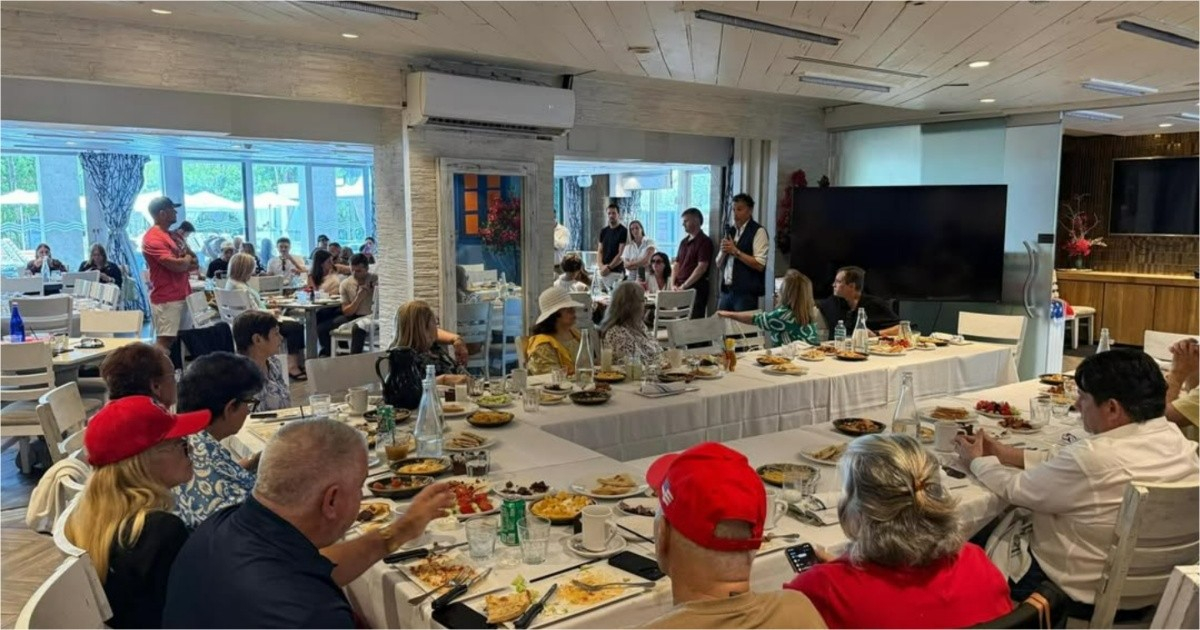
On Saturday, the Republican Club of Miami Beach reopened its doors after being inactive for approximately 30 years. The relaunch event, held at Santorini by Georgios, attracted dozens of attendees, including Byron Donalds, the Republican gubernatorial candidate for Florida.
The club initially closed three decades ago due to the strong Democratic presence in Miami Beach, which rendered its operations unsustainable. Its revival signifies the significant political transformation Miami-Dade has experienced in recent years, shifting from a long-standing Democratic stronghold.
Goran Cuk, the club's vice president, outlined the relaunch's purpose: "It's an opportunity to engage, have conversations, and connect with fellow voters."
Celebrating a New Era of Political Engagement
The event featured networking activities, celebrations, and the Greek tradition of breaking plates, fostering an atmosphere of unity and political renewal as described by the organizers.
The political landscape has undergone a dramatic shift. Recent voter registration data reveals that Miami-Dade now boasts 450,994 registered Republicans compared to 405,438 Democrats, marking a historical reversal from past decades. Statewide, Florida registers 5,545,284 Republicans versus 4,052,862 Democrats, showcasing a nearly 1.5 million voter advantage.
This historical shift in Miami-Dade was accelerated by the 2024 presidential election, where Trump secured 58% of the vote in the county, becoming the first Republican candidate to do so since George H.W. Bush in 1988.
Latino Influence and Housing Crisis
The Latino vote, particularly from Cuban Americans, played a crucial role in this outcome, with Florida International University data showing 68% support for Trump.
Donalds, backed by Trump since February 2025, used the event to emphasize his campaign's focus on the affordable housing crisis.
"We need to be efficient in building homes and roads. Government-related costs—permits, delays—account for 30% of new home costs. This only drives up housing prices, especially for young people entering the market," Donalds stated.
He acknowledged the economic pressure facing South Florida residents: "Yes, it's a bit pricier, especially here in Miami Beach, than it used to be."
The median home price in Miami reached $840,000 in April 2026, a 14% increase from the previous year, leading over 113,000 residents to leave the city in 2025 due to rising living costs.
With the national unemployment rate rising to 4.7% in March, economic pressures are mounting on voters ahead of the elections.
Electoral Outlook
Donalds is comfortably leading the Republican primaries for governor, with recent polls showing him between 38% and 50% in voter intention. However, in a general election scenario, he is statistically tied with Democrat David Jolly: 41.2% to 40.5%.
The Florida Republican Party has maintained a registered voter lead over Democrats by more than a million since 2024, a trend the Miami Beach club's relaunch aims to solidify as the November elections approach.
FAQ About the Political Shift in Miami-Dade
What prompted the reopening of the Republican Club in Miami Beach?
The reopening of the Republican Club in Miami Beach reflects the significant political shift in Miami-Dade, where the Republican voter base has grown considerably in recent years.
How has the political landscape changed in Miami-Dade?
Miami-Dade has transitioned from a Democratic stronghold to a more Republican-leaning area, with registered Republicans now outnumbering Democrats, a reversal from previous decades.
What role did the Latino vote play in the recent elections?
The Latino vote, particularly from Cuban Americans, was crucial, with a significant majority supporting Trump, which contributed to the Republican gains in the region.