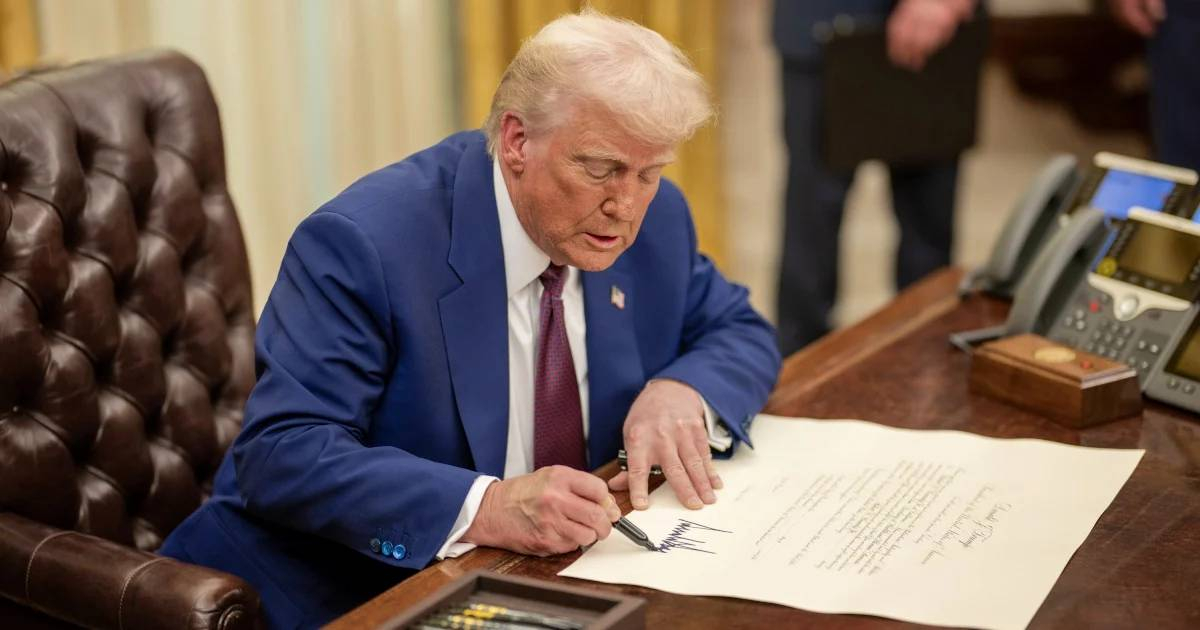
On Friday, President Donald Trump issued a new executive order that bars individuals connected to the Cuban regime from entering the United States. This order also intensifies economic sanctions targeting officials, collaborators, and adult relatives of those identified under this directive, according to a statement from the White House.
The order, entitled "Imposing Sanctions on Those Responsible for the Repression in Cuba and Threats to the National Security and Foreign Policy of the United States," is legally grounded in the International Emergency Economic Powers Act (IEEPA), the National Emergencies Act, and section 212(f) of the Immigration and Nationality Act of 1952. These laws grant the president authority to suspend the entry of certain foreigners if deemed harmful to U.S. interests.
The document outlines that the Cuban regime's policies "continue to pose an unusual and extraordinary threat to the national security and foreign policy of the United States," emphasizing that these policies are not only intended to harm the U.S. but are also offensive to the moral and political values of free and democratic societies.
This entry ban is comprehensive, affecting both immigrants and non-immigrants, and extends to those involved in critical sectors of the Cuban economy, including energy, defense, metals and mining, financial services, and security. The restriction includes leaders, officials, senior executives, and board members of the Cuban government, as well as individuals guilty of severe human rights abuses or corruption linked to the regime.
A significant aspect of the measure is its extension of sanctions to adult family members of any persons designated under the order, marking a substantial tightening compared to previous policies. Additionally, the order prohibits U.S. citizens from making donations to sanctioned individuals and specifies that prior notification of the designations is unnecessary, as those individuals "could instantly transfer funds or assets."
The order also empowers secondary sanctions against foreign financial institutions that conduct or facilitate significant transactions with designated individuals. The Secretary of the Treasury is authorized to deny these institutions access to correspondent accounts in the U.S. or directly freeze their assets within the United States. Implementation responsibility is assigned to both the Secretary of State and the Secretary of the Treasury.
This latest move is part of an ongoing escalation of pressure that the Trump administration has maintained against Cuba since the commencement of his second term. On January 20, 2026, Trump's first day back in the White House, he re-added Cuba to the list of state sponsors of terrorism. Nine days later, he signed Executive Order 14380, declaring a national emergency due to the threat posed by the Cuban regime, citing its alignment with Russia, China, and Iran.
Since then, the administration has enacted numerous new sanctions against Cuba, intercepted at least seven oil tankers en route to the island, and suspended Western Union transfers. Tariffs imposed on third countries supplying oil to Cuba reduced Cuban energy imports by 80% to 90%, although the Supreme Court deemed these tariffs illegal in February 2026, forcing Trump to lift them.
In July 2025, the United States had already directly sanctioned Miguel Díaz-Canel and his family under Section 7031(c) of the State Department Appropriations Act, as well as the ministers of the Revolutionary Armed Forces (FAR) and the Ministry of the Interior (MININT), Álvaro López Miera and Lázaro Alberto Álvarez Casas, respectively. That same month, Trump updated National Security Presidential Memorandum No. 5, prohibiting the entry of ministers, deputy ministers, and members of the Council of State and the National Assembly of People’s Power.
The order from May 1, 2026, consolidates and expands this framework by extending the entry ban beyond high-ranking officials to encompass anyone linked to the regime. It also incorporates, for the first time, secondary sanctions against foreign financial entities engaging with designated individuals, adding further pressure on the Cuban government's international partners.
Understanding Trump's Sanctions on Cuba
What is the main purpose of Trump's new executive order regarding Cuba?
The executive order aims to prohibit entry into the United States for individuals linked to the Cuban regime and to extend economic sanctions targeting officials and their adult relatives, thereby increasing pressure on the regime.
How does the order impact foreign financial institutions?
The order authorizes secondary sanctions against foreign financial institutions that conduct or facilitate significant transactions with designated individuals, potentially blocking their access to U.S. financial systems.
What sectors of the Cuban economy are targeted by the entry ban?
The entry ban targets individuals operating in critical sectors such as energy, defense, metals and mining, financial services, and security, as well as those involved in human rights abuses and corruption.