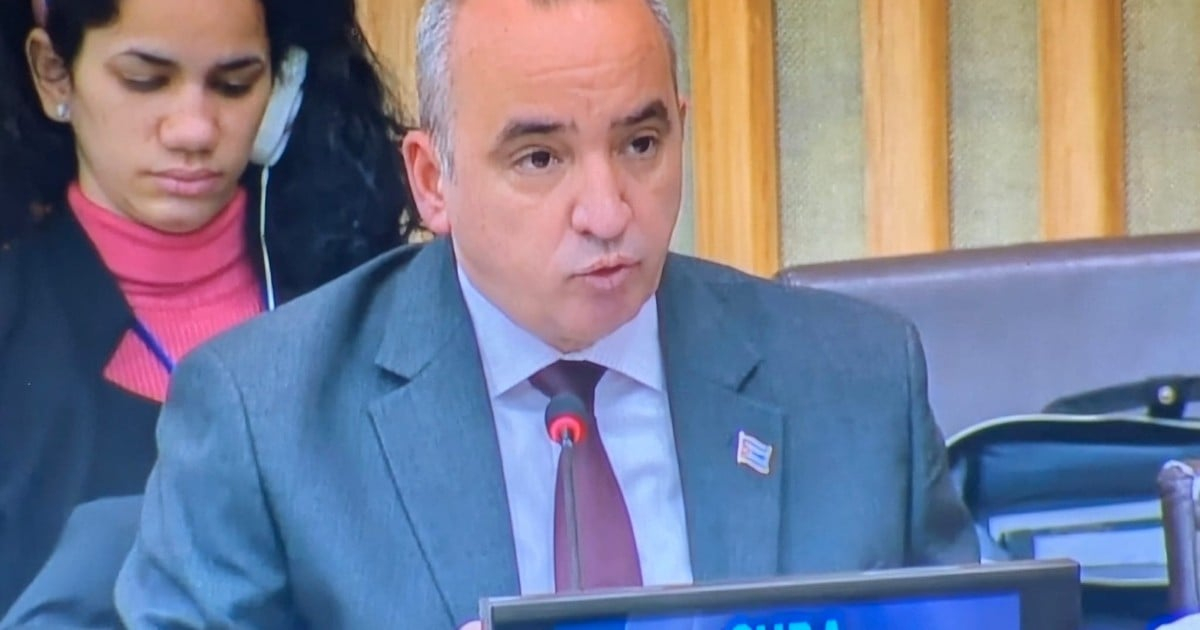
The Cuban government firmly dismissed any ultimatum from the United States to release political prisoners as a prerequisite for ongoing diplomatic negotiations. Meanwhile, the U.S. State Department warned that Havana has "a narrow window to strike a deal."
In an interview with the Associated Press, Ernesto Soberón Guzmán, Cuba's ambassador to the United Nations, stated that discussions on internal matters like detained individuals are not part of the negotiation agenda.
"We have our own legal system, just as the U.S. has theirs," Soberón Guzmán commented. "Therefore, we must respect each other's internal affairs," he stressed.
Responding to this stance, the State Department issued a statement reaffirming the Trump administration's commitment to the release of all political prisoners. The statement included a clear warning: "The Cuban regime must cease its games during direct dialogues. They have a small window to make a deal," as reported by AP.
The negotiations began on April 10, marked by a confidential visit from a U.S. delegation to Havana, initiating the first high-level direct talks in a decade.
Soberón Guzmán mentioned that the U.S. delegation was led by a Deputy Secretary of State, while Cuba was represented by a Deputy Foreign Minister.
Outlets such as USA Today and Axios reported that the U.S. set a two-week deadline—expiring this Friday, April 24—for Cuba to release high-profile political prisoners, including artist Luis Manuel Otero Alcántara and rapper Maykel Osorbo, both detained since the July 11, 2021 protests.
The Cuban regime denied the existence of such an ultimatum. Cuban President Miguel Díaz-Canel characterized the meetings as "respectful and professional" and emphasized their preliminary nature.
Backdrop of Economic Crisis
These talks occur amid an unprecedented energy crisis in Cuba, exacerbated by U.S. pressure. In January, President Trump signed an executive order imposing secondary tariffs on countries exporting oil to Cuba. This led to Mexico halting Pemex shipments and Venezuela cutting subsidized supplies after the arrest of Nicolás Maduro.
Cuba's oil demands range between 90,000 and 110,000 barrels daily, though domestic production barely reaches 40,000 barrels.
Late March saw the arrival of the Russian tanker Anatoly Kolodkin at Matanzas port with 730,000 barrels, marking the first significant delivery in over three months. Soberón Guzmán acknowledged this shipment only meets a small portion of the country's operational needs.
The fuel shortage has deepened blackouts, poverty, and hunger across the island, with some communities experiencing power outages exceeding 40 hours.
Property Compensation and Diplomatic Caution
Regarding compensation to Cuban Americans for properties confiscated since 1959, Soberón Guzmán confirmed the topic was discussed, and Havana is open to the idea, but any agreement hinges on reciprocal easing of the embargo.
"It's not just this claim; we have our own claims due to the embargo's economic impact," he remarked. "This is a two-way street."
The diplomat also cautioned that Cuba is monitoring Trump's foreign policy closely and is prepared for any scenario. "We are observing global developments, including in our region and the Middle East, so we are not naive," he stated.
"Our primary goal—what we truly seek—is a successful dialogue with the U.S. government."
However, he added that if the U.S. were to engage in military aggression, "we are ready to respond."
Frequently Asked Questions on U.S.-Cuba Negotiations
What was the U.S. ultimatum to Cuba about?
The U.S. ultimatum reportedly required Cuba to release high-profile political prisoners as a condition for diplomatic talks.
How is the energy crisis affecting Cuba?
The energy crisis in Cuba has led to severe fuel shortages, causing widespread blackouts and worsening poverty and hunger across the island.
What are the implications of the property compensation discussions?
Cuba is open to discussing compensation for seized properties, but any agreement is contingent on a reciprocal easing of the U.S. embargo.