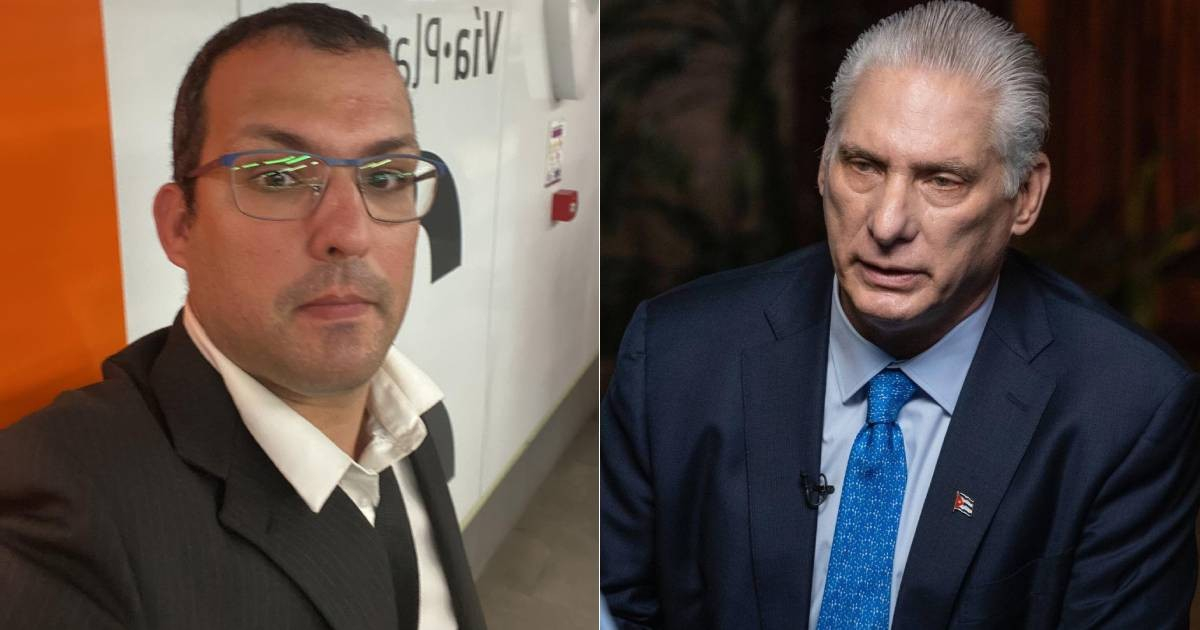
The independent Cuban journalist Waldo Fernández Cuenca has issued a sharp critique of Miguel Díaz-Canel following his appearance on NBC News' "Meet the Press," describing the interview as "forgettable."
Fernández Cuenca, a contributor to Diario de Cuba and recipient of the Inter American Press Association's Grand Prize for Press Freedom in 2021, expressed on Facebook that the Cuban leader stuck rigidly to the regime's worn-out narrative, failing to acknowledge any internal accountability throughout the nearly 50-minute discussion.
The journalist noted that the term "blockade" was Díaz-Canel's most frequently used word, encapsulating his stance: "All of Cuba's hardships are due to the United States."
Fernández Cuenca countered this logic with a straightforward question: "Why doesn't the Cuban government implement the necessary measures to end the 'blockade' once and for all?"
According to Fernández Cuenca, Washington has indeed set conditions for lifting the embargo: free elections, release of political prisoners, and an embrace of multiparty democracy. These are conditions the regime refuses, as meeting them would mean relinquishing power. "That's why the embargo—not a blockade—remains," he concluded.
The interview was recorded on April 9 at the José Martí Memorial in Havana and broadcasted in its full 53-minute version on Sunday, April 12.
During the interview with journalist Kristen Welker, Díaz-Canel denied the existence of political prisoners in Cuba, labeling such claims as "a big lie" and "slander," despite Prisoners Defenders documenting over 1,200 cases by the end of February. When asked if he would step down to save Cuba, he retorted irritably, "Is that question from you or the State Department?"
Fernández Cuenca also took aim at Welker's performance, noting that "she only managed to slightly unsettle Díaz-Canel with the final question," while he "felt comfortable spreading several falsehoods."
The journalist's critique echoes other voices. Journalist Mónica Baró described the interview as a "propaganda success" for the regime, arguing that Welker provided a comfortable platform for the Cuban leader with minimal challenge. Republican Senator Rick Scott accused NBC of legitimizing the regime by giving it such a platform.
Understanding the Critique of Díaz-Canel's NBC Interview
What was Waldo Fernández Cuenca's main criticism of Díaz-Canel's interview?
Fernández Cuenca criticized Díaz-Canel for sticking to the regime's narrative and not acknowledging any internal responsibility for Cuba's issues, attributing all problems to the U.S. embargo.
What conditions has Washington set to lift the embargo?
The U.S. conditions include holding free elections, releasing political prisoners, and embracing multiparty democracy, which the Cuban regime refuses to accept.
How did Díaz-Canel respond to questions about political prisoners?
Díaz-Canel denied the presence of political prisoners in Cuba, calling such claims a "big lie" and "slander," despite evidence to the contrary from organizations like Prisoners Defenders.