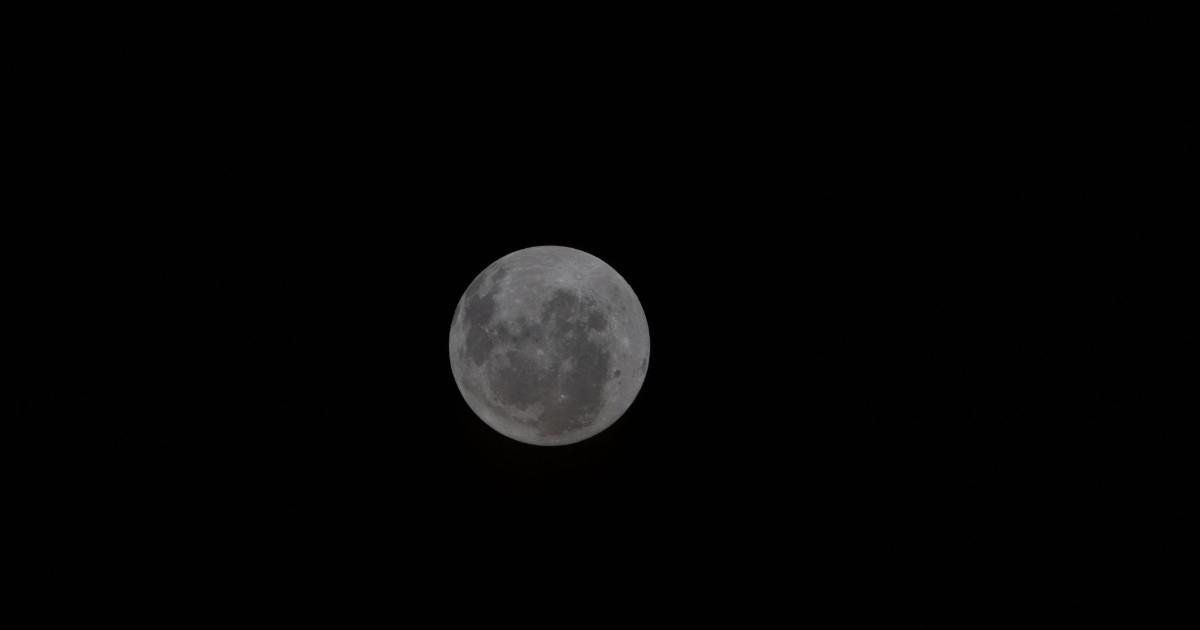
On Sunday, the crew of the Artemis II mission captured an unprecedented image of the Orientale Basin, a geological structure situated on the far western edge of the lunar disk, unseen in its entirety by human eyes until now.
NASA shared this historic photograph on its official X account, stating: "History in the making. In this new image from our Artemis II crew, you can observe the Orientale Basin on the right edge of the lunar disk. This mission marks the first time the entire basin has been viewed by human eyes."
The Orientale Basin is one of the Moon's most striking and well-preserved impact formations, spanning approximately 580 miles in diameter in its outer ring, known as the Montes Cordillera. It was formed around 3.8 billion years ago during the final phase of the Late Heavy Bombardment.
Located at the boundary between the Moon's visible and far sides, it can only be partially observed from Earth during specific phases of libration, making this image a significant scientific milestone.
Prior to Artemis II, only robotic probes had photographed this region. The Lunar Orbiter 4 first captured it as a multi-ringed structure in 1967, followed by the Lunar Reconnaissance Orbiter in later missions.
The photograph was taken from inside the Orion capsule, named "Integrity" by the crew, with most lights turned off to minimize window reflections.
The basin's minimal lava flooding, preserving its bullseye-like structure, offers a natural laboratory for studying impact geology, the crustal asymmetry between the Moon's two sides, and the processes that shaped the early solar system.
The mission launched last Tuesday from Launch Complex 39B at Kennedy Space Center in Cape Canaveral, Florida, with a crew of four astronauts: Commander Reid Wiseman, Pilot Victor Glover, Specialist Christina Koch, and Canadian Jeremy Hansen.
This marks the first time humans have ventured beyond Earth's orbit since Apollo 17's crew in December 1972, over 53 years ago.
Glover is the first African American to travel near the Moon, Koch is the first woman on a crewed lunar mission, and Hansen is the first Canadian citizen to participate in such a mission.
This image adds to a series of visual milestones from the mission: last Thursday, NASA released high-resolution photos of Earth with a visible green aurora, accompanied by the message "Good morning, world."
The lunar flyby is scheduled for this Monday, at an altitude between 4,000 and 6,000 miles from the Moon's far side, with the trajectory potentially taking the astronauts approximately 4,700 miles beyond the far side, possibly breaking the distance record from Earth set by the Apollo program.
Artemis II does not include a lunar landing; its goal is to validate the Orion spacecraft systems with a human crew before Artemis III, which is planned to achieve the first lunar south pole landing in 2027, amid the new space race between the United States and China.
Key Insights into Artemis II and Lunar Exploration
What makes the Orientale Basin significant in lunar studies?
The Orientale Basin is significant due to its well-preserved multi-ringed impact structure, providing insights into lunar geology and the early solar system's formation processes.
Who are the astronauts participating in the Artemis II mission?
The Artemis II crew includes Commander Reid Wiseman, Pilot Victor Glover, Specialist Christina Koch, and Canadian Jeremy Hansen.
What is the main objective of the Artemis II mission?
The primary goal of Artemis II is to validate the systems of the Orion spacecraft with a human crew in preparation for future missions, including Artemis III's planned lunar south pole landing.