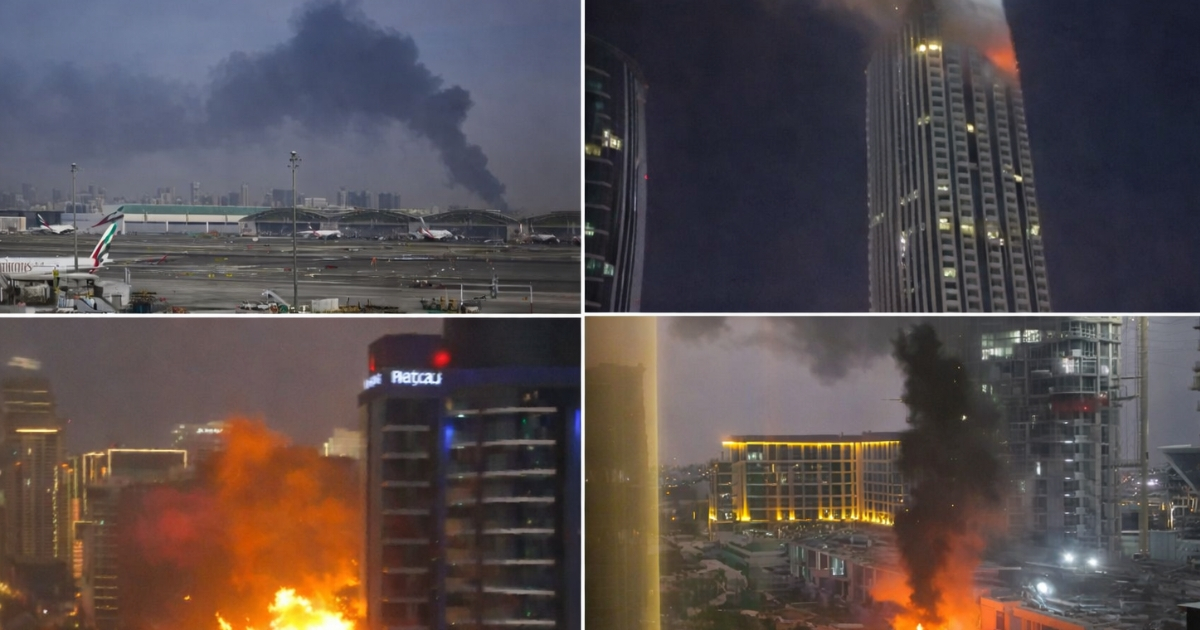
The tax-free fantasy that lured millions of expatriates to Dubai, including thousands of Cuban Americans and Cubans from the diaspora, has crumbled in mere days. Since late February 2026, Iranian assaults on the United Arab Emirates have triggered a mass departure of foreign residents who vow never to return to Dubai.
Between February 28 and March 6, Iran launched an onslaught of over 700 projectiles—comprising 174 ballistic missiles, 689 drones, and 8 cruise missiles—against the UAE as part of "Operation True Promise 4." This was a retaliatory move in response to U.S. and Israeli strikes on Iranian nuclear sites. Even though the Emirati air defense system intercepted roughly 95% of the attacks, debris led to at least six fatalities and injured more than 120 individuals from over 20 different nationalities.
The attacks struck landmarks close to Dubai’s iconic spots: the Fairmont Hotel on Palm Jumeirah, the Burj Al Arab, and Terminal 3 of Dubai International Airport. On March 4, a drone crash-landed near the U.S. Consulate in Dubai, and on March 11, a ballistic missile hit the Star Gwyneth vessel near Ras al-Khaimah.
Economic and Social Fallout
The exodus has exacted a steep toll. Since the conflict's outset, over 37,000 flights have been canceled, and Dubai International Airport operates at merely 70% capacity. Emirates Airlines reported a 40% drop in passengers during the first quarter of 2026. Those able to escape have paid up to $350,000 for private flights to Europe, while car journeys to Oman or Saudi Arabia for alternative travel routes have cost over $5,000.
For Cuban Americans from Miami and other Latinos who chose Dubai for its cosmopolitan lifestyle and tax-free income, the crisis introduces complications beyond physical safety: censorship. The UAE’s Attorney General, Hamid Saif Al Shamsi, has banned photographing, posting, or sharing images of missile impact sites under the Cybersecurity and Rumors Law, with penalties including a minimum of one-year imprisonment and fines up to AED 200,000.
The repercussions have been swift. An Australian citizen was forced to delete missile videos after facing direct jail threats and a $77,000 fine. An influencer with millions of followers removed images of debris near her apartment. Emirati authorities have directly contacted content creators, demanding the removal of material deemed harmful to "national unity."
Market Instability and Future Prospects
The economic impact is dire. Dubai's stock market plummeted 15% on Wednesday, March 11, and expatriate unemployment rose to 12% in February, according to KPMG. In 2025, around 9,800 millionaires relocated to Dubai, contributing $63 billion; many are now among those fleeing. The U.S. Department of State raised its travel advisory for the UAE to Level 3 on March 9, advising voluntary departure from the country.
Not everyone has left the city. A Cuban resident in Dubai watched from his balcony as Iranian missiles were intercepted. Greek attorney Maria Palmou, who has lived in Dubai for 10 years, described the situation as "unsettling" but expressed trust in local authorities and the air defense system. Real estate analysts note that unlike 2008, the Emirati market is supported by equity rather than debt.
Iran declared a halt to attacks on neighboring countries on March 7 but refused any surrender. Remote work was made mandatory until March 17, and schools remain closed until March 18, indicating that the city, once marketed as the world's safe haven, is far from returning to normalcy.
Understanding the Impact on Dubai's Stability
Why did expatriates leave Dubai?
Expatriates left Dubai due to Iranian attacks and the resulting fear for personal safety, along with flight cancellations and economic instability.
What measures did the UAE take in response to the attacks?
The UAE enforced censorship laws to maintain national unity and implemented mandatory remote work and school closures to ensure public safety.
How have these events affected Dubai's economy?
Dubai's economy has suffered significantly, with a steep drop in stock market value, increased unemployment, and a decline in flights and passenger numbers.