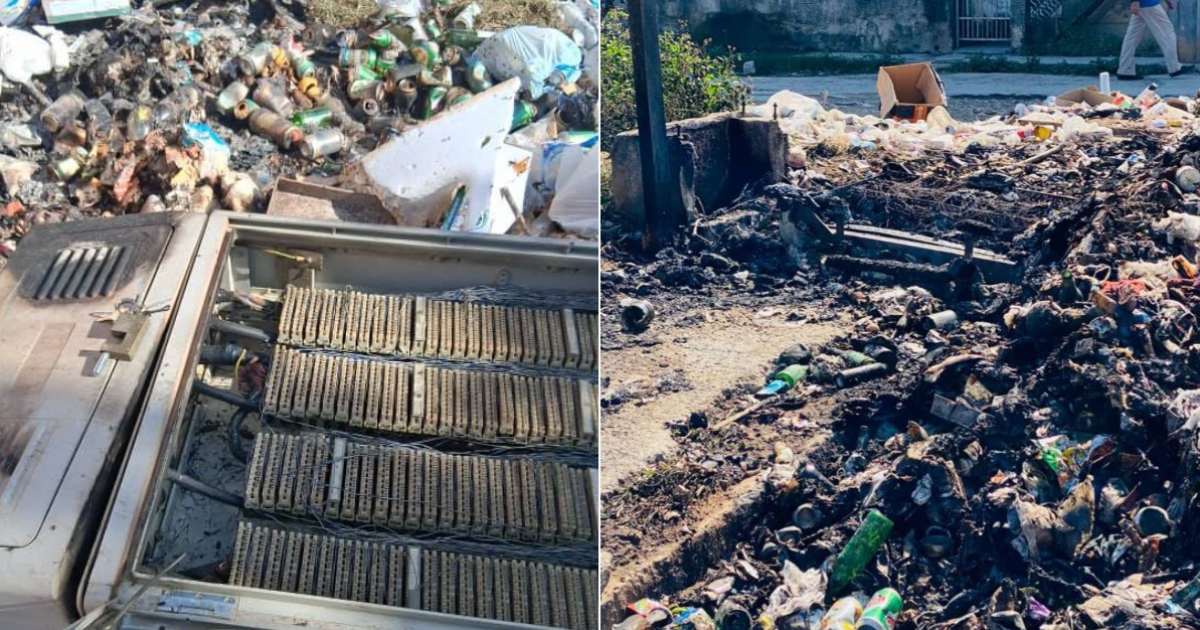
The Western Territorial Division of the Cuban Telecommunications Company (ETECSA) recently issued an "Urgent!" alert on Facebook, urging the public to refrain from burning trash near its technological facilities.
However, the public's reaction has been strikingly critical. Rather than viewing the announcement as a technical warning, many interpret it as an attempt to sidestep accountability amidst the collapse of public services.
In its post, ETECSA emphasized the dangers of burning waste near technological equipment, highlighting the adverse effects on its infrastructure, including cabinets, cables, and telephone poles.
Inappropriate practices, the company warned, lead to damage in telecommunications services, directly affecting users who will face long delays for service restoration due to limited resources for repairing or replacing damaged equipment.
ETECSA concluded by stressing, "Responsibility lies with everyone!"
A City Paralyzed by Crisis
The message emerges amidst a critical backdrop. Fuel shortages have virtually immobilized the country, severely impacting the collection of solid waste and turning entire Havana neighborhoods into makeshift dumpsites. Piles of garbage, left for days or weeks, have led to foul odors, an increase in rodents and insects, and escalating health risks.
With garbage trucks absent, residents resort to burning trash as the only immediate solution to reduce waste in front of their homes. This scene is repeated across various municipalities, with thick smoke invading residential areas and spaces near hospitals and schools.
In this context, ETECSA's call for "awareness" has been perceived by many as an attempt to shift blame onto the public, when the underlying issue is the government's inability to provide a basic service.
Civic Response: Outrage and Distrust
Reactions to ETECSA's post reveal anger and skepticism. One entrepreneur warned, "They're already making excuses, so brace for Internet outages."
A mother questioned the official narrative: "Investigate properly. I don't even think it's the public setting fire to dumps. It seems coordinated by the local government, considering how many dumps have burned recently..."
Another commenter pointedly stated, "This post addresses everything except the main problem: the collection of solid waste."
Echoing this sentiment, a Havana resident wrote, “They still don’t get that the main issue is that they don’t collect the garbage, and we have a horrible sanitation problem.”
One man directly challenged the company: "ETECSA, you're part of that 'everyone.' How often have you demanded the government, the main authority, to collect the garbage?"
An expatriate noted: "They're not directing the call to those who need to hear it."
One woman described the health implications: "Why not call on the government to be aware of the need to collect trash to prevent disease spread? I haven’t seen a garbage truck in my area for ages. The problem is affecting public health, increasing rats, mice, and mosquitoes, and spreading diseases."
Another citizen summarized the neighborhood's despair: "People burn trash because the smell is unbearable. Worms enter nearby homes. All the issues those dumps bring. The solution lies with the government; ETECSA shouldn't blame the citizens, they should address the government..."
One final comment suggested a more severe accusation: "Burning trash was proposed to reduce waste collection, but now there's more pollution due to chemicals from burning different plastics."
Widespread Complaints Across Municipalities
These grievances are not isolated. Music producer Laura Martín Nieto reported waste burning near Havana's Metropolitan Park, close to the Clinical Surgical Hospital, warning of visible respiratory issues and reminding that carbon monoxide is lethal.
Residents in areas like Lawton, Regla, and Diez de Octubre have reported similar scenes: dense smoke, strong odors, and waste accumulation due to the lack of daily collection. It was even reported that garbage trucks in San Miguel del Padrón dumped trash in front of a high school.
Citizens Without Institutional Protection
This situation highlights a widespread feeling of vulnerability. Citizens face simultaneous challenges of accumulating trash, toxic smoke pollution, and now warnings of potential disruptions in telecommunications services.
Meanwhile, state institutions are pointing fingers at each other or calling for "collective responsibility."
The ongoing crisis is not due to isolated neighbor actions but a chain of structural failures, including fuel shortages, lack of maintenance, and inability to ensure essential services.
When trash goes uncollected for days, burning becomes a desperate response rather than a whimsical act.
Within this context, ETECSA's message that "everyone is responsible" has been received as a dilution of accountability rather than an assumption of it.
The public, caught between service collapse and the lack of effective responses, perceives that state companies demand awareness while failing to provide solutions.
Public Concerns Over Waste Management and Telecommunications
Why is trash burning a significant issue in Havana?
Trash burning in Havana is primarily due to the inability of the government to provide effective waste collection services, leading residents to burn waste as a last resort to manage overflowing garbage.
How does trash burning affect telecommunications in Cuba?
Burning trash near ETECSA's installations can damage infrastructure like cabinets, cables, and telephone poles, leading to service disruptions and prolonged restoration times due to resource limitations.
What are the public reactions to ETECSA's warning?
The public has reacted with skepticism and frustration, viewing ETECSA's warning as an attempt to shift blame away from the government's failure to manage waste collection effectively.