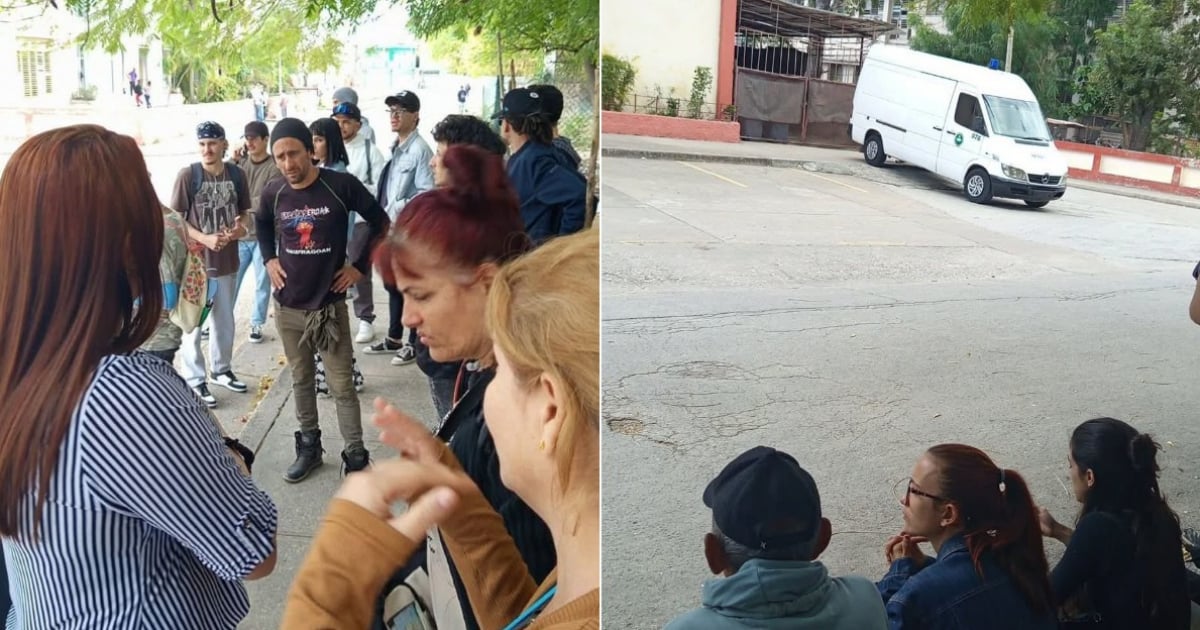
The habeas corpus hearing for Ernesto Ricardo Medina and Kamil Zayas Pérez, members of the independent project El4tico, is taking place this Thursday at the Holguín Provincial Court. The event is marked by a significant police presence and heightened tension, as reported by the independent platform, Citizenship and Freedom.
According to the organization, the courthouse was surrounded from early morning by police officers and plainclothes State Security agents who are monitoring both the premises and those approaching the area.
A prison transport truck is parked on a nearby street, amplifying the sense of control and intimidation surrounding what should theoretically be a procedure ensuring basic rights.
Citizenship and Freedom has also raised concerns about a particularly serious issue: the whereabouts of Yanet Rodríguez Sánchez, the activist who filed the petition and was expected to attend the hearing, are unknown.
The organization warned that she might have been detained by the DGI, preventing her from reaching the court, which, if confirmed, would be a direct violation of the right to defense and procedural transparency.
Adding to the complications, reports from the area indicate that internet service has been cut off, and there is no electricity supply, limiting communication and public monitoring of the court proceedings.
Meanwhile, family and friends of the young men are gathered outside the courthouse, calling on the community to come and show support.
"The habeas corpus petition is a crucial safeguard against arbitrary detention," Citizenship and Freedom emphasized, demanding:
- Immediate information on Yanet Rodríguez Sánchez's whereabouts.
- Procedural transparency and access to information.
- Restoration of basic services in the area.
- Full respect for judicial guarantees and the integrity of all involved individuals.
The police blockade, service interruptions, and potential temporary disappearance of the activist spearheading the petition illustrate the Cuban regime's reluctance to allow a transparent and visible process, even when the country's own law recognizes habeas corpus as protection against illegal detentions.
At stake is not only the fate of two young content creators but also the minimal credibility of a judicial system that rarely entertains such petitions and is now under the scrutiny of a society increasingly aware of its rights.
The El4tico Case
On February 9, the Holguín People's Provincial Court accepted a habeas corpus petition for Kamil Zayas Pérez and Ernesto Ricardo Medina, members of the independent project El4tico.
This unusual decision in the Cuban judiciary requires the Prosecutor's Office to officially explain why both remain detained, under what charges, and in what conditions.
Citizenship and Freedom confirmed that the First Criminal Chamber has processed the petition and ordered the Provincial Prosecutor to immediately address the legality of the detention, the charges, and the treatment received by the young men arrested on February 6.
The judicial order, signed by Judge Marcos Michel Betancourt Leyva, highlights that the detention occurred without notifying charges, specifying crimes, or complying with established legal formalities, potentially violating fundamental rights recognized even by the Cuban Constitution.
The document notes that Zayas Pérez and Medina were processed based on an unnumbered complaint, remain detained without known charges, and were arrested without legal requirements being fulfilled.
Therefore, the court considers the "immediate release" of both parties to be of interest.
The hearing was set for February 12 at 9:00 am, when the Prosecutor's Office must present the files and reports and submit to judicial examination of the case, theoretically breaking the opacity that has characterized the detention.
Yanet Rodríguez Sánchez filed the habeas corpus petition, having previously approached the court on behalf of the youths, demanding official information on their whereabouts, formal accusations, and detention conditions.
Both were detained during a dawn police operation and taken to the province's Criminal Investigation headquarters, known as "Everyone Sings," a center criticized in multiple complaints for violent interrogations and degrading treatment.
During the arrest, State Security agents confiscated computers, phones, cameras, and other equipment used by the youths to document their work, as reported by activists and civil society organizations.
The acceptance of the habeas corpus petition is a rare occurrence, placing the Prosecutor's Office under public and legal scrutiny amid growing opposition both inside and outside the Island to the detention of the El4tico youths, who have become symbols of the cost of attempting to exercise freedom of expression and depict the reality of the country in Cuba.
Frequently Asked Questions on Cuban Judicial Processes
What is the significance of a habeas corpus petition in Cuba?
In Cuba, a habeas corpus petition is a legal procedure intended to protect individuals from arbitrary detention by requiring authorities to justify the legality of a person's detention. It is a crucial safeguard for human rights, although rarely entertained in the Cuban judicial system.
Why is the El4tico case drawing significant attention?
The El4tico case is notable due to the unusual acceptance of a habeas corpus petition, which challenges the Cuban judicial norms. It highlights issues of arbitrary detention, lack of transparency, and suppression of freedom of expression, drawing attention from both local and international communities.