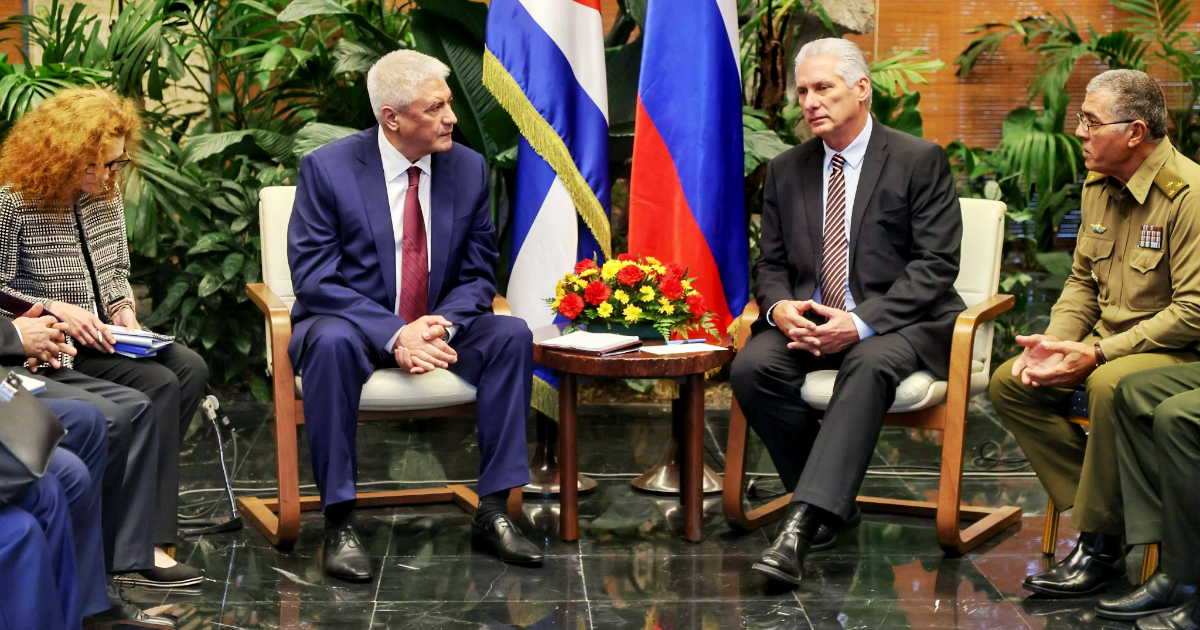
Havana once again became the stage for a politically charged visit. Russia's Minister of the Interior, Vladimir Kolokoltsev, began an official visit to Cuba and was welcomed by Miguel Díaz-Canel at the Palace. The Cuban leader described the meeting as of "great significance."
This was not merely a diplomatic courtesy. Amid international isolation, internal decay, and the recent collapse of its primary regional ally—Venezuela—the presence of Russia's top police official in Havana sends a clear message: Moscow remains a crucial strategic pillar for a government in crisis.
Kolokoltsev is not just any official; he is a general with political clout within the Kremlin's inner circle, head of the Russian police apparatus, and responsible for internal security, social surveillance, and dissent repression.
Since 2012, he has led the Ministry of the Interior and has faced sanctions from the United States and the European Union for his role in repressive policies and the war against Ukraine. His presence in Cuba is not about investments or cultural exchange but about security, control, and political survival.
The Role of Russia in Cuba's Current Crisis
Welcomed with honors by his Cuban counterpart, Lázaro Alberto Álvarez Casas, and greeted by the nonagenarian general Raúl Castro, Kolokoltsev's visit aims to strengthen internal control mechanisms amid social fragility and dwindling regional support.
To understand Kolokoltsev's presence in Cuba in January 2026, one must rewind to 2022. Before the invasion of Ukraine, Moscow hinted at the possibility of deploying military infrastructure on the island, including missiles and nuclear weapons—a symbolic maneuver to reaffirm its geopolitical pressure in the Caribbean against the United States.
Following the war's onset, Cuba aligned itself with Moscow. By 2023, visits from high-ranking Russian security officials and interactions between the Cuban Ministry of the Interior (MININT) and its Russian counterpart cemented an increasingly tight cooperation.
Security and Repression: The Heart of the Alliance
Since 2023, the collaboration between Cuba's MININT and Russia's Ministry of the Interior has intensified remarkably. Technical delegations, training programs, and high-level visits have established a cooperation axis in intelligence, surveillance, and cyber control.
Russia has provided Cuba with digital monitoring technologies, police software, and tactical training under the guise of "modernizing security." However, international observers see it as a fortification of repression and civil control mechanisms.
Kolokoltsev's visit at the end of 2023 set this course. His return in 2026, following the fall of Chavismo in Venezuela, reaffirms Moscow's role as an external guarantor of the Cuban regime's survival.
From Political Backing to Human Resources
In 2025, the Cuba–Russia relationship revealed its stark reality. Reports of thousands of Cubans being recruited to fight in Ukraine highlighted Havana's willingness to pay the price for its alignment.
Youths, driven by poverty or deceived by job promises, found themselves integrated into Russia's invading army. This episode confirmed that the alliance had evolved from diplomatic or military ties to a functional one: Cuba provides human resources and political loyalty, while Russia offers financial support, diplomatic backing, and security cooperation. In this scheme, Russia's Ministry of the Interior plays a central role.
The Vacuum Left by Venezuela
During the meeting with Kolokoltsev, Díaz-Canel referred to the "events of January 3rd," directly alluding to Nicolás Maduro's arrest and his regime's collapse.
The loss of Caracas, the main source of energy support for two decades, leaves Havana extremely vulnerable. Venezuela was the political and economic backbone of the Castro regime during the harshest "special period" years. Its fall forces Cuba to deepen its dependence on Moscow.
Without Venezuelan oil and with a collapsed economy, the regime focuses its strategy on internal security and maintaining Russian support in the UN Security Council.
A Message of Control and Alliance
Official discourse presents Kolokoltsev's visit as an act of "fraternal" cooperation, but it is essentially an alliance of convenience between two authoritarian systems.
For the Kremlin, Cuba is a symbolic piece in its influence strategy; for the Castro regime, Russia is a logistic lifeline and a source of legitimacy before its hardline base.
The real agenda includes meetings with MININT, the National Revolutionary Police, and top State Security officials. Diplomatic sources indicate discussions focus on "technical and operational cooperation mechanisms," a euphemism for exchanging strategies to maintain control during crises and protests.
Meanwhile, the country sinks deeper The visit happens during a particularly tough time for the Cuban people. Prolonged blackouts, rampant inflation, food and medicine shortages, and massive migration define daily life.
In this scenario, it is evident that the regime prioritizes retaining power over citizen welfare.
Every approach to Moscow reinforces this logic: the regime seeks to fortify itself, not reform. While Russia offers "security" assistance, the population remains without solutions to the issues driving them to despair or exodus.
A Message Both Internal and External The arrival of Vladimir Kolokoltsev in Havana is not a mere ceremonial visit but a political declaration.
Internally, it aims to reassure the ruling elite and MININT leaders that they are not alone. Externally, it intends to send a signal of defiance: Cuba remains in the Moscow–Havana axis despite international isolation and evidence that Moscow does not guarantee immunity or fulfill agreements with its partners.
However, this alliance, based on repression, dependence, and political calculus, is unlikely to bring relief to the Cuban people. Instead, it confirms that as the country sinks into poverty and hopelessness, the regime focuses on perfecting control tools.
Understanding the Implications of Kolokoltsev's Visit
What is the significance of Kolokoltsev's visit to Cuba?
Kolokoltsev's visit signifies the strengthening of collaboration between Russia and Cuba, particularly in areas of security and internal control, amid Cuba's increasing vulnerability after losing Venezuela as an ally.
How does Russia support Cuba in the current geopolitical climate?
Russia supports Cuba by providing military and security assistance, including training and technology, reinforcing the regime's internal control during a time of socio-political instability.
Why is Cuba increasing its dependence on Russia?
With the collapse of Venezuela, Cuba has lost a crucial energy and political ally. This situation has forced Cuba to rely more heavily on Russia for support, particularly in security and diplomatic backing.