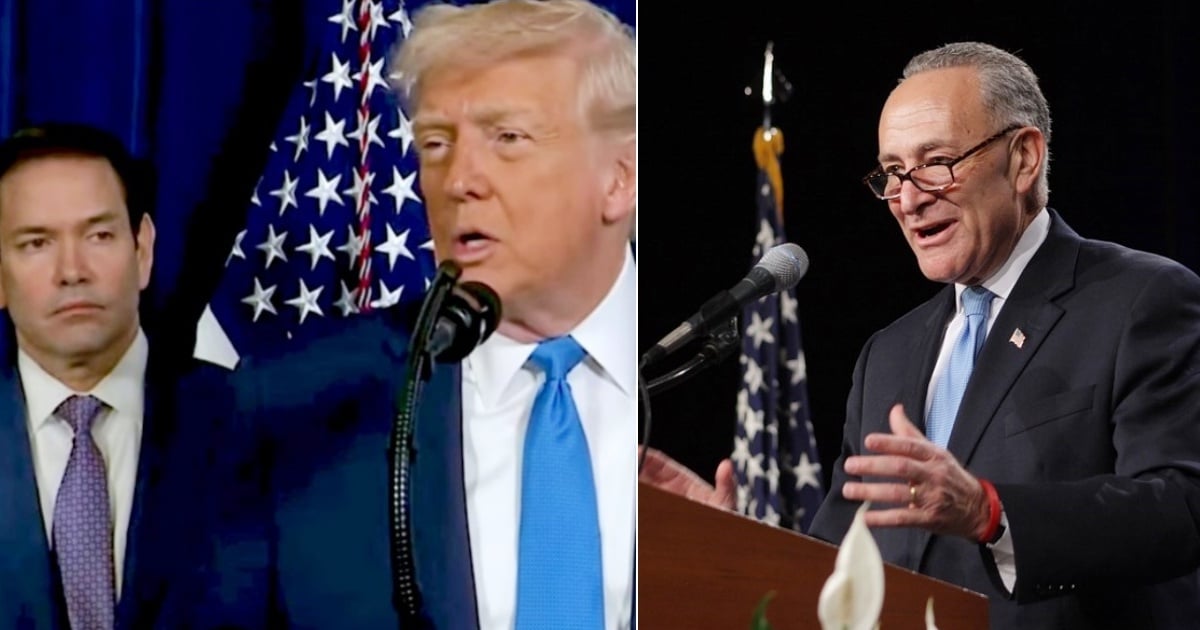
The aggressive military stance of Donald Trump's administration in Venezuela has caused concern within the United States Congress.
Earlier this week, during a briefing with top White House officials, Democratic Senator Chuck Schumer sought explicit assurances that the administration would not expand its military operations to other nations in the region.
Specifically, Schumer highlighted Cuba and Colombia. Unfortunately, the response he received was anything but reassuring.
"I asked for clear assurances that they were not planning operations in other countries, and I mentioned some of the ones you mentioned, including Colombia and Cuba, and their response was extremely disappointing," Schumer told the media after the meeting.
Although he did not divulge the specifics of the officials' responses, his reaction strongly suggested that the Republican administration has not ruled out further military actions.
Briefing Lacked Clear Answers
The closed-door session with White House officials, attended by members of both Congressional chambers, aimed to outline the details of the U.S. military operation in Venezuela, which culminated in the capture of Nicolás Maduro and his wife, Cilia Flores.
Among those present were Secretary of State Marco Rubio, Secretary of War Pete Hegseth, Attorney General Pam Bondi, CIA Director John Ratcliffe, and Joint Chiefs of Staff Chairman Dan Caine.
As the Democratic Senate Minority Leader, Schumer used the opportunity to voice a growing concern within Capitol Hill: Are other countries being considered targets by the Pentagon?
Despite his direct and pointed inquiries, the lack of a convincing response only intensified the unease.
"I was extremely dissatisfied when I asked if they were considering actions in other countries. It was genuinely troubling," the senator admitted.
Schumer lamented the administration's failure to provide "any real answers" regarding future plans, or even about the current deployment in Venezuela.
"I posed four simple questions. How many American soldiers are we sending to Venezuela? They don't know. How long will we govern Venezuela? They don't know. How much will this cost? They don't know. Which country is next? Unknown," he summarized to the press.
Escalating Diplomatic Tensions
The senator's remarks add to the mounting diplomatic tension, further fueled by Trump's recent statements hinting at possible intervention in Colombia and direct attacks on President Gustavo Petro.
For Schumer and other lawmakers, the administration's lack of transparency poses a threat not only to regional stability but also to democratic control over war decisions.
Trump Hints at Action in Colombia: "Sounds Good to Me"
Schumer's concerns were amplified by President Trump's comments on Sunday, just a day after the intervention in Venezuela.
When asked by reporters about a potential similar operation in Colombia, the President replied bluntly: "Sounds good to me."
Trump went further by directly addressing Colombian President Gustavo Petro, whom he labeled a "sick man who likes to make cocaine and sell it to the United States."
He added a veiled threat: "He better watch out," which has been interpreted as a significant escalation of tensions between Bogotá and Washington.
These remarks, made aboard Air Force One, have sparked strong condemnation from Colombia and fueled speculation about a potential U.S. military operation on Colombian soil.
Colombian Government Responds: "Repeated Aggression"
From the Casa de Nariño, the Colombian executive responded firmly to Trump's threats.
In a joint statement read by Angie Rodríguez, Director of the Presidential Administrative Department (DAPRE), cabinet ministers expressed support for President Petro and condemned what they termed a "repeated aggression and threat" by the U.S. government.
The statement warns that Trump's actions not only affect the Colombian leader but also compromise fundamental principles of international law and relations between sovereign nations.
The Colombian government attributes the rising tensions to Petro's international role in defending multilateralism, national sovereignty, the Palestinian cause, the fight against climate change, and world peace.
Cuba's Uncertain Future Amid Threats
Although Cuba has not been the target of direct statements like those against Colombia, Schumer specifically mentioned the island when seeking assurances of non-intervention.
The lack of a response from the U.S. executive has also raised concerns about the possibility of Cuba becoming a future target.
In the past, Trump has repeatedly linked Cuba with the Maduro government and narcotics networks like the Cartel of the Suns, designated as a Foreign Terrorist Organization by the State Department.
Under the same pretext—the war on drugs—the military operation in Venezuela was executed.
From Congress, some lawmakers warn that the national security narrative could extend to other countries in the region, particularly those critical of Washington's foreign policy.
Venezuelan Operation: Capture, Trial, and International Condemnation
Last Saturday, U.S. forces launched a surprise military operation in Venezuela, affecting areas in Caracas, Miranda, Aragua, and La Guaira.
The intervention resulted in the capture of President Nicolás Maduro and his wife, who were transported to New York under custody.
The Venezuelan government described the events as a "grave military aggression" and accused the attack of being a ploy to seize the country's strategic resources, such as oil and minerals.
On Monday, Maduro was presented before a Southern District of New York court, where he pleaded not guilty to several charges, including narcoterrorism offenses.
In his absence, Vice President Delcy Rodríguez assumed the role of acting president.
The international community has reacted with concern. Countries like Russia have demanded Maduro's release and condemned the operation.
"Venezuela must have the right to decide its fate without any foreign intervention," stated the Russian government in a communiqué.
Is U.S. Foreign Policy Out of Control?
The White House has justified the intervention in Venezuela as a necessary step to protect U.S. security, citing that most of the drugs entering the country originate from the South American nation.
In recent months, the U.S. Navy has reported the sinking of alleged "narco-boats" and the execution of nearly a hundred suspected drug traffickers in operations in the Caribbean and the Pacific.
But for Schumer and other senators, the real danger lies in the absence of a coherent and transparent plan. The fear is not only the expansion of military actions but the precedent set when the executive acts without consulting Congress or the international system.
"They think they can take the first step, overthrow Maduro, and have no idea what steps two through ten will be," Schumer warned.
"That is very concerning to all of us," he added.
Amid this confusion, one question remains unanswered: Which country will be next?
Key Questions About U.S. Military Actions in Latin America
What countries did Senator Schumer express concern about regarding U.S. military action?
Senator Schumer expressed concerns about potential U.S. military actions in Cuba and Colombia.
What was the outcome of the U.S. military operation in Venezuela?
The U.S. military operation in Venezuela resulted in the capture of President Nicolás Maduro and his wife, Cilia Flores, who were taken into custody in New York.
How did President Trump respond to questions about military action in Colombia?
President Trump responded to questions about a potential military operation in Colombia by saying, "Sounds good to me," and issued a veiled threat to Colombian President Gustavo Petro.
What was Colombia's reaction to Trump's statements?
The Colombian government responded firmly, condemning Trump's statements as "repeated aggression and threat" and expressing support for President Gustavo Petro.