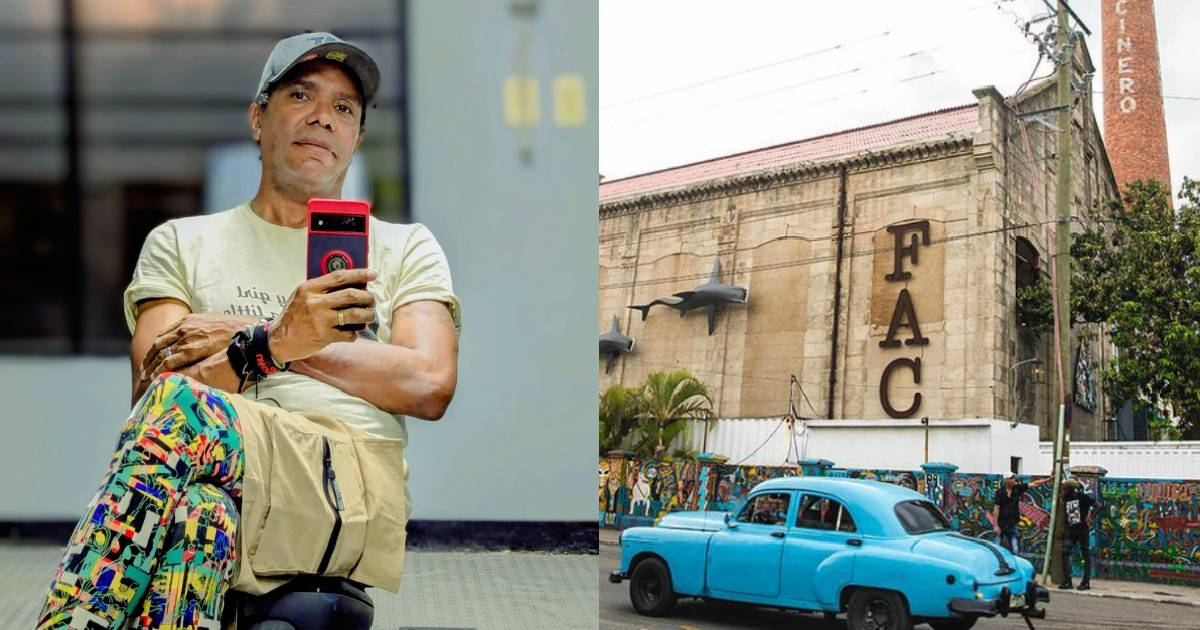
Cuban troubadour Raúl Torres has publicly defended the Cuban Art Factory (FAC), describing it as "a sanctuary worth protecting" amidst a heated controversy over allegations of racial discrimination against the cultural venue managed by musician and composer X Alfonso.
In a detailed Facebook post, Torres expressed his stance "with caution yet clarity," dismissing criticisms aimed at the FAC following an incident in late December when a young man claimed he was denied entry under the "right of admission" policy.
The musician believes there has been "too much commotion" surrounding a project he views as unparalleled in the Cuban cultural landscape.
Torres shared his personal connection with the FAC, recalling performances he gave there years ago at the invitation of Carlos Alfonso. Despite his artistic path diverging later on, he emphasized that he was never barred or blacklisted from the venue.
He recounted a conversation with X Alfonso, highlighting it as an example of integrity, where the FAC's founder made it clear that the venue operates independently of the government and state institutions.
Torres denied witnessing or experiencing any racist behavior within the space. "I never believed it," he wrote, affirming that the FAC has always been a haven where "the only thing it segregates is beauty."
In his view, it is a creative workshop where skin color fades into shared culture and art serves as common ground.
Without claiming the institution is "perfect," Torres urged for the protection of what he termed "a daily miracle" and criticized the buildup of resentment and political manipulation of the conflict.
"We have bigger issues to address," he noted, while urging not to dismantle one of the few cutting-edge cultural spaces that, in his words, still exist in Cuba.
The singer-songwriter's remarks come after the FAC publicly countered accusations from the Cuban Institute of Music and other official media, labeling them as "false, shameful, and defamatory."
In a statement released on social media on January 1, the FAC condemned an official campaign to discredit an independent project that has championed inclusion and diversity for over a decade.
The cultural center stressed that the controversy escalated after they decided to honor Celia Cruz (1925-2003) on what would have been her 100th birthday, an event abruptly censored by authorities.
It also underscored its economic and artistic independence, as well as its community outreach during emergencies and the pandemic.
Artists, intellectuals, and social media users have expressed support for the FAC, including musicologist Rosa Marquetti and numerous citizens who see the official attack as unjust.
For many, the controversy highlights the growing tension between autonomous cultural spaces and the regime's institutional framework, in a context marked by attempts at control and censorship.
Cuban Art Factory and Cultural Autonomy
What sparked the recent controversy involving the FAC?
The controversy began after a young man alleged he was denied entry to the FAC due to the "right of admission" policy, leading to accusations of racial discrimination against the venue.
How has the FAC responded to accusations of discrimination?
The FAC has refuted the accusations, describing them as "false, shameful, and defamatory," and has highlighted its longstanding commitment to inclusion and diversity.
Why is the FAC considered independent from the Cuban government?
The FAC operates without government control, maintaining both economic and artistic independence, and does not respond to state institutions.