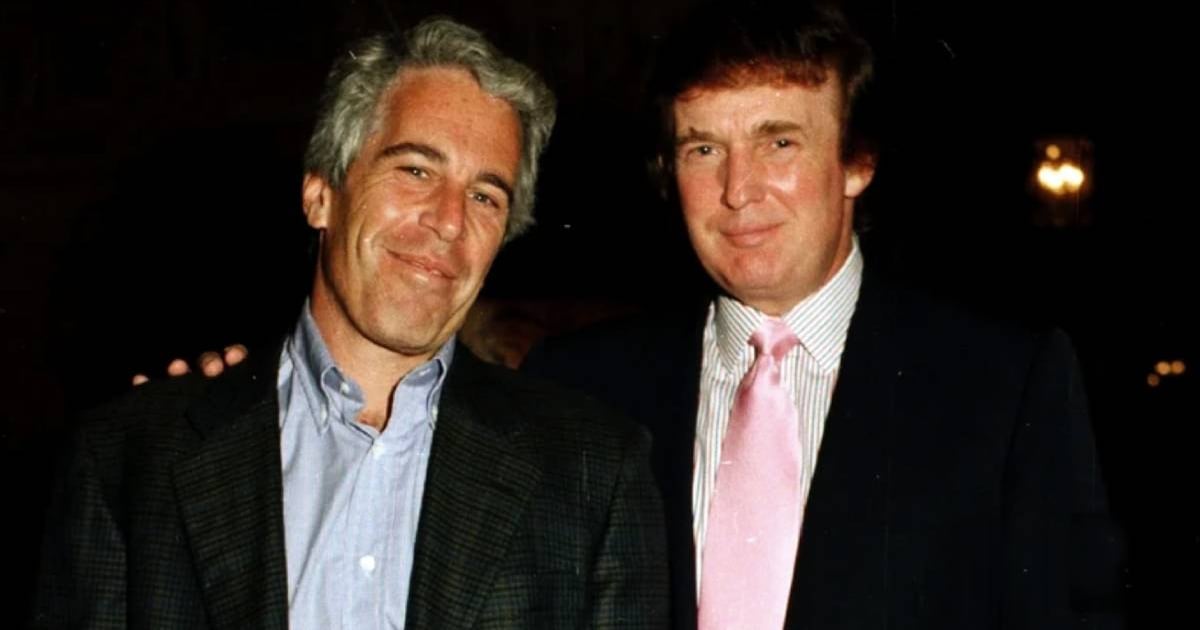
In a landmark decision, the United States House of Representatives overwhelmingly passed a resolution on Tuesday requiring the Department of Justice to disclose all documents related to the late financier and sex offender Jeffrey Epstein.
This initiative, led by Democrats and supported by nearly all Republicans, must now advance to the Senate before reaching President Donald Trump's desk for approval. Upon hearing the vote's outcome, Trump sharply responded to a White House reporter.
"You're a terrible person and a terrible reporter... I have nothing to do with Jeffrey Epstein. I kicked him out of my club years ago because I thought he was a sick pervert; turns out I was right," Trump asserted when questioned by the press.
The resolution saw an overwhelming 427 votes in favor, with only one dissenting vote from Republican Clay Higgins of Louisiana, who argued that the release could harm innocent individuals.
The decision was met with applause from the Congressional gallery, where families of victims involved in Epstein's sex trafficking network were present to witness the vote.
Republican support was unexpected but came after a change in stance by President Trump, who had previously restricted access to some of the files during his first term.
On Sunday, Trump urged his party to support the measure, stating, “I have nothing to hide.” His name appears in hundreds of emails and documents already published by the Congressional Oversight Committee, including three suggesting he was aware of Epstein’s criminal activities.
Democratic leader Jamie Raskin, who spearheaded the initiative, praised the bipartisan vote: “We want the whole truth to come out. Not even the British monarchy would have tolerated this cover-up,” he remarked, referencing Prince Andrew of England, also implicated in Epstein’s files.
Hours before the vote, survivors and families demanded full transparency on the Capitol steps.
Sky Roberts, brother of the late Virginia Giuffre—one of Epstein's primary accusers—urged lawmakers to “stop politicizing the victims’ pain” and promised to continue fighting for justice.
“We want truth, justice, and accountability. No more excuses, no more silence,” Roberts declared to the media.
The Congressional Oversight Committee has already released over 23,000 pages of case files, including letters, emails, and financial records.
Among these, a 2003 letter from Trump to Epstein containing sexual references and explicit signatures has sparked significant controversy.
Other documents reveal that Trump “spent hours” with one of the victims at Epstein's residence and that the financier wrote to Ghislaine Maxwell—his partner, sentenced to 20 years in prison—that the then-magnate “knew about the girls.”
Trump has countered by claiming the files will prove that “Epstein was a Democrat” and that the investigation “is a political ploy to distract from Republican achievements.”
The resolution now awaits a Senate vote. If passed, President Trump has promised to sign it “as soon as it hits my desk.”
Senate Democratic Minority Leader Chuck Schumer challenged the president to act: “Let’s make it easier. Just release the files now.”
If enacted, the law would mandate the full disclosure of records, including the names of political, business, and entertainment figures linked to Epstein.
The vote was enabled by a discharge petition, a legislative mechanism allowing a bypass of House leadership to force a direct vote. A majority of the 435 representatives signed the request, despite initial resistance from House Speaker Mike Johnson.
Analysts suggest this decision could usher in a new era of political and judicial tension in Washington, as the remaining documents might implicate figures from both parties, as well as moguls, artists, and scholars associated with Epstein over two decades.
Understanding the Implications of the Epstein Files Release
What prompted the House of Representatives to pass this resolution?
The resolution was driven by a demand for transparency and accountability in the case of Jeffrey Epstein, with bipartisan support reflecting the urgency to uncover the full extent of his criminal activities and associations.
What are the potential consequences of releasing Epstein's files?
Releasing Epstein's files could have significant legal and political ramifications, potentially implicating high-profile individuals across various sectors, leading to further investigations and legal actions.
How did President Trump react to the House's decision?
President Trump reacted defensively, asserting that he had disassociated from Epstein years ago and emphasizing that he has nothing to hide, while suggesting the investigation is politically motivated.
What is the next step for this resolution?
The resolution now moves to the Senate for a vote. If approved, it will be sent to President Trump for his signature to become law.