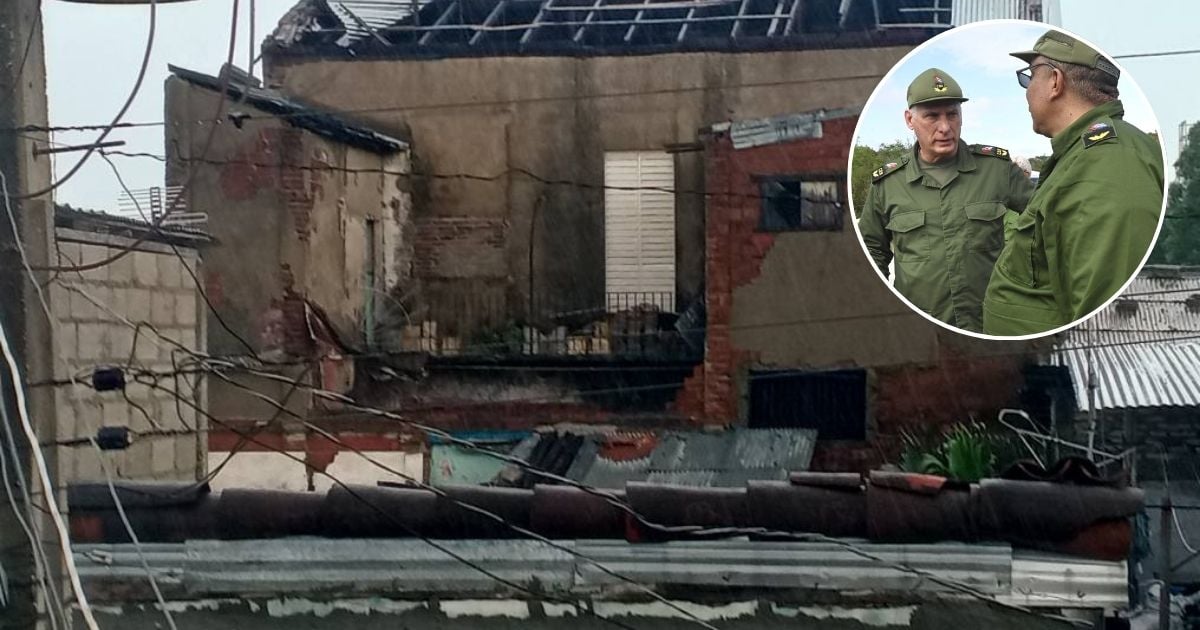
Cuban leader Miguel Díaz-Canel declared on Saturday that the devastation caused by Hurricane Melissa in Guantánamo was "minimal" and that the province could rebound using its own "strength and resources."
In a post on the social media platform X, the president praised local authorities and spoke of a "spirit of victory," a narrative starkly contrasting with the dire conditions and discontent that have plagued Guantánamo residents since the cyclone's onslaught.
While Díaz-Canel attempts to portray an image of control and resilience, reports from the province tell a different story. Residents describe a grim reality marked by shortages of water, electricity, and food, street protests, and a growing sense of abandonment among the populace.
The government’s efforts, presented by the leader appointed by Raúl Castro as efficient and supportive, are perceived by many as an attempt to downplay the crisis and quell social unrest.
Local Protests Reveal Growing Discontent
Just hours before Díaz-Canel's statement, dozens of residents in the Ho Chi Minh neighborhood of Guantánamo took to the streets to protest the lack of basic services and the absence of official responses.
"We are desperate. We have no electricity, no water, and no one gives us answers. There are children and elderly people here who cannot continue like this," one resident told CiberCuba anonymously. The protest, which gathered around a hundred people, was dispersed by police and State Security agents.
Protesters also reported irregularities in the distribution of aid and criticized the slow recovery efforts. "This is a dictatorship, the whole world knows it," one protester stated, while others shouted, "We are not dogs, we are people," and "How long will the abuse continue?"
Official Narratives vs. Harsh Realities
Although state media outlets like Radio Guantánamo have emphasized the absence of human casualties and that reservoirs reached optimal levels after the rains, images circulating on social media show flooded streets, destroyed homes, and families still waiting for help.
The disconnect between the official narrative and the everyday experiences of citizens reinforces the perception that the regime is attempting to minimize the severity of the damage to maintain its narrative of control.
Hurricane Melissa has significantly impacted eastern Cuba, with damage also reported in Santiago de Cuba, Granma, and Holguín. In these provinces, power outages, food shortages, and infrastructure deterioration exacerbate the social crisis that was already affecting the region before the cyclone's arrival.
Despite the government's attempts to convey calm, the reality in Guantánamo reveals a populace exhausted from broken promises and a state that remains absent when most needed.
Understanding the Aftermath of Hurricane Melissa in Guantánamo
What did Díaz-Canel claim about the damage in Guantánamo?
Díaz-Canel claimed that the damage caused by Hurricane Melissa in Guantánamo was minimal and that the province could recover using its own resources.
How have residents of Guantánamo responded to the government's statements?
Residents have expressed discontent and frustration, protesting the lack of basic services and accusing the government of being absent and negligent in addressing their needs.
What challenges are Guantánamo residents currently facing?
Residents are struggling with shortages of water, electricity, and food, along with the slow pace of recovery efforts following Hurricane Melissa.