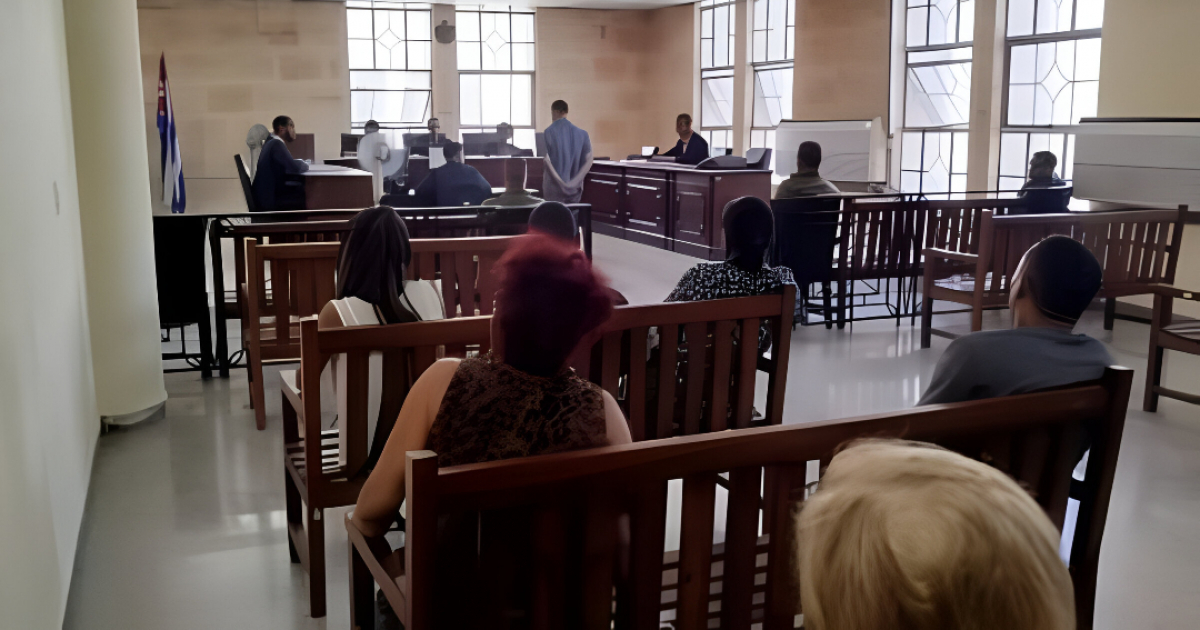
Yordan Revé Abrahante, a 21-year-old, tragically lost his life after being stabbed during a dispute in Havana. The perpetrator, Gabriel Peña Oviedo, received a 25-year prison sentence. This information was confirmed by the Ministry of the Interior (MININT), which released a statement from the Provincial Popular Court of Havana detailing the outcomes of the public trial held on September 23, related to case number 133 of 2025.
According to the court's findings, Peña was found guilty of murder after it was proven that he engaged in a violent family confrontation while intoxicated, during which the victim was present. In the heat of the argument, without any prior warning, Peña used a knife to attack the young man, resulting in his immediate death and leaving him on the street.
The court considered the defendant's social conduct, the severity of the incident, its impact on the community, and the anguish caused to the victim's family. Additionally, the act was seen as an irreparable violation of the most fundamental human right: the right to life.
Authorities assured that throughout the legal proceedings, all procedural guarantees and due process, as outlined by the Constitution and the current Criminal Procedure Law of Cuba, were upheld. Both the defendant and the prosecution have the right to appeal the verdict.
The 25-year prison sentence for Gabriel Peña Oviedo for the murder of Yordan Revé Abrahante sparked heated discussions on social media. None of the comments gathered expressed satisfaction with the judicial decision.
"Twenty-five years is the maximum severity, but with benefits, he could be eligible for parole in 15. Those who commit murder deserve the death penalty," commented Dqva Jaime, reflecting concerns that the punishment might not be sufficiently deterrent.
Similarly, Gustavo Lázaro Comet Rueda questioned the fairness of the punishment: "Twenty-five years in prison for taking a life, this leniency in our laws is what contributes to the rising violence in Cuba."
Other users criticized the consistency of the legal system. Luis Castillo pointed out the application of the so-called Dangerousness Law, noting that "procedural rights in Cuba may exist in law books, but they are not enforced."
There were also calls for harsher penalties. "It should have been life imprisonment; it was a murder, and he left the victim in the street," said Nadia Tocabens. Similarly, Yoan Pérez Montero questioned, "How long will our laws keep forgiving these miscreants who disturb families' peace?"
For Pedro Deleon, the only solution is "the death penalty, except in cases of self-defense." Meanwhile, Yaylin Morales argued that the sentence was "below expectations" and called for maximum security sentences.
Discontent was also evident in more blunt expressions, such as Elier González Milian, who described the sentence as insufficient, stating, "Kill someone in cold blood, and you're out in ten years."
Recently, the Cuban regime showed remarkable efficiency in a high-profile criminal case, particularly because it involved a police officer. It was the murder of a police officer in Caibarién, whose alleged perpetrator was apprehended just days after the crime was confirmed. The arrest followed a swift investigation led by the Ministry of the Interior.
The case drew significant media and state attention, especially after the fallen officer's funeral—a police captain—took place in a public ceremony attended by dozens and covered by official media outlets. The Office of the Attorney General quickly issued a statement, revealing the identity of the detainee and emphasizing the seriousness of the crime in an official announcement that confirmed the filing of charges.
Key Questions About the Havana Stabbing Case
What was Gabriel Peña Oviedo convicted of?
Gabriel Peña Oviedo was convicted of murder for the fatal stabbing of Yordan Revé Abrahante during a family dispute in Havana.
What factors did the court consider when sentencing Peña?
The court took into account Peña's social conduct, the severity of the crime, the community impact, and the grief caused to the victim's family, as well as the violation of the right to life.
How did the public react to Peña's sentencing?
The public reaction was largely critical, with many expressing dissatisfaction on social media, arguing that the sentence was too lenient and calling for harsher penalties.