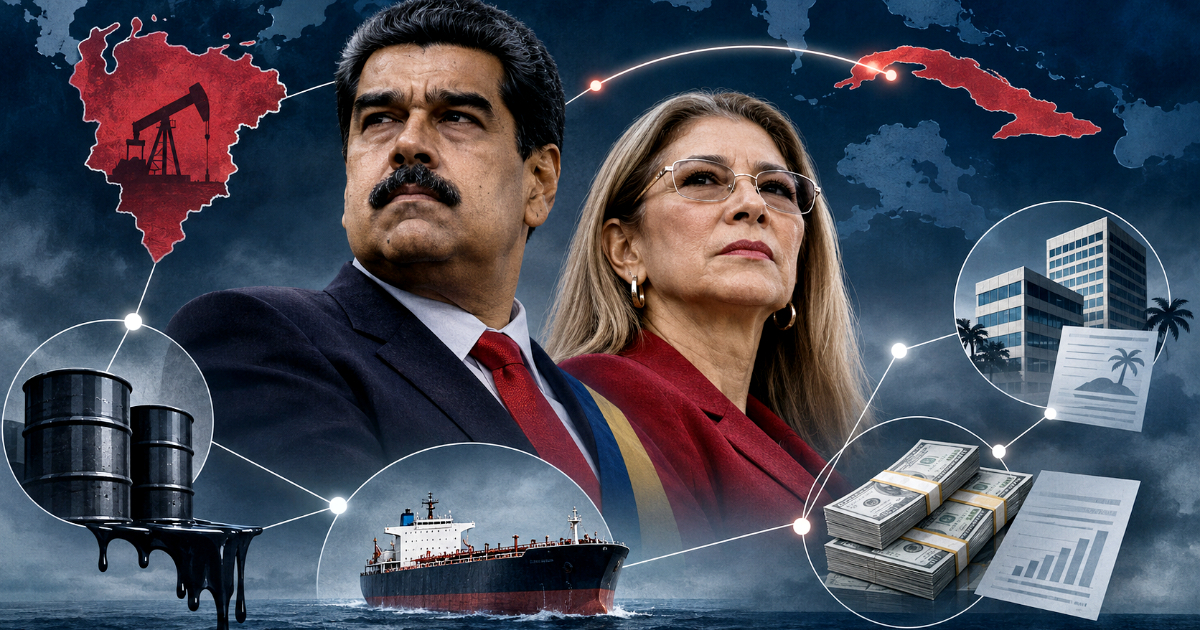
An intricate power structure, connecting thousands of officials, businesspeople, financial intermediaries, family members, and state institutions, with Nicolás Maduro positioned as the chief orchestrator and Cilia Flores acting as the link between the government apparatus and private enterprises, has been unveiled by Transparency Venezuela. This investigation has been submitted to the U.S. judiciary.
The comprehensive 170-page report, titled "Corruption, State Capture, and Transnational Networks in Venezuela," outlines 154 corruption cases, encompassing 13,521 individuals, 30,467 relationships, and 865 companies. The report highlights the mechanisms that enabled the looting of public resources during the era of Chavismo.
In 96 of the analyzed cases alone, the resources involved exceed $36.115 billion. The remaining 58 cases have yet to disclose the financial magnitude of the operations involved.
Mercedes De Freitas, director of Transparency Venezuela, suggested in an interview with Infobae that the economic damage could reach into the hundreds of billions of dollars.
The organization has shared the document with the Federal Prosecutor's Office for the Southern District of New York, collaborating with U.S. investigations due to the ineffectiveness of Venezuelan justice.
The dossier details 110 cases brought to legal attention across 26 countries, with 37 of those in the United States. Maduro and Flores remain under legal proceedings following their capture on January 3rd.
The Central Role of Maduro in the Corruption Network
Based on a decade of collecting trade records, official gazettes, judicial files, and other documentary sources, the study places Maduro at the center of the analyzed structure.
His immediate network includes 496 individuals directly associated with him. Nearly 89% of his direct interactions are linked to appointments and public positions, underscoring the significance of presidential powers in shaping the network.
The report outlines a process of state capture through the concentration of power within the Executive, subjugation of the judiciary, weakening of oversight bodies, militarization of economic activities, and gradual erosion of transparency mechanisms.
Highlighted figures include Delcy Rodríguez, acting president of Venezuela, who has held various significant positions under Maduro, including roles in the Ministry of Foreign Affairs, Vice Presidency, Ministry of Economy and Finance, the Central Bank, and the oil sector.
The Business Ventures of the Presidential Family
While Maduro's connections focus on state apparatus, Cilia Flores' network exhibits a pronounced familial, business, and financial component.
Transparency Venezuela identified 201 companies linked to the so-called presidential family, engaging in real estate, financial, commercial, oil, mining, and construction activities, among others.
At least 21 of these firms entered contracts with state bodies, and seven were awarded foreign currency at preferential rates.
One of the key figures is Carlos Erik Malpica Flores, Cilia Flores' nephew. He held the position of National Treasurer and was appointed by Maduro as a director of Petróleos de Venezuela (PDVSA) in December 2014 and Vice President of Finance for the oil company in June 2015.
His career path links public resource management with business structures and oil operations that have been the subject of international investigations.
The Plundering of PDVSA
The state oil company plays a critical role in the examined network. One notable case is the Money Flight operation, where an initial financial obligation of $57.4 million resulted in disbursements of $1.2 billion through currency exchange operations.
Another significant scandal is the so-called PDVSA-Cripto, involving the sale of Venezuelan oil through intermediaries and opaque financial mechanisms.
According to Transparency Venezuela, from 2019 to 2023, at least $16.96 billion from oil operations did not reach state coffers.
The scandal led to the downfall of then Oil Minister Tareck El Aissami, who was subsequently detained by Venezuelan authorities.
The Cuban Regime's Role and "El Cangrejo" Connections
The report devotes a section to Cuba, whose relationship with Chavismo is considered deeper than that of other international allies, due to its involvement in security, intelligence, and institutional assistance areas.
The organization also examines the role of Cuban state company Cubametales in international circuits for marketing sanctioned Venezuelan oil.
Based on internal PDVSA sources cited in the document, Cubametales managed 31 crude shipments from Venezuela during 2025 and held contracts to acquire approximately 65,000 barrels daily.
Despite Cuba's severe energy crisis, some of this oil was reportedly resold to Asian intermediaries or temporarily stored in Cuba before being sent to China.
The report links these operations with the tanker Skipper, seized by the U.S. in December 2025, and the company Shinefull Energy, associated with Panamanian businessman Ramón Carretero Napolitano.
Carretero is connected to Carlos Erik Malpica Flores and Raúl Guillermo Rodríguez Castro, grandson of Raúl Castro, known as "El Cangrejo."
A prior investigation by CiberCuba revealed the challenges in tracing the destination of oil shipments consigned to Cubametales and the connections between the Panamanian businessman and members of the ruling families of Cuba and Venezuela.
Transparency Venezuela asserts that the Cuban regime acted not only as a beneficiary of Venezuelan oil but also as an intermediary in its international marketing. The document also attributes the protection of Maduro and Cilia Flores' inner circle to Cuban personnel.
A System Resilient to Maduro's Departure
One of the study's most concerning conclusions is that the removal of Maduro from the political scene does not necessarily dismantle the system built over years.
Through computer simulations, researchers determined that even if the top ten intermediaries were removed, about 75% of the network's members would remain connected to its core.
The authors clarify that an individual's position within this structure does not automatically imply participation in specific crimes, which is a matter for the courts to decide.
The organization calls for the publication of oil contracts, the identification of the true owners of beneficiary companies, public debt audits, and greater international judicial cooperation to recover resources stolen from Venezuela's assets.
Understanding the Corruption Network in Venezuela
How extensive is the corruption network involving Nicolás Maduro?
The corruption network involves thousands of officials, businessmen, financial intermediaries, and family members, with over $36 billion in resources implicated in just 96 cases.
What role does Cilia Flores play in the corruption network?
Cilia Flores acts as a crucial link between the government and private businesses, with her network showing a strong familial, business, and financial component.
What is the impact of PDVSA in the corruption scheme?
PDVSA is central to the corruption network, with operations like Money Flight and PDVSA-Cripto leading to significant financial losses for the state.
How is the Cuban regime involved in the Venezuelan corruption network?
The Cuban regime acts as both a beneficiary and intermediary in the marketing of sanctioned Venezuelan oil, with Cuban personnel allegedly protecting Maduro's inner circle.