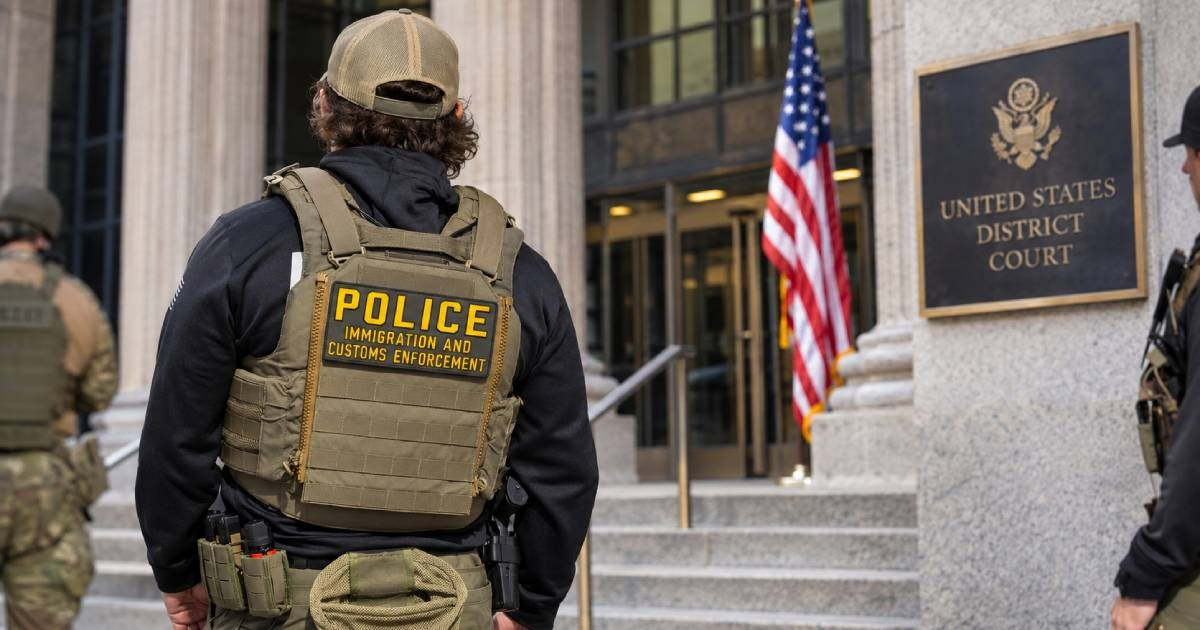
A federal judge in Florida has mandated that U.S. immigration authorities grant a bond hearing to a Cuban national detained by the Immigration and Customs Enforcement (ICE) in Miami, or alternatively, release him under reasonable supervision conditions.
Judge Beth Bloom from the Southern District of Florida ruled on November 25 that the detention of the migrant under the mandatory hold provisions cited by the U.S. government was in violation of the country's laws.
The court's decision states that Michel Martínez Mujica entered the United States on September 22, 2023, under the humanitarian parole program for Cubans.
By November 29, 2024, he had applied for permanent residency through the Cuban Adjustment Act, a process still pending resolution. Martínez Mujica submitted his residency application before his parole expired and had been awaiting a response from USCIS for over a year when he was apprehended by ICE.
On August 28, he was detained by ICE agents following a traffic stop and subsequently held at the Krome Detention Center in Miami.
Authorities initiated deportation proceedings against him on September 4 of this year, classifying him as an "alien seeking admission," a designation used to justify detention without bond eligibility.
Judge Dismisses ICE's Arguments
Martínez Mujica filed a habeas corpus petition challenging the legality of his detention, asserting that he had adhered to the established process to regularize his immigration status.
In her decision, Judge Bloom stated that after the expiration of his humanitarian parole, the authorities could not apply the mandatory detention provisions meant for those attempting to enter the country at the border.
The judge concluded that his situation should be evaluated under immigration laws that allow for a bond hearing request, rather than those that impose mandatory detention.
She also based her decision on a precedent from the Eleventh Circuit Court of Appeals, which on May 6 recognized the right of certain detained immigrants within the U.S. to request a bond hearing.
This precedent, binding for federal courts in Florida, Georgia, and Alabama, rejected the government's interpretation that extended mandatory detention to certain immigrants already within the country.
Additionally, the judge explained that resolving Martínez Mujica's residency application should be pursued through a different legal action than the habeas corpus petition.
The government has until December 2 to either grant him a bond hearing or release him. His next immigration hearing is scheduled for the following day.
Should the hearing proceed, authorities will need to provide clear and convincing evidence that Martínez Mujica poses a danger or flight risk to justify continued detention. They must also report the hearing's outcome to the court within 24 hours and explain any decision to deny bond.
Nonetheless, Judge Bloom determined she lacked jurisdiction to review the commencement of deportation proceedings and that the request to expedite his residency application resolution should be handled through a separate legal action.
Just two days before Bloom's ruling, another federal judge ordered a bond hearing for a 34-year-old Cuban woman detained by ICE in Florida or to release her.
The immigrant had entered the United States on parole in June 2024 and was taken into immigration custody in October 2026, several months after her parole expired.
In August, federal judge Sheri Polster Chappell also ordered the release of a Cuban who had entered via CBP One, received parole, and applied for permanent residency under the Cuban Adjustment Act.
In that instance, the judge found that immigration authorities had violated the immigrant's due process rights and dismissed the government's arguments for maintaining mandatory detention.
This ruling is part of a continually evolving immigration landscape. Follow all developments on detentions, deportations, and immigrant rights in our U.S. Immigration section.
Key Questions About Cuban Immigration and Legal Challenges
What legal precedent did Judge Bloom refer to in her ruling?
Judge Bloom referred to a ruling from the Eleventh Circuit Court of Appeals, which recognized the right of certain detained immigrants within the U.S. to request a bond hearing.
What is the significance of the Cuban Adjustment Act in this case?
The Cuban Adjustment Act allows certain Cuban nationals to apply for permanent residency in the U.S., which Michel Martínez Mujica did before his parole expired, making his pending application a key element of his case.
How does this case impact future immigration detention cases?
This case may set a precedent for challenging mandatory detention without bond hearings for certain immigrants already present in the U.S., potentially influencing future cases.