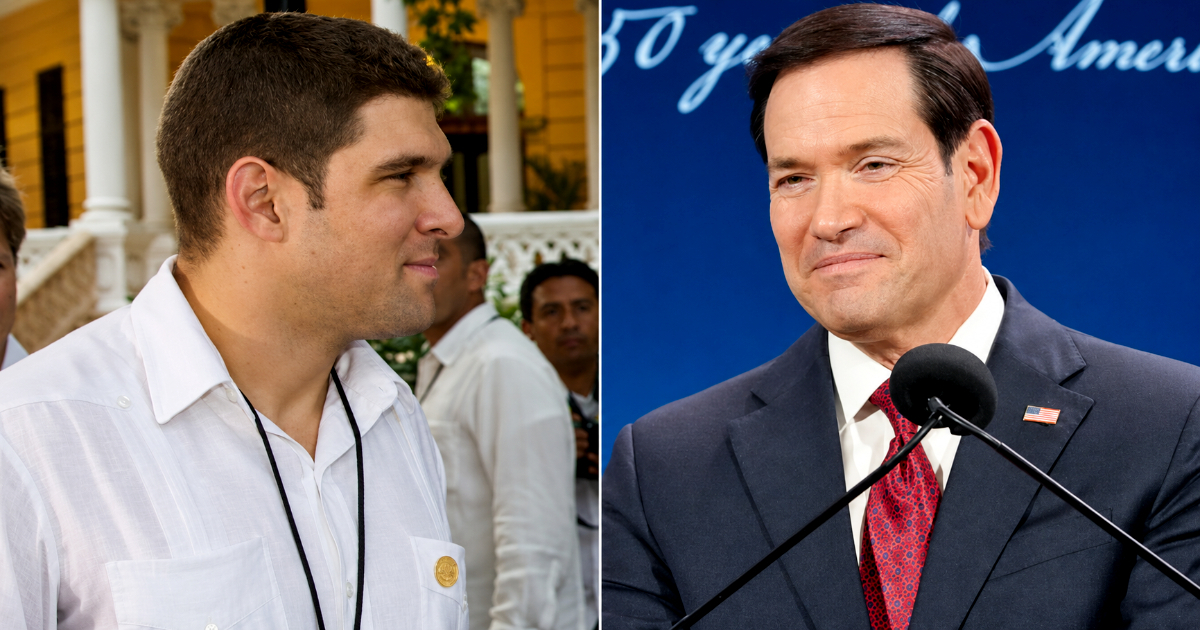
Why did the Trump administration choose Raúl Guillermo Rodríguez Castro, nicknamed "The Crab," as a mediator in discussions with Havana, bypassing Miguel Díaz-Canel and the formal channels of the Ministry of Foreign Affairs?
In a recent interview with El País, former Cuban ambassador Carlos Alzugaray shared his insights, delving into the uncertainties surrounding the political rise of Raúl Castro's grandson and the internal tensions his presence might be causing within the Cuban regime.
Exploring Rubio's Shift in Strategy
Alzugaray suggested that Senator Marco Rubio altered his approach towards Cuba after realizing that the situation in Venezuela had not led to the Cuban regime's collapse. In response, Washington sought a negotiated solution by engaging someone within the Castro lineage.
"Rubio approaches this with his Miami mentality. In Miami, Cuba isn't seen as a country but as the Castro's estate. Thus, negotiations must involve a Castro," Alzugaray remarked critically.
This perspective raises an uncomfortable question for Havana: to what extent do the officially recognized authorities have the power to negotiate independently of Raúl Castro and his family's influence?
Washington's Limited Options
According to Alzugaray, Washington's choices were constrained. With Fidel Castro deceased, Raúl retired, and Alejandro Castro Espín, who had been involved in talks with the Obama administration, sidelined, the U.S. seemingly turned to Raúl Guillermo.
"So, it looks like they picked Raulito, and he accepted," Alzugaray explained.
The Proposal and the Shadow Players
The former ambassador claimed that the U.S. proposal included the Castro family's relocation to Moscow with their funds and Díaz-Canel's resignation.
While Alzugaray did not provide documentary evidence of this offer, he introduced a lesser-known element: the potential involvement of a brother of the late General Luis Alberto Rodríguez López-Calleja in the discussions.
"Everything about this has been opaque. I'm not sure if Raulito attended these meetings alone. Recently, I was told that he was accompanied by a brother of his father," he noted.
In a July interview with USA Today, Raúl Guillermo expressed his willingness to negotiate with U.S. representatives, despite claiming he never intended to enter politics.
Power Dynamics and Family Influence
Alzugaray linked Raúl Guillermo's positioning to his father's death in July 2022 and the Castro family's need to maintain political influence. However, he questioned the grandson's independent authority within military and political structures.
"He has a playboy reputation, which isn't well-regarded in Cuba. I'm unsure if the generals support him. If Raúl were to pass away tomorrow, what backing would he have?" he pondered.
Alzugaray acknowledged that elevating the grandson over institutional leaders might unsettle high-ranking regime officials.
"Suddenly, you elevate your grandson above generals and Díaz-Canel, whom you promoted. Do you think the senior officials at MINREX find this amusing? They can't be pleased," he stated.
This contradiction highlights a central issue: while Alzugaray attributes Rubio's decision to negotiate with a Castro to his "Miami mentality," it's Raúl Castro who seemingly placed his grandson above Cuba's official representatives, treating the nation like the family's personal domain.
Unspoken Tensions Within the Regime
Alzugaray warned that Raúl Guillermo's lack of institutional authority could lead to a power vacuum. He even suggested that a government official might refuse to follow his directives due to the absence of hierarchical support.
"Perhaps no one dares, but tensions are building," Alzugaray acknowledged.
This observation is particularly notable: the challenge is not just the grandson's lack of legal authority but the difficulty Cuban officials face in asserting those laws against a family member.
The former ambassador also noted that Díaz-Canel's political wear is affecting Raúl Castro, with some in power circles questioning the general's choice of him as a successor.
Given these circumstances, Raúl Guillermo's capacity to act as a U.S. interlocutor does not necessarily translate into the ability to secure or enforce an agreement with the broader Cuban leadership.
Key Questions on Cuban Political Dynamics
Why did Washington choose Raúl Guillermo Rodríguez Castro as a negotiator?
Washington saw an opportunity to engage with the Castro family directly, leveraging Raúl Guillermo as a potential mediator due to his family connections and perceived influence within the regime.
What implications does Raúl Guillermo's role have for Cuban politics?
His role underscores the informal power distribution within the regime and highlights the potential tensions and challenges to authority that arise from his family ties and lack of institutional backing.
How are internal tensions affecting the Cuban regime?
Internal tensions stem from the perceived overreach of Raúl Guillermo's influence and the challenge of balancing familial authority with established institutional structures.