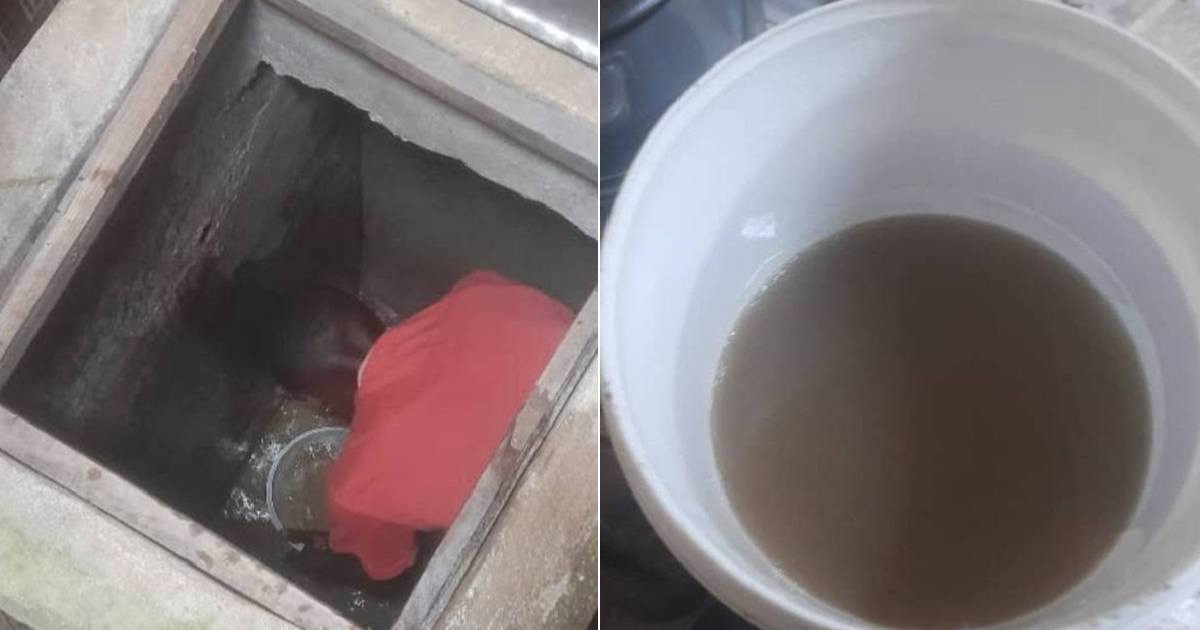
A resident from La Lisa, a district in Havana, reported on Friday that her family and other locals have been suffering from vomiting and diarrhea for two weeks, symptoms they believe are caused by drinking contaminated water.
Alibet Prats Sánchez, who posted her complaint on the Facebook page "VENTAS EN LA LISA," shared two photos alongside her report. One image shows a person inside what appears to be a damp concrete cistern with water pooled at the bottom, and the other displays a container filled with dark-colored liquid.
Prats Sánchez explained that her home is just two blocks from the Frank País Hospital. Instead of using the limited electricity available for household chores, her family has had to spend that time emptying the cistern due to the poor quality of the stored water. "Everything is disgusting," she described upon discovering the situation one morning.
Her two grandchildren were the first to experience vomiting and diarrhea, symptoms that later spread to other neighbors. She recounted attempts to boil water when power returns, aiming to minimize health risks, but ultimately decided to discard the cistern water due to its deplorable condition. "What the hell am I supposed to boil?" she exclaimed, expressing frustration over the lack of usable water to safeguard her family.
The complaint garnered responses from others facing similar issues with water quality, questioning the authorities' failure to deliver tangible solutions. Many noted that these problems have persisted for months without effective intervention.
This report emerged shortly after Aguas de La Habana announced a significant failure in the 78-inch Cuenca Sur pipeline, which serves as a central water supply for the city. The breakdown affected water services in six municipalities: Plaza de la Revolución, Cerro, Centro Habana, Habana Vieja, 10 de Octubre, and Boyeros.
Prior to this incident, approximately 255,000 people in Havana were already struggling with water supply issues, nearly half of the 577,000 reported at the beginning of the month.
La Lisa has been grappling with a prolonged water crisis. Earlier this year, San Agustín neighborhood went without water for 22 days; in April, a pipeline break resulted in a more than 10-day outage for families in the Novia del Mediodía area, and in September, residents reported longstanding leaks near homes and schools.
Recently, another resident documented rubbish piles, stagnant water, and rodents in the streets of San Agustín, raising alarms about dengue, chikungunya, hepatitis A, and acute diarrheal diseases in the area.
According to UNICEF, 3.4 million Cubans face challenges accessing clean water. In September, the Ministry of Public Health acknowledged an uptick in diarrheal diseases, hepatitis, and dengue, attributing this to inadequate water treatment and sanitation measures.
Meanwhile, the U.S. Embassy in Cuba issued a warning about outbreaks of E. coli, norovirus, Shigella, and hepatitis A in at least six provinces, including Havana.
Dr. Vivian Mena Miranda, vice president of the Cuban Society of Pediatrics, highlighted the critical link between access to safe water and disease prevention during a state television broadcast. "Without safe water, you cannot prevent diseases," she emphasized.
The lack of electricity and fuel further complicates efforts for families to boil water, a basic step to mitigate health risks.
Understanding the Water Crisis in La Lisa
What are the symptoms reported by La Lisa residents?
Residents have reported symptoms like vomiting and diarrhea, which they suspect are linked to contaminated water.
What recent water supply failures have affected Havana?
A recent major failure occurred in the 78-inch Cuenca Sur pipeline, cutting off water services to six municipalities in Havana.
How has the Cuban government responded to water-related health issues?
The Ministry of Public Health has acknowledged an increase in diseases linked to poor water treatment and sanitation, yet effective solutions have been lacking.
What public health warnings have been issued recently?
The U.S. Embassy in Cuba warned about outbreaks of E. coli, norovirus, Shigella, and hepatitis A in multiple provinces, including Havana.