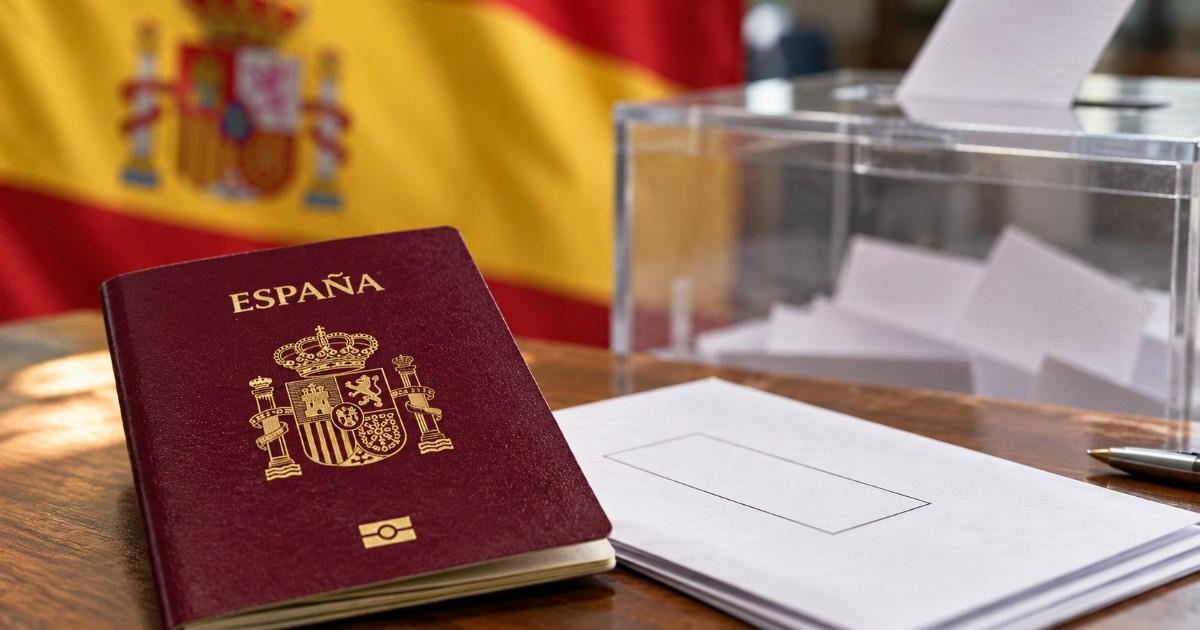
The general elections in Spain scheduled for November 29 present a fragmented polling landscape and hold significant implications for the large Cuban community holding Spanish nationality, which exceeds 160,000 registered voters abroad.
As the legal campaign period draws to a close, most polling organizations forecast a win for the People's Party (PP), although the final outcome remains uncertain.
On average, surveys indicate the People's Party (PP) garnering 31.4% of the votes compared to the Spanish Socialist Workers' Party (PSOE) at 29.1%. Vox is projected to receive 17.9%, while the alliances under the Frentes, including the Broad Front and coalitions linked to Podemos, are estimated at 6.8%.
The gap between the two major parties has narrowed significantly throughout the campaign: the PP's lead over the PSOE has shrunk from nearly six points to just over two.
Polling firms GAD3 and Sigma Dos both suggest an absolute majority for the combined forces of PP and Vox. GAD3, on behalf of ABC, attributes them 194 seats—18 over the threshold of 176—while Sigma Dos, analyzing for El Mundo, places them between 183 and 194 seats.
Meanwhile, the 40dB tracking survey for El País and Cadena SER presents a much closer race, estimating 130 seats for the PP and 124 for the PSOE, with a mere 0.9 percentage point difference, projecting 187 seats for PP+Vox combined.
The outlier is the Center for Sociological Research (CIS), whose November 23 barometer—based on over 8,000 interviews—positions the PSOE as the leading force with 34.4% compared to PP's 24.7%, a 9.7-point advantage that starkly contrasts with other polls.
CIS does not provide seat projections, rendering its vote estimate insufficient for determining which bloc might achieve a parliamentary majority.
An electoral model synthesized from surveys available by November 23 indicates an 87% probability of an absolute majority for PP+Vox, a 7% chance for a left-wing majority, and a 6% possibility that no bloc reaches the necessary 176 seats to govern.
What Cubans Stand to Gain or Lose
The election results are particularly significant for the Cuban community in Spain. According to the 2026 Annual Population Census by the National Statistics Institute (INE), 282,881 individuals born in Cuba resided in Spain at the start of the year, marking a 70.3% increase since 2021. Among them, 190,681 hold Spanish citizenship.
Cuba ranks as the fifth-largest country in the Electoral Census of Absent Residents (CERA), with 169,290 registered voters.
The disparities between the two primary political blocs are stark, especially in immigration policy and their stance on Cuba's communist regime. The PP's program, featuring 249 initiatives under "National Reconstruction," proposes tighter integration requirements, a points-based visa system, and a more stringent Nationality Law.
Crucially, its point 244 explicitly condemns the "dictatorships of Cuba, Nicaragua, and Venezuela," pledging support for democratic transition on the island.
A critical issue for Cubans is the Grandchildren’s Law: the PP aims to repeal the Democratic Memory Law and replace it with a Concord Law, without clarifying the fate of the over 137,700 pending applications at the Spanish Consulate in Havana, out of 300,000 to 350,000 Cuban applicants since October 2022.
Conversely, the PSOE intends to uphold the existing legal framework, more favorable to regularization.
Their approach towards Havana involves diplomatic dialogue, advocating for the release of prisoners of conscience while avoiding the term "dictatorship" in official discourse, and rejecting a PP initiative in Congress condemning the "Cuban dictatorship" earlier this year.
Cuban residents in Spain will cast their votes at ordinary polling stations this Sunday.
The deadline for mail-in voting from Cuba closed on November 24, and in-person voting at the Spanish Consulate in Havana concluded the day before. As pollsters caution, no survey equates to an electoral result: the ballot boxes will ultimately provide the definitive answer.
Understanding the Cuban Vote in the Spanish Elections
How many Cubans are eligible to vote in the Spanish elections?
Over 160,000 Cubans with Spanish nationality are registered to vote in the elections.
What are the main differences between PP and PSOE concerning Cuba?
PP condemns the Cuban regime and seeks stricter immigration policies, while PSOE favors diplomatic dialogue and maintaining the current immigration framework.
What implications does the Grandchildren's Law have for Cubans?
The Grandchildren's Law affects citizenship applications; PP wants to repeal it, affecting thousands of pending applications at the Spanish Consulate in Havana.